Daily insights for city builders, delivered every morning at 6 AM ET. I’m Brandon Donnelly — a Toronto-based real estate developer and founder of Globizen. I’ve been writing here since 2013.

Tag: penn

  • An MBA post-mortem from a real estate guy

    image

    This post originally appeared on the Rotman Morning & Evening MBA blog

    As a recent graduate of Rotman’s Morning MBA program (and presumably because somebody over there reads Architect This City), I was asked to write a guest post for their MBA blog. More specifically, I was asked to share my thoughts on the real estate industry and on my time at Rotman. And since I haven’t really done a post like this before, I thought it would be worthwhile to do.

    But before I begin, I think it’s important to explain a bit about my background and my motivations for doing an MBA in the first place. Before going to Rotman, my first master’s degree was in architecture and real estate from the University of Pennsylvania. Basically it was a Master of Architecture combined with their MBA real estate concentration. So it included everything from real estate finance to real estate development.

    Having already done this 3-year program, there were a couple of things I wanted out of an MBA program. First of all, I wasn’t prepared to go full-time. Five years out of the workforce was simply too high of an opportunity cost for me and so part-time was all I considered. I also only applied to Rotman because I didn’t want to waste any time traveling outside of the city (or to other parts of the city). I also saw Rotman as a rising star and one of, if not the, best option in Canada.

    At the same time, I didn’t give much thought to the real estate curriculum being offered even though I fully planned to stay working in the real estate industry. I felt like I already had that sort of formal training and so, unlike some of my classmates who were looking to switch into real estate, I was after something else. I ended up majoring in Innovation & Entrepreneurship.

    What I was trying to do was really round out my skillset and fill in some of the missing holes: accounting, marketing, and so on. But even more importantly, I had drunk the kool-aid around Rotman’s focus on integrative thinking (renamed “business problem solving”) and “design thinking”. And since there will always be a part of me that thinks of itself as a designer, it seemed like the perfect program for me. 

    Because at the end of the day, it’s not that hard to learn how to create a real estate development pro forma or calculate your expected exit cap rate on some piece of real estate. That stuff is all fairly mechanical. It might seem quite mythical when you don’t know how to do it, but once you do, you quickly realize that a financial model is only as good as the assumptions you put in. As we’re told in school, garbage in = garbage out.

    The real value gets created in the assumptions. It’s created in the way you think about the market, your product, and your customers. And a lot of the time, the most value is created when you know or believe something that nobody else believes to be true. If you’re a lemming, you’re going to get lemming like returns and outcomes. So in a lot of ways, I went to Rotman to help me think better and think differently.

    In some industries, resting on your laurels can kill you in a relatively short period of time. See Blackberry. Real estate, on the other hand, is generally a bit slower moving. But that doesn’t mean that change doesn’t happen and that there isn’t room for loads of innovation.

    Just look at the Toronto of today versus the Toronto of 10-15 years ago. We’ve transformed ourselves into a city of high-rises where more and more people now want to live in the core of the city. This has brought commercial landlords back to the city center so that employers have downtown office space to attract the best human capital (see South Core) and it’s brought suburban retailers into the core to sell to these same urbanites. We’re seeing a complete reversal of the trends experienced with the last generation.

    Amidst all of this, I’ve been noticing a growing awareness and passion around cities. My blog Architect This City started as a forum for architects, planners, and developers, but it has grown into a community of thousands of people who simply love cities. They’re passionate about everything from architecture to grade-separated bike lanes (as geeky as that probably sounds).

    So I think that it’s not only the real estate market that’s changing, but also the professions involved with it. I’ve written a lot about the future of the architecture profession because I think we’re starting to see the emergence of new business models. Architects are becoming developers and developers are starting to become much more heavily involved in the shaping of the communities in which they build. Which is why in many ways, I think of my self as a city builder more than anything else.

    Finally, to make matters even more complicated, technology is starting to have a huge impact on the business. Zillow.com just bought Trulia.com for $3.5 billion to form a portal that will now serve around ¼ of the online US residential market. And Opendoor.com is getting ready to launch a product that seems entirely poised to disrupt the way homes are bought and sold in America.

    So what I’m getting at is that there’s absolutely no guarantee that the way we used to do something, is the way we’re going to continue doing it. In fact, I operate under the assumption that everything can and will be changed by somebody at some point. And if this is the way you approach things, then it should become abundantly clear to you that being able think critically is going to be one of your most important assets.

    When I was just starting at Rotman, I met for lunch with an upper year classmate who told me that one of the best things he’s taken away from the program is the ability to think about the way he thinks. That may sound silly to some, but in our uncertain world, it’s actually a great skill to have.

  • Studying to become a real estate developer

    Earlier this week I received a message from an undergraduate architecture student interested in moving into real estate development after school. That was his 10 year plan. And he had clearly read my blog post, “Transitioning from architecture to development.”

    In his message, he asked me if there were any books I would recommend he read to improve his real estate and finance knowledge, and, if I could have a “redo”, if I would still do a M.Arch (Master of Architecture) or just go straight to the MBA?

    After responding to his message, I thought: “This would make a good blog post, as well as an opportunity to talk about the current state of real estate education in Canada.” So here goes.

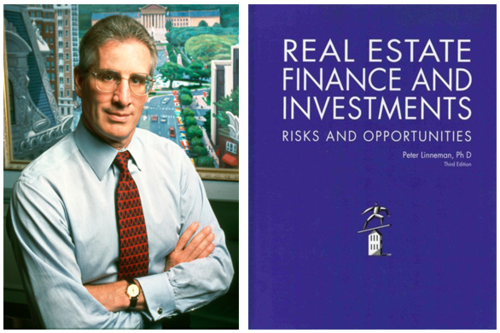
    If you’re looking for a good real estate book to get you started, I recommend checking out “Real Estate Finance and Investments: Risks and Opportunities" by Peter Linneman. It’s a much easier read and way more casual compared to most textbooks. When I was in grad school, people referred to this book as the "blue bible.” The cover on the previous edition was less purple and more blue. Unfortunately, he has also changed his glasses since the photo below.

    image

    To his second question, if I were to do it all over again, I wouldn’t change a thing about my education. I loved architecture school and combining it with business school classes and a real estate concentration was the best thing for me. I never wanted to be just a “numbers guy”, but I also never wanted to be a fanciful artist type who didn’t know how to build and manage a pro forma.

    Now, let’s talk about real estate education in Canada.

    I think we’re way behind. In the US, you can do a Master of Science in Real Estate Development, a Master of Real Estate Development, and all sorts of other real estate degrees. In Canada, you’re probably doing a MBA with a few elective real estate classes. Real estate is the largest asset class in the world. Does that not justify a dedicated degree?

    Part of the reason for this, I think, is because real estate development is still very much an entrepreneur’s business–though it has become more institutionalized in recent years. Because of this, people get into development from a variety of different professions. They just need that entrepreneurial hutzpah. And that’s all fine, but I still think that the profession, the economy and our cities would benefit from University trained developers.

    So if you’re reading this University of Toronto, I think–and I’ve thought this for awhile now–that The John H. Daniels Faculty of Architecture, Landscape and Design and The Rotman School of Management should get together and collectively form a real estate program. Who’s with me?

  • Mies

    image

    If you’re into architecture, specifically epic modernism, then I would encourage you to pick up this new monograph on Mies van der Rohe–simply called Mies. It was written by the late Detlef Mertins, who was the Chair of the Department of Architecture at the University of Pennsylvania from 2002 to 2007, but is originally from Toronto.

    Detlef was one of the most brilliant, but also nicest, people I’ve ever met and unquestionably the leading scholar on all things Mies. He passed away in the midst of working on this publication, but it was completed by his partner Keller Easterling–another powerful architecture mind–and a few other contributors.

    For those of you unfamiliar with the work of Mies, here’s a brief description from the book publisher:

    Ludwig Mies van der Rohe is one of the twentieth century’s most influential architects. His most well-known projects include the Barcelona Pavilion in Spain (1929); the Seagram Building in New York (1954-56); the Farnsworth House (1945-50), 860 and 880 Lakeshore Drive (1945-51) and the IIT Campus (1939-58), all in and around Chicago, and the New National Gallery in Berlin (1962-68). These are only a few of Mies’s pavilions, houses, skyscrapers and campuses, which all epitomized a radically new structural and spatial clarity. 

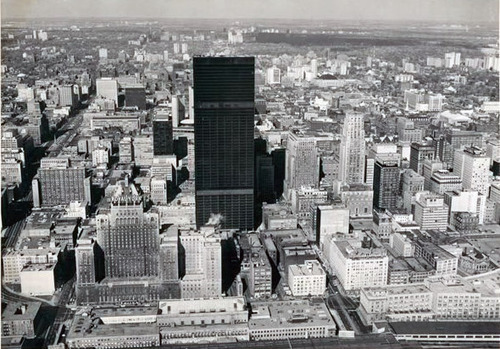
    For readers in Toronto, Mies’s biggest contribution is the Toronto Dominion Centre, which is a beautiful example of the International Style. The complex was designated under the Ontario Heritage Act in 2003. But in addition to it being great architecture, its construction in the late 60s really coincided with Toronto’s rise as a modern metropolis. Here’s a photo of the first tower from blogTO.

    image

    The TD Centre introduced not only a new architectural language into Toronto’s urban fabric, it also introduced a new and bolder way of how we thought of ourselves as a city. Remember this was a moment in time where Toronto was just about to overtake Montreal as the most populous city in Canada.

    We were reimagining our city with Mies.

  • Why food trucks won’t destroy Toronto’s restaurant scene

    Yesterday City Council voted 34 to 3 in favor of allowing more food trucks on the streets of Toronto (125 of them to be exact).

    Food trucks will be allowed to roam and park in pay-and-display spots on city streets as well as in private lots. However, the total number of trucks can’t exceed 125; they’re not allowed to park for more than 3 hours in one spot; and they can’t park within 50 metres of a restaurant.

    Most supporters of food trucks in this city are calling it a baby step forward. A lot of the reforms that they had been advocating for were not achieved with this vote. Frankly, I find it surprising how long this discussion has been going on for and how we’re still at the point of baby steps.

    But perhaps even more surprising, is the fact that I agree with Rob Ford on this issue:

    Mayor Rob Ford advocated for less regulation, arguing that people who make a date to go to a restaurant don’t change their mind and buy a hot dog when they pass a cart. “I think putting all this red tape around people, that’s not very friendly,” he said. “This is free enterprise. This is capitalism. Let them sell what they want and let the customer decide.”

    The concern from the other side is that food carts are going to threaten Toronto’s restaurant industry and turn our streets into the wild west of food service–hence the 50m rule. But I actually think the opposite could end up proving to be true. I think food trucks could end up empowering entrepreneurs.

    When I used to live in Philadelphia, which is a city with a thriving food truck scene (people publish food truck guides), I practically lived off the things. For breakfast I would go to this couple who barely spoke English and they would make me an egg and cheese sandwich for $2.50. And for lunch, I would go to the guy some people called the “nice little Mexican boy” for a burrito. It was somewhere around $5. And his food truck was so small that I had to duck while ordering food so I didn’t hit my head.

    At first I actually found it odd to be consuming egg sandwiches and burritos from trucks that would pack up and leave at the end of the day. I kept thinking I was going to get sick. But I warmed to the idea and learned to love them. As does everybody else.

    In fact, we loved our food trucks so much that when Renzo Piano–the Italian Pritzker Prize-winning architect–came to Penn to talk about how he had been retained to redesign the School of Design’s building, somebody stood up and asked: “How are you going to accommodate the food trucks in your design?” Renzo responded perfectly and said something along the lines of: “I’m Italian. Don’t worry, I will provide for the food.”

    But my point of all this is to say that instead of looking at food trucks as a threat to our restaurant industry, we should be looking at them as a way to empower more entrepreneurs to take the risk on starting something for themselves–many of which could end up being new Canadians. The “nice little Mexican boy” also barely spoke English and looked young enough to be in high school. But he was a business owner.

    Starting a restaurant is a risky proposition. You need to lease space, you need to buy equipment, and so on. And everybody knows the failure rate is high. But what if you could test that killer recipe of yours on a few hundred people at lunch in front of First Canadian Place? That sounds like a much easier proposition to me.

    So what I hope happens is that people in Toronto start to see food trucks, not as a threat to our restaurant scene, but as an opportunity to get more entrepreneurs into it and make our city even more vibrant. Because if we do that, I’m positive we’ll end up with an even better restaurant scene than what we have today in our great city.

  • Urbanization in the developing world

    A few days ago I asked a reader of this blog if there was anything, in particular, that she’d like to see more of on here. She responded by saying that she’d love to learn more about how other cities—outside of Toronto—are managing urbanization, as well as how we shape cities and cities shape us.

    It’s an interesting and important question because, frankly, the challenges are greater outside of Toronto. One of the stats that often gets cited here in the media is how the Greater Toronto Area gets approximately 100,000 new immigrants every year. This doesn’t include domestic migration though, so I would assume that our total number is even greater.

    But if we stick with 100,000 for now, it means the GTA receives about 11.4 new immigrants every hour (100,000 people / 8,765 hours in a year). Lagos, Nigeria, on the other hand, receives between 50-60 new people every hour. In fact, it’s predicted to be 7th fastest growing city in the world between now and 2020. 

    If you take a look at the complete list of the world’s fastest growing cities (all estimates, of course), you’ll likely notice that the vast majority of the cities are in the developing world. And that’s really the challenge. The world is rapidly urbanizing and becoming the most urban it’s ever been, but the changes are the greatest outside of developed nations. This poses entirely unique challenges.

    Of the kinds of cities I’m talking about, I’m most familiar with Dhaka, Bangladesh. In my last year at Penn, I was part of a studio led by KieranTimberlake Architects that focused on water and housing issues in that city. It was a partnership with the University of Dhaka. We spent roughly 2 weeks there and it was an eye opening experience.

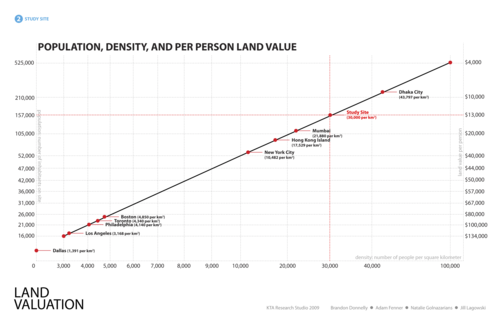
    Here’s a telling slide from our final presentation:

    image

    What we were trying to do with this chart was compare population and per person land value for our development site according to various city types. In other words, we were essentially asking: If we were to build out our proposed site in the same way, as say, Dallas, Los Angeles, Hong Kong, or what is typical for Dhaka, how many people could we fit and what would be the resulting per person land value?

    I don’t remember where we got the land value figures from, but we were trying to be cognizant of the fact that every city requires a unique solution. Using the same per person land values in Dhaka as in Dallas would be unimaginable because Dhaka has over 40,000 people per square kilometre (top right on the diagonal line above) and Dallas has under 1,400 per square kilometre (bottom left on the diagonal line above).

    The challenges of urbanization in the developing world are profound, particularly in places like Dhaka where most of the city is subject to severe annual floods. By some estimates, 18% of the city’s land area gets flooded every year—talk about adding another layer of city building complexity.

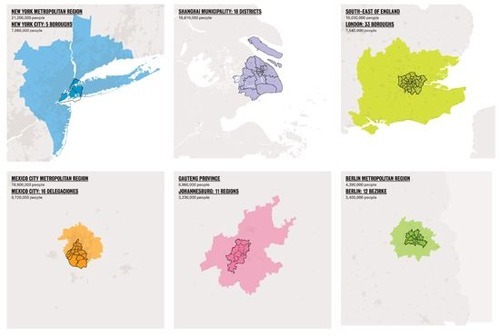
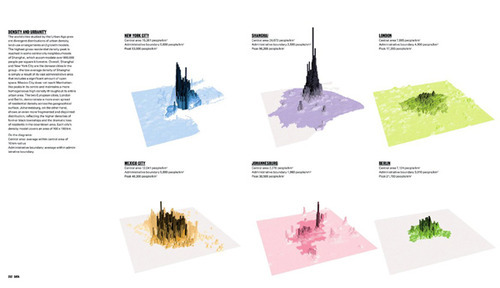
    We didn’t solve all of the problems in that studio and we’re not going to do it here, but I do think it’s important to fully understand the problem. One of my favorite books on cities is called “The Endless City.” It examines New York, Shanghai, London, Mexico City, Johannesburg and Berlin, and has a ton of great data and diagrams.

    Here are a two that outline densities and land use patterns for the above 6 cities (same order starting on the top left):

    image

    image

    If you’re interested in cities, it’s definitely worth having it on your coffee table. And fitting to @PhatNancy’s tweet, ”The Endless City doesn’t just show how cities are changing but also how they are changing us.

  • The Penn Annual

    I spent this morning booking the last leg of my flights for my annual ski and snowboarding trip this February. It’s a tradition that a few of us started during grad school at Penn. We call it the “Penn Annual” and we’re now into our fifth year. This year we’re going to Jackson Hole, which has been on the top of my list of places to snowboard for a number of years now.

    We started the Annual because we obviously love to ski and snowboard, but we also did it as a way to reconnect at least once a year. It’s a forced reunion. We pick a spot and all convene. The core group is about 4-5 people. But depending on where we go, it often expands as local friends and family join in. 

    Interestingly enough, we’re apparently a defined target market known as the “brocation” segment. Or at least this is what a marketing guy told us during the Third Annual in Lake Tahoe. So far we’ve been to Tremblant, Stowe, Lake Tahoe and Whistler. We usually alternate between Canada and the US. Next year we’re already thinking it’ll be Banff.

    One of the things we’ve talked about doing since the beginning is turning the The Annual into a larger Penn alumni reunion and networking event. In fact, we’ve parked pennannual.com. If we did this, we could bring down the per person costs, as well as create a much larger pull for participants. I love the idea of staying connected and meeting new Quakers (as well as others).

    Of course this is one of those ideas that usually loses air once the trip is over. But this year I thought I’d put it out there on my blog, and also send the idea over to Penn Alumni. So if you’d like to join us in Jackson Hole, drop me a line.