Daily insights for city builders, delivered every morning at 6 AM ET. I’m Brandon Donnelly — a Toronto-based real estate developer and founder of Globizen. I’ve been writing here since 2013.

Tag: pedestrian

  • Montréal is making yet another case for pedestrian-only streets

    There are parts of Toronto that are pedestrian only. There’s the Distillery District, some small laneways in Yorkville, the Toronto Islands (though this is a bit of a unique situation), and various other pockets around the city.

    There are also streets that we temporarily open up to only pedestrians, such as Market Street and King Street, and areas, such as Kensington Market, that we have been rigorously considering pedestrianizing for as long as I can remember.

    What is clear is that pedestrian-only streets are controversial. Motorists fear that it will make driving in the city even more inconvenient. And businesses fear that it will limit their customer base.

    While it is true that not all streets can and should be pedestrianized, there are countless examples of streets and areas that appear to be thriving because of it.

    Take, for example, Montréal.

    Since 2021, the city has been pedestrianizing a stretch of 30 blocks along Mont-Royal Avenue during the summer months. And according to Mayor Valérie Plante, the commercial vacancy rate for the street has dropped from 14.5% in 2018 to 5.6% in 2023:

    Maybe you don’t want to infer causality here, but at the very least, it seems to suggest that the street isn’t dying and bereft of human activity. This year, pedestrianization is also planned to be extended further into the fall.

    This won’t necessarily be the outcome for all streets, but I do agree with this recent Globe and Mail article that, oftentimes, the reasons for not pedestrianizing are “a question of philosophy, not geography.” Because there’s lots of research and data to support doing this.

    If any of you are business owners along Mont-Royal, I’d love to hear about your experiences and how you think, for better or for worse, it has changed the area. Leave a comment below or drop me a line.
  • Fabricating a new urbanism

    image

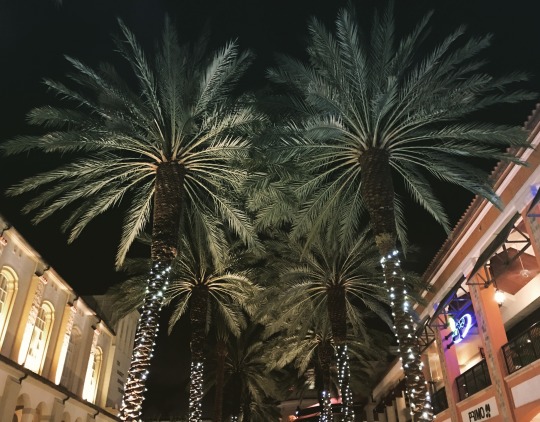
    Last night I was in CityPlace, West Palm Beach. Completed in 2000, CityPlace is a quintessential example of New Urbanism. (For those of you from Toronto, this is a different kind of a CityPlace.)

    In case you’re unfamiliar with this movement, here’s a snippet from The Charter of New Urbanism (via Wikipedia):

    “We advocate the restructuring of public policy and development practices to support the following principles: neighborhoods should be diverse in use and population; communities should be designed for the pedestrian and transit as well as the car; cities and towns should be shaped by physically defined and universally accessible public spaces and community institutions; urban places should be framed by architecture and landscape design that celebrate local history, climate, ecology, and building practice.”

    At a high level, New Urbanism makes a lot of sense. American cities were sprawling uncontrollably and so advocates had decided that something had to change. The Congress for New Urbanism was founded in 1993.

    But the New Urbanism movement has had its share of critics. Here’s how Witold Rybczynski – professor at the University of Pennsylvania – talked about it on his blog:

    “What are the important ideas that have affected American cities in the last 20 years? The development of waterfronts. The renaissance in constructing urban parks. The move of genXers and retirees into downtowns. High-rise urban living and Vancouverism. The popularity of urban bicycling and bike-rental programs. Ditto for Zipcars. Urban farmers markets and community gardens. Urban charter schools. The dramatic expansion in attendance of urban cultural institutions, especially art museums. Urban tourism. Downtown trophy buildings. The emergence of influential big-city mayors. Have any of these been the result of the new urbanism movement?”

    Frankly, I have never been a big follower of New Urbanism. It has always felt artificial to me. But I recognize the immense challenge in transforming car-oriented cities and communities into walkable ones. It’s one of the greatest challenges in city building. You’re asking people to change their habits.

    If any of you are experts on New Urbanism (because I am certainly not), I would love to hear from you in the comment section below.

  • Being exemplary

    image

    Yesterday morning I had coffee with a good friend of mine and fellow city geek. We don’t connect nearly as often as I’d like, but when we do we always have great conversations about cities and about Toronto.

    One of the things he asked me was whether I was still loving Toronto. And I responded by saying absolutely. We then both agreed that there are a lot of exciting things happening in the city right now. 

    But I qualified this statement by saying that I wish we were bolder. I wish we took more chances. Because while it’s great that we’re doing things like building more bike lanes and intensifying our growth centers, lots of other cities are doing those things as well.

    To be a leading city, you have to be prepared to do things that other cities think are wrong or won’t work and that are truly remarkable. Whether you’re city, company, or an individual, following trends is never enough.

    Take for example the dramatic anti-pollution measures that were recently announced by Paris mayor Anne Hidalgo:

    By 2020, no diesel fuel at all will be burnt within Paris. Regular cars will be banned outright from its more polluted roads, which will be open solely to electric and hybrid vehicles. Meanwhile, the city’s most central districts (the first four arrondissements) will be barred to all but residents’ vehicles, deliveries, and emergency services, transforming Paris’ Right Bank core into a semi-pedestrian zone. As a counterbalance, the number of cycle lanes will be doubled by 2020, while the city will fund an extended electric bikeshare scheme to encourage more people to get on two wheels. “I want us to be exemplary” Mayor Hidalgo has declared. 

    That’s how you win hearts: by being exemplary.

    As always though, I’m incredibly optimistic about the future. Toronto has a new leader at its helm and I know that there are a lot of passionate people in this city who care deeply about its future. I am certainly one of them.

    Image: Not my actual coffee (via Flickr)

  • A new vision of Yonge Street

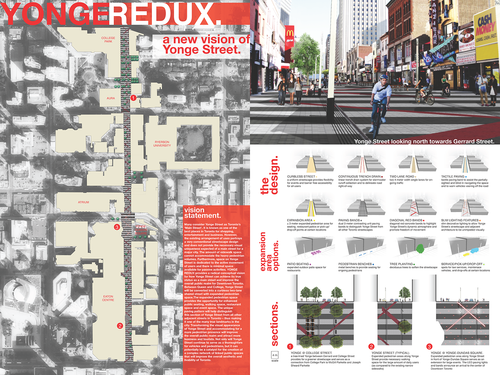
    Back in April I wrote about a competition for young people to reimagine public space in Toronto. It was called NXT City. Well that prize has been awarded and the winner was Richard Valenzona for his vision–called Yonge-Redux–of a new and reimagined Yonge Street. To download the PDF of his entry (the image shown above), click here.

    The proposal encompasses a stretch of Yonge Street that runs from Queen Street in the south, to College Street in the north. It would capture the Toronto Eaton Centre (mall), Yonge-Dundas Square, Ryerson University’s expanded Yonge Street footprint, and the massive mixed-use developments happening in the College Park area (see Aura Tower). To quickly simplify, the proposal is essentially about enhancing the urban experience, prioritizing pedestrians, and reducing the flow of cars to two lanes.

    Overall, I think it’s a wonderful proposal and I’m not surprised it won NXT City. This type of intervention is on so many of our minds. In fact, it’s somewhat surprising that we’ve been as slow as we have to improve our main street. There are so many anchor institutions, such as the Eaton Centre and Ryerson University, that plug into this section of Yonge Street. It makes a lot of sense.

    But as I said in my original post, one of the most exciting things about the NXT City Prize is that it has always been about execution. This is not just an academic exercise–or at least that’s the hope. This exercise is about spurring real change in the city and I genuinely hope that they’re successful in doing so. Because then I can turn around and say: Take that Melbourne 🙂

    Kudos to Richard Valenzona, Mackenzie Keast, as well as everyone else involved in NXT City, for making this initiative a reality and for doing your part to make Toronto even more awesome.