
Daily insights for city builders, delivered every morning at 6 AM ET. I’m Brandon Donnelly — a Toronto-based real estate developer and founder of Globizen. I’ve been writing here since 2013.

Tag: path

  • Office utilization update

    Some of you might remember my Jimmy the Greek Reopening Index. It has become my crude way of measuring office utilization in Toronto’s CBD. Based on this I can tell you that utilization is firmly up this week. Most lunch spots in Toronto’s PATH are back to having lines and the people working at these fine establishments are saying things like “finally” and “the people are back.” All of this is, of course, anecdotal. And I am not saying that we are back to pre-COVID levels. But there was a clear and meaningful uptick this week, which happens to coincide with the lifting of a number of COVID restrictions.

    Now let’s consider some actual numbers. I don’t know what they are for Toronto’s CBD (if you do, please share them in the comments below), but Kastle Systems has what seems like accurate “office swipe card” data for the 10 largest US cities. What this data tells us as of the end of February 2022 is that there has been a “return to normal, but not to the office.” Compared to 2019, NBA games are at 93.3%, movie theater ticket sales are at 89.4%, TSA checkpoints are at 87.8%, OpenTable reservations are at 87%, and yet office utilization sits on average at 36.8%.

    The “best” performing city is Austin with an average utilization of 53.4% as of February 23. And the “worst” performing city is San Francisco with an average utilization of 26.1% as of the same date. This makes intuitive sense given that tech has been pretty much leading the charge when it comes to remote and flexible work. Still, things are heading up and to the right. And as I argued at the beginning of this year with my annual predictions, I continue to believe that the majority of office workers will return at some point. Offices aren’t going away. And I think they’re going to remain the dominant place of work.

    Chart: Bloomberg
  • Masterplanning a successful main street

    I had a discussion with a friend of mine over the weekend about what it takes to masterplan a successful retail main street. We talked about street networks, storefront sizes, the impact of Toronto’s PATH on ground level experiences, and a bunch of other things. Ultimately, we both agreed that this is really not an easy feat to accomplish. More often than not, we screw it up. Many of the most cherished retail spines in this city rely on buildings that were primarily built during a different era. They’re old stock.

    All of this got me wondering:

    Some people responded by saying it doesn’t exist. Hmm. Is our track record that bad? Let’s dig a bit deeper and expand the scope of this question. What are some of the best retail streets around the world that comprise of buildings that were all or mostly built in the last 50 years? I would love to hear from you. Please leave any responses and/or thoughts in the comment section below. I plan to look at this topic in more detail and share specific examples in the coming weeks.

  • Below-grade urbanism

    I came across an interesting discussion on Twitter last night about tunnels, bridges, elevated walkways, and Toronto’s elaborate (mostly) underground shopping complex known as the PATH. It’s the largest of its kind in the world.

    Here’s the thing: the idea of pulling people off the street and into an underground shopping mall, runs counter to what many urbanists believe is the optimal outcome.

    Below is a footnote I found in a 2006 research paper by Pierre

    Bélanger called, Underground landscape: The urbanism and infrastructure of Toronto’s downtown pedestrian network.

    “The reluctance of urban designers and academics to engage the
    dynamics of the underground is stunning. For almost 50 years, urban
    designers, landscape architects and planners have longed for car-free
    pedestrian environments that are safe, secure and accessible. From a
    planning perspective, the Toronto underground may be the ultimate form
    of attrition of the automobile on the urban landscape: there are no parking
    lots, no asphalt, and no congestion. With its mass-transit accessibility, it is
    an ideal pedestrian network. This reluctance may in part be attributable to
    a prevailing attitude that privately-controlled underground shopping is
    undesirable, at best dismissible. As self-contained environments, they are
    perceived as lying outside the so-called public domain and that they kill off
    street life. As a more legitimate form of collective space, street-level
    activity located within municipal right-of-ways therefore receives much
    more advocacy.”

    Of course, there is truth to the notion that activity gets concentrated below grade. When people visit Toronto’s Financial District for the first time, they’ll often ask: Where is the retail? And then you have to explain that it’s all underground and that we live like mole people from 9-5.

    But despite this reluctance on the part of urbanists, people do seem to like it. When you’re marketing a building in the CBD, being PATH-connected is a feature, not a bug. I always joke that in the summer, I hate the PATH. But in the winter, I love it. 

    There’s also a feeling of hyper-connectivity during business hours in the PATH – particularly at lunch. You have everyone leaving their desks, descending from their towers, and mixing all about in a dense pedestrian-only network. It’s unusual not to run into someone you know.

    So love it or hate it, perhaps we should appreciate it for what it is: thriving city life.

  • Life below zero and underground

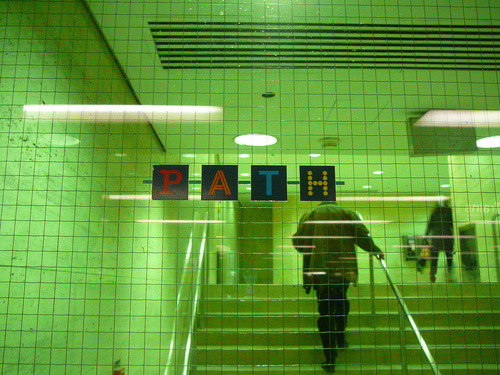
    image

    A few years ago, I was touring a friend from the US around Toronto’s Financial District and the first thing he said to me was: “You have no retail.” And that’s certainly what it might look like at first glance.

    But there’s actually lots of retail. It’s just all underground in an over 30 kilometer long network of walkways called the PATH.

    Initially conceived of as the antidote to Canadian winters, “underground cities” are a kind of uniquely Canadian form of urbanism. Toronto and Montreal have the largest ones in the world and they continue to grow. As new towers are built, new connections are added.

    But the downside to all of this is that it pulls street life down underground. And it can conceal a lot of the urban vibrancy that is actually take place. So maybe we need to come up with design solutions to better connect these subterranean cities back to street level and also not forget about the street.

    I’m thinking about this today because of a CBC documentary I watched this morning called Life Below Zero. It basically argues that – unlike other cold climate cities and countries – the vast majority of Canadians actually hate winter. And underground cities are our way of trying to ignore it.

    Well, I don’t hate winter. In fact, I love it because it signals snowboarding season for me. But I may be in the minority. What’s your position on winter?

    Image: Flickr

  • [vimeo 61161274 w=500 h=375]

    davemorin:

    Introducing Path 3

    Big fan of Path.