Daily insights for city builders, delivered every morning at 6 AM ET. I’m Brandon Donnelly — a Toronto-based real estate developer and founder of Globizen. I’ve been writing here since 2013.
At the intersection of rue Eugene Sue and rue Simart in Paris is a collection of mid-rise buildings that were constructed during Haussmann’s renovation of Paris in the second half of the 19th century. They were intended to house some 10,000 workers.
Here’s an aerial image of that intersection from Google Maps:
Some people, namely the folks over at The Funambulist, have compared this area to the Kowloon Walled City in Hong Kong as a result of its extreme population density. But unlike the Walled City, this area of Paris still exists today.
The way these blocks are able to achieve such a high population density is by employing compact internal courtyards. In some cases they would be more accurately referred to as light wells.
Here’s a fascinating diagram from The Funambulist showing the approximate areas of each courtyard/light well:
I have become very interested in these sorts of European courtyard buildings. They do have their benefits. For one, they offer respite from the rest of the city. But you can also understand why the modernists were so fixated on access to light and air.
This UN report (2018) on urbanization trends is a fascinating way to understand how our world is growing and changing. So today’s post is about some of my takeaways. If you have others, feel free to add them to the comment section below.
But first, some definitions.
The UN report considers 3 ways to measure the size of a city, all of which we have used before on this blog. The first is the “city proper.” That is the current administrative boundary of a city. The second is the “urban agglomeration” area, which is a city’s contiguous built-up area. And the third is the “metropolitan area,” which is the approximate area of economic and social interconnectedness.
Above is what these 3 boundaries might look like for Toronto (which is the example they use in their report). About the only one that isn’t debatable is the “city proper” boundary; but it really doesn’t capture the full extent of a city. Wherever possible, the UN report relies on the city’s urban agglomeration area. They also define a “megacity” as a city of over 10 million people.
The largest city in the world is currently Tokyo. However, from 2018 to 2030 it is expected to decline by almost 900,000 people. Whereas, the city in 2nd position — Delhi — is expected to add more than 10 million inhabitants during this same time period. By 2030, these are expected to be the largest cities in the world:
Most current megacities are located in what the UN refers to as the “Global South.” And 9 out of the 10 cities projected to become megacities by 2030 are located in developing countries. The one exception is London. Though all regions in the world are becoming more urban, the real population growth is happening in Asia and Africa.
Most cities — 59% of cities with 500,000 or more people — are at risk of at least one natural disaster. And 3 megacities — namely Manila, Osaka, and Tokyo — are high risk for 3 or more types of natural disaster.
Going through the report’s data charts, it’s also interesting to note that Toronto is not projected to become a megacity by 2030. However, the Toronto area already represents over 20% of Canada’s entire urban population.
In the United States, Chicago’s urban agglomeration is projected to continuing growing and does come close to megacity status by 2030. The Miami region is similarly expected to grow and is actually right on top of Toronto in terms of population. But the fastest growing regions are, of course, expected to be the city’s that can more easily sprawl (Las Vegas, Phoenix, and so on).
Bogotá, Colombia is already a megacity and is expected to add almost 2 million people by 2030. It currently represents about 26.5% of the country’s entire urban population. São Paulo remains one of the top 10 largest cities in the world and is similarly projected to add over 2 million people in the same time period, but to a much larger base.
In Europe, it’s London, Paris, and Moscow, with the latter two already in possession of megacity status.
Now quantity isn’t everything. Despite not ranking in the top 10 in terms of population, both New York and London are widely considered to be the world’s preeminent global cities. At the same time, we do know that the size of a city does create certain socioeconomic benefits. Urban agglomerations create agglomeration economies.
If you’d like to download a copy of the World’s Cities in 2018 (United Nations), click here.
There is something happening in many North American cities right now. We are starting to question the supremacy of zoning for only single-family homes.
This past summer, the state of Oregon passed policy requiring cities of 25,000 people or more to allow duplexes, triplexes, and fourplexes within their single-family home neighborhoods. Minneapolis is poised to do something similar with its Minneapolis 2040 plan (though it has been contentious). And, of course, here in Toronto we recently rolled out laneway suites all across the city. Small scale multi-family dwellings are also already permissible in some areas (though few are being built).
Some are calling this a YIMBY movement. But however you want to define it, it’s an acknowledgement that, if the goal is to built up instead of out, perhaps it’s time we look at the parts of our cities with the lowest population densities. I would also add that following my recent post on Paris vs. Vancouver, many seemed to gravitate (in the comments) toward the Parisian model — even if it did result in over 50,000 people per square kilometer. Density, it would appear, is okay.
While positive, it remains to be seen whether these policy changes will result in a meaningful increase in housing supply. And a lot of that will come down to the details. As I have said before on the blog, the math can be challenging on these sorts of smaller projects, which is why you have smart people proposing things like an “inverse density” rule to help encourage more smaller scale development.
But as the saying goes, sometimes you need to crawl before you can walk. And, if nothing else, there’s certainly symbolic value to what seems to be taking hold across North America right now.
In this January 2018 report from the Fraser Institute, they pegged the average population density of Paris to be about 21,067 inhabitants per square kilometer (2014 population year). It is the second densest city in their report after Hong Kong, but the densest in Europe. By comparison, Vancouver sits at around 5,493 inhabitants per square kilometer (2016 population year).
Now, these are of course city averages. Some neighborhoods will be higher and some will be lower. According to a January 2018 study by Alasdair Rae — who is a works in the Department of Urban Studies and Planning at the University of Sheffield — these are the most densely populated square kilometers across Europe (or at least within the 39 countries that he looked at).
Paris, once again, comes in near the top with a peak density somewhere around 52,218 inhabitants per 1km square. The square in question is in the neighborhood of Goutte D’Or. And the only square within the study to come in denser is one from the L’Hospitalet de Llobegrat in Greater Barcelona (53,119 inhabitants per square kilometer).
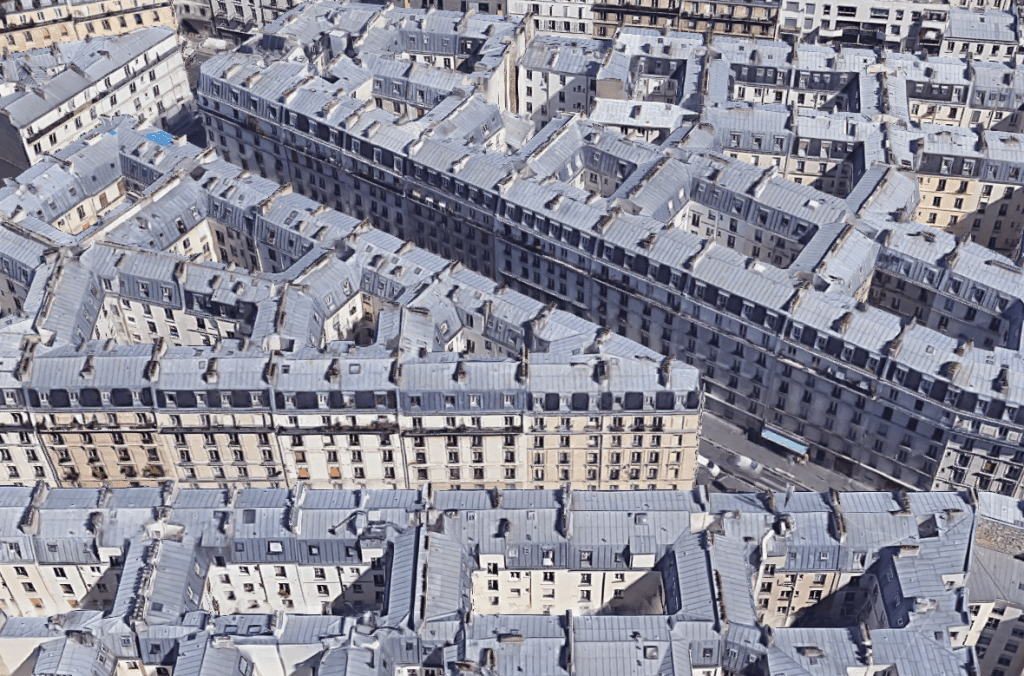
Now let’s take a look at how these sorts of densities actually manifest themselves. Below is an aerial capture from Google Maps showing a section of Goutte D’Or in Paris. The buildings are all pretty much 7 storeys (mid-rise), but the blocks are mostly filled in. Lots of interior courtyard apartments. This is one way to get to over 50,000 people per square kilometer.
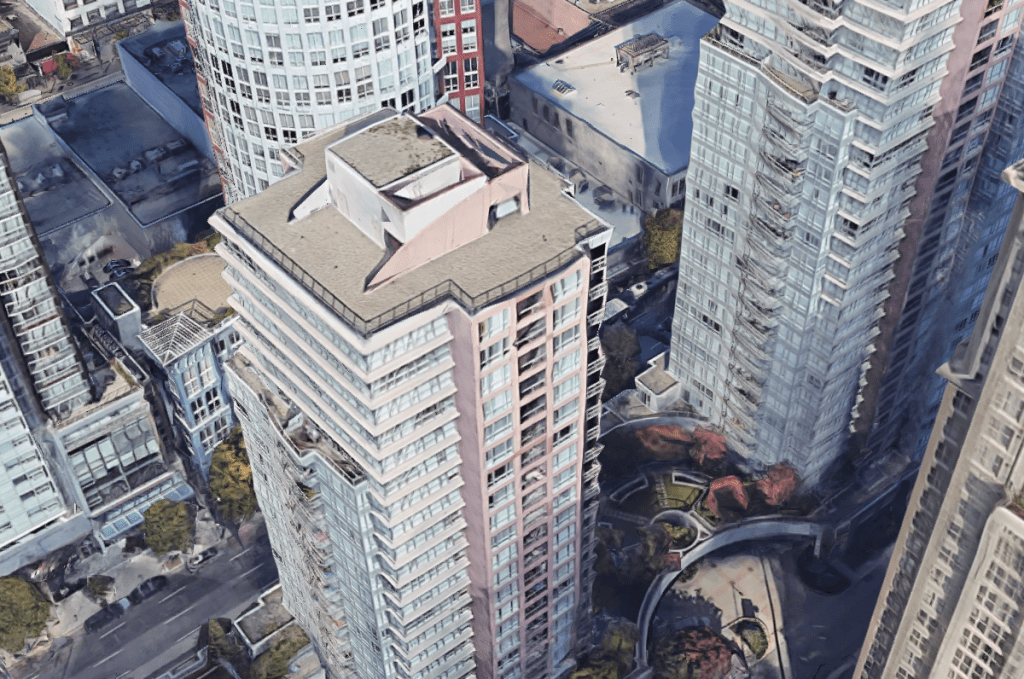
Returning to Vancouver as a point of comparison, below is an aerial capture from downtown Vancouver at exactly the same scale as the Paris capture. I couldn’t find a density map of downtown, but it’s probably safe to assume that it’s greater than 5,493 and a lot less than 52,218 residents per square kilometer.
What you see here is typical Vancouverism. Lots of slender point towers, careful tower positioning and spacing, and generally low podiums. It is a perfect demonstration that height and density do not necessarily correlate. It is possible to have low buildings and high density, which is something that Europe obviously does very well.
But here’s the important question: In which of these two examples would you rather live? Please leave a comment below.
The below graphs are taken from a recent (June 2019) report by Knight Frank on “prime” residential pricing across the world. They define “prime” as generally being the top 5% of each market by value. What these graphs show are the spread between the average price of a prime property and the top price achieved in that market.
The most expensive market is Hong Kong. The average price of a prime property in 2018 was USD 4,251 per square foot (or USD 45,760 per square meter) and the top price achieved was in 2016 at USD 28,154 per square foot (or USD 303,051 per square meter).
Using the 2018 average, a 350 square foot studio apartment would run nearly USD 1.5 million (or almost CAD 2 million), assuming there are “prime” studios available in the market. Remember, we are talking about the top end of the market.
If you’d like to download a copy of the full report, you can do that over here.
This recent Economist article makes the argument that, despite the recent (and sometimes annoying) proliferation of electric scooters across Europe, we probably shouldn’t be that grouchy about them. And that’s, “because the rise of the electric scooter is part of a broader and welcome phenomenon: the gradual retreat of the car from the European city.” By way of one example, by next year, Paris will have grown its bike lane network by 50% in five years.
The article ends with the point that, while this may seem like a “revolution,” it’s actually a “reversion.” European cities such as Paris and Antwerp (examples from the article) were both built before the advent of the car and were never really designed for it, although Haussmann’s wide avenues certainly helped. All of this gets back to a point I tried to make over the weekend with this post about driving and parking, and the relevance of urban form.
Reversion is a lot easier than a revolution. And for most North American cities, a revolution is what’s needed if we are in fact serious about a post-car future.
This recent NY Times article — which makes the case that the current protests in Hong Kong are at least partially a result of inequality — has a pair of interesting diagrams that speak to the city’s tight housing market.
The first compares average living space per person in Hong Kong to Paris and New York City. New York City appears palatial compared to the illegally subdivided apartments that are discussed in the article.
The second looks at housing affordability as a multiple of median household income. Hong Kong is over 20x. I am curious what median incomes were used for each of the cities. A small denominator makes the multiples look worse.
In this chart, New York also includes the entire metropolitan area, which would help to improve its affordability ranking. So one could argue that this isn’t really a fair comparison.
At the same time, none of this changes the fact that Hong Kong has some of, if not, the most expensive housing in the world.
Architect I.M. Pei died this week in New York City. He was 102. Being a centenarian is noteworthy enough. He was born in Hong Kong in 1917. I would love to join that club. Imagine how much change he experienced throughout his life. But, of course, Pei was also a celebrated Pritzker Prize winning architect.
For those of you in Toronto, you can look to Commerce Court West to see an example of his work (Page & Steele was the local architect). Completed in 1972, it was the tallest building in Canada until 1976. But perhaps his most well known project is the Louvre Pyramid in Paris (pictured above).
In reading some of his obituaries, I was intrigued — but in no way surprised — to learn that the Louvre Pyramid was deeply hated by Parisians at the time it was being proposed and built. Supposedly, for the first few years after completion, Pei couldn’t walk the streets of Paris without people berating him.
However, if you surveyed Parisians today, I would bet you that the approval rating of the Pyramid would be extremely high. And I would also argue that it has since become one of Paris’ most globally recognizable symbols. (Parisians, please weigh in below in the comments.)
All of this, once again, suggests to me that we’re often not very good at evaluating the merits of things that are new to us. Pei’s Pyramid, beyond being a new circulation strategy for the broader complex, was a radically different style of architecture.
Appreciating that sometimes requires a bit of time.
Photographer Michael Wolf died at his home in Hong Kong this week. He was 64. Even if you don’t recognize the name, I am sure that many of you have seen his work. Perhaps his most famous project was “Architecture of Density”, which had him documenting Hong Kong’s extreme urban density from 2003 to 2014. Here is a photo (taken from his website):
Michael was born in Germany, but grew up in Canada (he went to school in midtown Toronto) and in the United States. He eventually settled in Hong Kong and Paris — both of which became muses for his work. Michael made a career out of documenting cities and the life that happens within them. If you aren’t familiar with his work, I would encourage you to check it out here.
Witold Rybczynski’s recent post about the tragic fire at Notre-Dame de Paris provides an interesting summary of cathedral construction techniques over the years:
The Paris fire is also a reminder of what a weird hybrid structure Gothic cathedrals really are. The ancient Romans roofed their basilicas and baths with concrete vaults (the Pantheon with a dome), and the Byzantines used thin domes and vaults of brick. Over time, builders lost these skills and Romanesque cathedrals were roofed with exposed timber rafters like big barns. This made the buildings highly susceptible to fire, often caused by lightning strikes. The solution, pioneered at Durham Cathedral in the 11th century, was to build a lightweight ribbed stone vault over the nave. The timber roof remained, so the vault had no structural function (except to support itself) but it separated the interior from the flammable roof above. This was largely effective as the April 15 fire shows.
Below is an image from the WSJ depicting Notre-Dame’s timber rafters and showing the extent of the area consumed by the fire. Fortunately, relatively little of the cathedral was actually destroyed.
Going forward, there will almost certainly be a debate about how the roof and spire should be rebuilt. What materials and construction methods are appropriate for this emblem of Christianity and French culture?
But I agree with Witold in that “there is nothing inauthentic about rebuilding.”
It is common to lament that buildings simply aren’t built like they used to be. But this is not a new phenomenon. Construction methods change, as do the skills of builders.
There may have been critics in the 1220’s complaining about how the cathedral’s roof was built using wood, instead of concrete or brick vaulting. But that’s what was relevant at the time.
But Victor Hugo once wrote that, “great buildings, like great mountains, are the work of centuries.” Despite what unfortunately happened this week, that remains true of Notre-Dame de Paris.