Daily insights for city builders, delivered every morning at 6 AM ET. I’m Brandon Donnelly — a Toronto-based real estate developer and founder of Globizen. I’ve been writing here since 2013.

Tag: paper

  • Urbanization and its discontents

    Harvard economist Edward Glaeser has a new paper out talking about “urbanization and its discontents.” In it, he argues that while cities today are working remarkably well for highly skilled people, they don’t seem to be delivering the same upward mobility to lower skilled people. The “urban wage premium” for this segment of the population has seemingly disappeared.

    The posited causes of this discontent will likely resonate with many of you:

    Urban resurgence represents private sector success, and the public sector typically only catches up to urban change with a considerable lag. Moreover, as urban machines have been replaced by governments that are more accountable to empowered residents, urban governments do more to protect insiders and less to enable growth. The power of insiders can be seen in the regulatory limits on new construction and new businesses, the slow pace of school reform and the unwillingness to embrace congestion pricing.

    Unfortunately, this paper isn’t available for free online. If you’re interested, you’ll need to purchase a copy, here.

  • IPOs and home prices

    Fred Wilson made an interesting remark in his recent post about the current “IPO bonanza” that is taking place in the tech space. He is, of course, talking about the recent IPO of Lyft, the recent S-1 filings from Pinterest and others, and the expected filings from Uber, Airbnb, and so on.

    After listing the benefits of going public, he went on to say that this bonanza will surely also mean that it is going to become even more unaffordable in the Bay Area. Part of this is perhaps self-serving, since he operates a VC firm out of NYC. (Take your money and move to NYC.)

    But the data suggests that there is truth to this.

    When Twitter when public in 2013, it was estimated that it created some 1,600 millionaires. This is great for the local startup ecosystem as many of these beneficiaries could go on to found their own companies and create a whole new batch of jobs. The money gets recycled.

    But what does it do to the local housing market — especially a supply-constrained one like that of the Bay Area where it is difficult to build?

    In 2018, Barney Hartman-Glaser, Mark Thibodeau, and Jiro Yoshida penned a paper called, Cash to Spend: IPO Wealth and House Prices. In it, they looked at the impact of IPOs on local home prices in California from 1993 through to 2017.

    What they found, among other things, was a “positive and significant association between local house price changes and firms going public.” The price increases were also found to be the greatest the closer you get to the headquarters of the firm that just went public.

    If you’d like to download a copy of the paper, you can do that here.

  • The real reason people oppose new development

    image

    A good friend of mine just sent me this fascinating research paper called: Opposition to Development or Opposition to Developers? Survey Evidence from Los Angeles County on Attitudes towards New Housing. It is a study out of UCLA that was published earlier this year by Paavo Monkkonen and Michael Manville.

    For the paper, they conducted a survey-framing experiment with over 1,300 people in Los Angeles County to test how strongly they felt about a number of common anti-housing sentiments; arguments such as traffic congestion, neighborhood character, and strain on local services. 

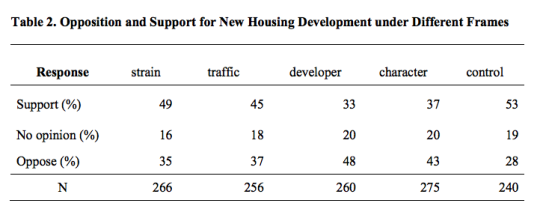
    However, they also introduced another argument: large developer profits. And interestingly enough, they discovered that respondents were 20 percentage points more likely to oppose a new hypothetical housing development when the survey was framed around the developer making a lot of money.

    Here is a table from the paper showing the various frames, as well as the percentage of people who supported, had no opinion, and who opposed. Note that under the “developer” frame, the opposition number is 48%.

    image

    So their “takeaway for practice” is as follows: “Housing opposition is often framed as a form of risk aversion. Our findings, however, suggest that at least some opposition to housing might be motivated not by residents’ fears of their own losses, but resentment of others’ gains.”

    Photo by Cameron Stow on Unsplash

  • The status quo, please

    In 1988, William Samuelson (Boston University) and Richard Zeckhauser (Harvard University) published a seminal paper called, Status Quo Bias in Decision Making.

    In one of the experiments cited in the paper, two groups of people are given a hypothetical task that involves picking from a selection of different investment opportunities.

    In both cases, the groups are told that they are someone who regularly reads the “financial pages”, but that up until recently hasn’t had much money to invest.

    Both groups are then told that they have just inherited “a large sum of money” from their great-uncle. This is now where the groups diverge in terms of the information given.

    The first group is given a neutral version. They are told they can invest in any of the following portfolios: a moderate-risk company, a high-risk company, treasury bills, or municipal bonds.

    The second group is given the same selection of portfolios, but is also given a “status quo selection.” They are told that a significant portion of their great-uncle’s portfolio is currently invested in a moderate risk company. 

    (They are also told that the fees associated with an investment change are insignificant and should not be a consideration for this decision.)

    What do you think happened?

    A number of different scenarios were tested, but as soon as one of the options was presented as the status quo, it became “significantly more popular”.

    This status quo advantage also tended to increase as the number of investment options increased. Perhaps people just got overwhelmed by the options and went with the “safe bet”.

    This phenomenon has become known as the status quo bias. 

    It is one of the reasons why some political offices have term limits. The incumbent bias can make for an uneven playing field. People vote for the name they recognize on the ballot.

    And it is one of the reasons why change, in general, can be so unsettling. The countless studies suggest we have an inherent bias towards the status quo irrespective of its objective merits.

    P.S. This is what came to mind as soon as I heard people calling the King Street Transit Pilot a “disaster” before the first weekday of its run was even over.

  • How we perceive commuting

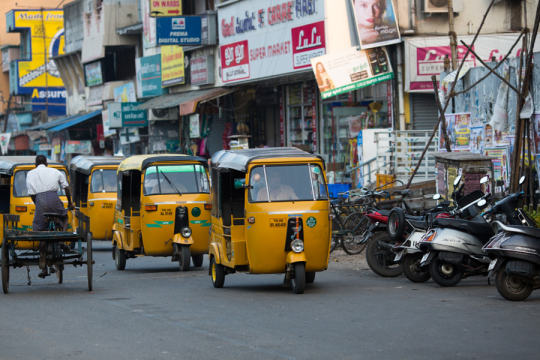
    CHENNAI, INDIA-FEBRUARY 10: Street of Indian city 10, 2013 in Ch by sergemi on 500px.com

    https://500px.com/embed.js

    Wharton real estate professor, Mariaflavia Harari, recently published a paper that looks at the relationship between urban geometry (specifically compactness) and inner city commuting efficiency across 450 cities in India.

    Consistent with previous research done in this space, she finds that people generally prefer compact cities and that they are willing to pay a premium for it. It increases overall welfare. Here’s an excerpt from her paper:

    “My findings are broadly consistent with compact city shape being a consumption
    amenity. All else being equal, more compact cities grow faster. There is also evidence that
    consumers are paying a premium for living in more compact cities, in terms of lower wages and,
    possibly, higher housing rents.”

    So her recommendations for the Indian cities she analyzed was that they should relax land use restrictions to allow for more vertical / compact development and that they should focus on improving urban transport in order to offset some of the negatives externalities associated with sprawl. This is no different than the approach that many cities in the developing world are adopting or looking to adopt.

    One of things that really stood out for me in her paper though is the way people perceive commuting:

    “The loss associated with non-compact
    shape appears to be substantial: a one-standard deviation deterioration in city shape, corresponding
    to a 720 meter increase in the average within-city round-trip, entails a welfare loss
    equivalent to a 5% decrease in income. This is considerably larger than the direct monetary and
    opportunity cost associated to lengthier commutes. Less compact cities also appear to attract
    fewer low-income immigrants, as captured by the share of slum dwellers.”

    What this is saying is that we tend to overvalue the negatives of commuting, beyond the direct costs of gas, insurance, car payments, our time, and so on. We hate it so much that we also want to be compensated for the mental anguish. Here is that same idea said differently:

    The estimated welfare loss from longer commutes appears to be large, relative to the immediate
    time and monetary costs of commuting. This is consistent with the interpretation that
    commuting is perceived as a particularly burdensome activity. The behavioral literature has
    come to similar conclusions, albeit in the context of developed countries. Stutzer and Frey
    (2008) find a large and robust negative relation between commuting time and subjective wellbeing,
    using German data. They estimate that individuals commuting 23 minutes one way
    would have to earn 19 percent more per month, on average, in order to be fully compensated.

    So I guess I’m not the only one who thinks commuting and driving sucks.