Daily insights for city builders, delivered every morning at 6 AM ET. I’m Brandon Donnelly — a Toronto-based real estate developer and founder of Globizen. I’ve been writing here since 2013.

Tag: panel

  • The pre-meeting is often better than most panel discussions

    When you’re preparing for a panel discussion, one of the things you usually do is have a pre-meeting with all of the participants. The purpose of this meeting is, of course, to get to know everyone and decide on what you’re going to talk about. Everything then gets buttoned up and you have the actual panel.

    But one of the things I’ve been feeling lately is that oftentimes the pre-meeting is more interesting than the actual panel. And that’s because everyone is more relaxed and everyone is engaged in a genuine discussion that hasn’t been pre-meditated. Nobody wants to hear boring and overly-scripted answers. Natural and free-flowing discussions are so much more engaging.

    So I’m going to try and keep this in mind and not put on a sucky panel next week at the land & development conference (which, by the way, will be in person). I’m moderating a panel on innovations in project design, delivery, and building operations. If you’d like to join, you can register over here.

  • The inclusionary zoning shortfall

    Colliers recently hosted a webinar about inclusionary zoning here in Toronto. On the panel was Jeremiah Shamess (SVP at Colliers / moderator), David Bronskill (partner at Goodmans), Giulio Cescato (senior planner at IBI Group), and Richard Witt (principal at BDP Quadrangle). I wasn’t able to attend (either because of a critical meeting or because I was off attending to a gluttonous lunch burrito), but the slides are now available online. I was going through them this morning and I came across this chart from NBLC:

    What you are seeing here is a comparison between a typical market development before IZ and a development after IZ. As you can see, soft costs remain the same, hard costs remain the same, and the profit margin remains the same. What changes is the overall revenue. Market revenue goes down because you now have fewer market-rate units and a new IZ revenue is added, which is the revenue generated from the addition of affordable units to the project.

    But when you add up the market revenue and the IZ revenue, you don’t get back to the same economic equilibrium. In other words, there has been a destruction of value, and so something is going to have to give in order for this project to pencil and remain financeable. Otherwise, no development will take place. This shortfall is the red box area in the above graph that says, “impact of inclusionary zoning.”

    We have discussed this red box gap a lot on the blog, because how you think this gap gets filled might determine how you think of inclusionary zoning as a policy tool. In this particular instance/graph, the gap is filled by a reduction in the value of the land. Everything else remains static. So what is effectively happening in this model is that the landowner, who has decided to sell their land to the above developer, is now the one who has to indirectly pay for this new affordable housing.

    This may seem like a sensible way to go about it. I mean, people who own land must be rich. Let’s make them pay. But is this actually what is going to happen in practice and over extended periods of time? Soft costs — things like development charges — are always going up. Why aren’t land values perpetually declining in order to offset these additional costs? It is largely because market revenues have also been increasing. Housing keeps getting more expensive. And that is what has been keeping the market going.

    I suspect that over an extended period of time, the same thing will happen here.

  • Innovation in real estate development

    I am moderating a panel at the Toronto Real Estate Forum later this year (it’s on December 2 to be exact). The topic is innovation in development. There is a great panel of speakers (more info here) and the plan right now is to cover everything from new design and construction approaches to the rise of crypto and blockchains. Topics that are all near and dear to this blog.

    But we are still in the early stages of planning and I haven’t yet figured out what the questions to the panel will be. So I thought it would be interesting to hear from all of you: What would you say are the most important topics to cover when it comes to innovation in development? What’s next for our industry, or what should be next for our industry?

    If you have any thoughts, please leave a comment below. That way everyone can see them. Supposedly this is one of the most asked for topics at the real estate forum, and so it’s clearly top of mind for many people.

  • The resilient story of Toronto’s tall towers

    The Urban Land Institute Toronto is hosting an event and panel discussion on April 8, 2021 about the future of high-rises in our cities. Here’s the blurb:

    Against the backdrop of the pandemic and its toll, what is the future of high-rises in our cities? What role do tall towers now play in shaping Toronto’s identity? While the pandemic has accelerated existing large trends, residential tall towers are proving the durability of a quality urban centre and hyper-urban lifestyles in Toronto and around the world.

    An introduction will be provided by James Parakh (author, Fellow of the Council on Tall Buildings and Urban Habitat, and Urban Design Manager for the Toronto & East York District) and then a discussion will be moderated by Robyn Player (Director, BTY).

    The discussion will be focused on what ULI is calling three of Toronto’s most exciting tower projects under development: Pinnacle One Yonge, One Delisle, and 11 Yorkville.

    I will be on the panel (talking One Delisle) alongside Lee Koutsaris (VP, Sales and Marketing, Metropia) and Anson Kwok (VP, Sales and Marketing, Pinnacle International).

    If you’d like to register, you can do that over here. It should be a great/timely conversation.

  • Some tweets about construction costs

    Today was the 2019 Land & Development Conference here in Toronto. I was on a panel in the morning about Proptech. I then sat in on a discussion about construction costs. But after that I had to get back to the office to prepare for a couple of meetings.

    Here are my tweet takeaways (from the back of the room) during the construction cost session. You may need to click through to see the full thread.

    The construction cost escalations that we have seen over the last 2-3 years have had a significant impact on new construction in this region. Niall Finnegan’s view is that we are 85% of the way through this “storm.”

    From his experience, it takes 18 months or so for hard costs to respond to changes in demand. And so the storm we are currently in is a result of elevated condo sales from 2017-2018.

    The general consensus from the panel was that costs should start to moderate sometime soon, though maybe not this year. Nobody really knows when that will happen. But if/when hard costs do adjust, it typically happens quickly.

    One comment that didn’t make it into my tweets, but that I found interesting, was about how uncertainty and volatility in the market — like what we are seeing today with construction costs — could actually stifle innovation.

    Because it creates additional project risks, it limits people’s appetite for other kinds of risks — like trying new things. I can see that.

  • The Future of Hamilton

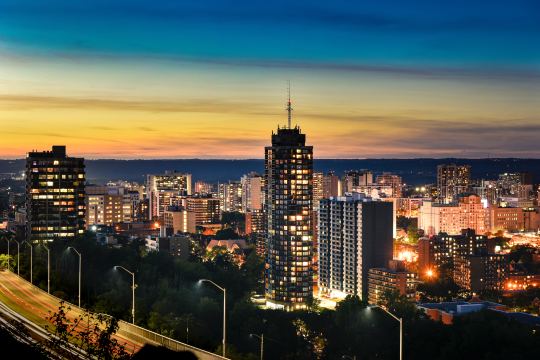
    image

    As many of you know, we have a development project in Hamilton, Ontario – more specifically in the Corktown neighborhood. We filed our development application earlier this summer.

    Because of this I was invited to participate in a Bisnow event on The Future of Hamilton. It takes place the morning of Wednesday, September 12, 2018 in The Alley by Core Urban. I walked this space last summer while it was under construction and so I’m excited to see it finished.

    For those of you who aren’t familiar with Core Urban, they are doing some really great work in Hamilton and have established themselves as a responsible city builder with a focus on adaptive reuse projects.

    Steve Kulakowsky, who is co-owner of Core Urban, will be speaking at the event along with the mayor, some guy who has pretentiously included his middle name, and many other smart people. To see the full list of speakers and to buy a ticket, click here.

    Photo of Hamilton by Vivek Trivedi on Unsplash

  • Bringing laneway suites to Toronto

    This morning I presented and sat on a panel at BILD called “bringing laneway suites to Toronto.” The other participants were Councillor Mary-Margaret McMahon, George Pantazis (Planner at the City of Toronto), Mike Collins-Williams (Director, Policy at OHBA), and Andrew Sorbara (co-founder of Lanescape).

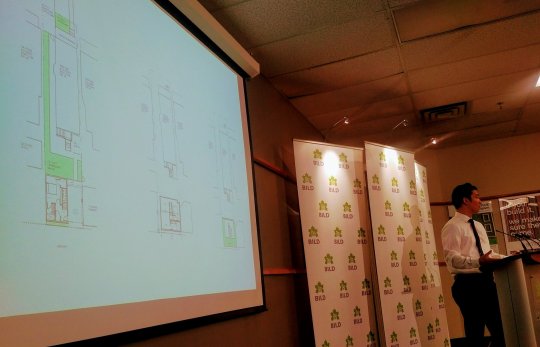
    Here is a photo that Mike took of me while I was talking about my failed laneway house:

    image

    For those of you wondering if/when this will happen in Toronto, here are the key takeaways from this morning: The city is already drafting laneway suite policies specific to Toronto & East York (not the other parts of the city) and they are due to report back to council in Q2-2018. Nothing is 100% certain at this stage, but there’s lots of optimism. 

    Councillor McMahon delivered this morning’s opening remarks and I was impressed by her deep commitment to laneway suites. I was also impressed by her stance on NIMBYISM, saying that education is important and that we can’t let NIMBYs stop what makes sense for the greater city.

    She gave the example of the 6 storey condominium in her ward that faced fierce community opposition a number of years back. If you can’t put a midrise building on a main street in this city, where can you put it? 

  • Is Toronto a world-class city?

    image

    Earlier this week I was on a panel discussion called Building Toronto Tomorrow. One of the questions was about whether or not Toronto is world-class city. It elicited a good discussion, so I thought I would talk about that today on the blog.

    Shamez Virani, President of CentreCourt Developments, responded by saying that he thinks Toronto is the greatest city in the world and that he wishes more people would just accept how incredible this city is. I agreed with him.

    I also responded by saying that I hate this question. I think it reeks of insecurity and I think it’s a bit of a red herring. It distracts from more direct and meaningful questions – questions such as our livability and our position as a global city.

    Because the reality is that Toronto is one of the most livable cities in the world and, in my view, we are the only true global city in Canada. We are an important node in the global economy for the flow of goods, people (we’re particularly good at this), capital, and now information. There’s a lot to be proud of.

    But that’s not to say that we’re perfect. Everyone knows we need better transit. And to name a few others (non-exhaustive list), I also think we need to:

    • Get a move on road pricing.
    • Loosen up our archaic alcohol laws and start using nightlife as a competitive advantage for attracting talent.
    • Acknowledge through our governance structures that cities are what drive today’s information economy.
    • Stop thinking about the Canadian/Toronto value proposition as being about cost savings. That is, buy this from us because our currency is weaker than yours. This is anti-innovation and there are much better ways to create sustainable value. (Innovation is still a weak spot.)
    • Focus on developing an information economy that leverages the unique talent and knowledge base of Toronto. For example, I think we’re in a great position for real estate + tech innovation.
    • Do everything we can to encourage big tech IPOs in this city. They are critical to developing the ecosystem.

    There’s a saying in Silicon Valley that you “make what you measure.” It means that whatever you decide to focus your attention on, is invariably what you end up making – regardless of whether or not you happen to be focusing on the right metric.

    In the context of Toronto, I think we’d be better served if we focused on and quantified our position in the global economy, as opposed to chasing some idea of “world-class.” The latter will grow as the former grows.

    I also think that this needs to be balanced against our livability. Sometimes there’s a tension. But there are cities – the best example is perhaps Tokyo – who have managed to pair a high quality of life with one of the strongest positions in the global economy.

    Is there anything else you think we should be doing? We can talk about it in the comments below.

    Image: Building T.O Toronto (BuzzBuzzHome Event)

  • Building Toronto Tomorrow

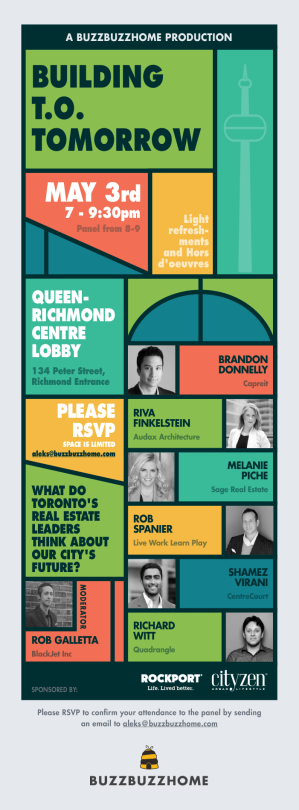
    I’m going to be speaking on a panel on May 3rd, here in Toronto, called Building T.O. Tomorrow. The topic is the future of this city.

    It is being put on by the good folks at BuzzBuzzHome and it will be held in the lobby of Allied’s new Queen-Richmond Centre (134 Peter Street). If you haven’t yet been to this building, that alone makes attending worthwhile.

    Here’s the event poster:

    If you’d like to attend, make sure you RSVP to aleks@buzzbuzzhome.com.

    On a largely unrelated note, I recently picked up the handlebar bicycle mount for my GoPro and I’m looking for some fellow city geeks who would like to ride around the city and film some – potentially cool – videos.

    I find that being on a bike is one of the best ways to experience a city (at least the cities that are actually bikeable). So I’m hoping some of that magic will translate into video. If that sounds at all interesting, drop me a line.

  • Panel: What is Smart Now?

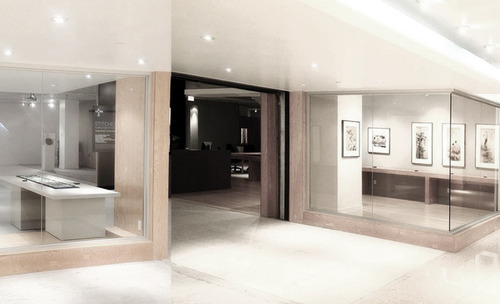
    image

    This Tuesday evening at 630pm, WORKSHOP – which is a design studio, gallery, and retail shop located in Yorkville, Toronto – will be hosting a panel discussion titled: What is Smart Now?

    On the panel will be a building scientist, a computer scientist, and two architects. The moderator will be Larry Wayne Richards, who is Creative Director of WORKSHOP and the former dean of the Faculty of Architecture, Landscape, and Design at the University of Toronto. He was dean when I was completing my undergraduate degree and is one of my favorite people in the world of Toronto architecture.

    Here’s a bit more on the panel:

    For more than half a century, visionaries and companies such as Monsanto, Hewlett-Packard, Microsoft, and Samsung have promoted the concept of technologically smart homes with highly integrated, interactive systems.  However few of these homes have actually been realized, leaving us to wonder why.

    Meanwhile, architects, builders, and home owners have become aware of the advantages of being smart in terms of energy efficiency and sustainability, from using common sense to selectively employing high-tech.  

    But now, with the digital realm and software advancing rapidly, will sophisticated smart home systems merge with recent advances in high performance materials and energy-efficient construction, making “totally smart” (and affordable) homes commonplace? Will we finally be living in the magical future that was imagined 50 years ago?  And what are the implications for architects and architectural education?

    And here are the panelists:

    • PAUL DOWSETT, Architect and Founding Principal, Sustainable TO
    • SRINIVASAN KESHAV, Professor of Computer Science, University of Waterloo
    • TED KESIK, Professor of Building Science, University of Toronto
    • JANNA LEVITT, Founding Partner, LGA Architects, Toronto
    • LARRY WAYNE RICHARDS (Moderator), Creative Director, WORKSHOP

    Given the current “Internet of Things” trend and the fact that software is creeping into so many non-tech fields, such as housing, I think this is a really timely discussion to be having. I also think it’s critical for these kinds of conversations to be cross-disciplinary. There are infinite opportunities in the housing market for people who are able to think in that way.

    If you’d like to attend, click here to sign up. It’s free and open to the public. WORKSHOP is located in the lower concourse level of 80 Bloor Street West.

    Image: WORKSHOP