Daily insights for city builders, delivered every morning at 6 AM ET. I’m Brandon Donnelly — a Toronto-based real estate developer and founder of Globizen. I’ve been writing here since 2013.

Tag: pan am games

  • The Olympics are dead. Or are they?

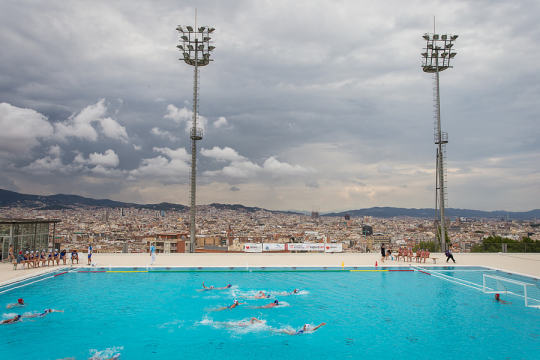
    Olympic Pool – Barcelona, Spain by Tom Weightman on 500px.com

    https://500px.com/embed.js

    Early this morning Professor Robert Wright – who is a regular reader and commenter on this blog – sent me an article from The Guardian called, ‘The Olympics are dead’: Does anyone want to be a host city any more? And that got me thinking.

    With Toronto having just hosted the Pan Am Games (the Parapan Am Games are still going on), there’s a lot of talk and debate happening in this city right now about whether or not we should make a go at hosting the 2024 Summer Games. The deadline for cities to express their interest is September 15th, 2015.

    The supporters (of which I would include myself) say it’s a great opportunity for civic (re)branding and urban renewal. It creates real deadlines to get things done. But the naysayers argue it’s a fiscal disaster waiting to happen. See 1976 Summer Olympics in Montreal.

    But in my view there are ways to host the Olympics and there are ways not to host the Olympics. Montreal (1976) is an example of what not to do. And Los Angeles (1984) and Barcelona (1992) are some of the best examples of what to do.

    The key is to think of the Olympics not as the end, but more as the beginning. In Olympic talk, they refer to this as legacy. Here’s what Los Angeles managed to accomplish as a result of the 1984 Summer Games (via Gizmodo):

    In 1979, the L.A. organizing committee had made a deal. If the games saw any profits, LA84 would give 60 percent back to the U.S. Olympic Committee and keep 40 percent for Southern California. At the end of the games, the total expenditures came in at a respectable $546 million, but even more impressive was the profit: A surplus of $232.5 million, meaning $93 million would stay in the region. This was huge. The only other games at the time which could claim to be financially successful at all were the other L.A. Olympics: The ones held in the city in 1932.

    The profits were used to create an endowment called the LA84 Foundation, which funds youth sporting events, resources, and facilities throughout the area. With smart management, the endowment has grown over the years, and over $214 million has helped an estimated three million children and 1,100 organizations in Southern California. Recently, the LA84 Foundation helped raise money to pay coaches and buy equipment at LAUSD high schools after budget cuts decimated their programs.

    The rest of the above article is definitely worth a read. It’s a great example of fiscal prudence.

    So what I am suggesting is not that we run blindly into hosting the Summer Games. But that we instead open our minds to the opportunities. Let’s great creative. If we could catalyze further city building, turn a profit, and leave meaningful legacies for this region (like what LA did), then why wouldn’t we want to have a go at it?

  • The PRESTO Push

    image

    Back in 2004, I spent a summer living in Asia. And one of the things that I remember really standing out for me was Hong Kong’s Octopus card. It’s a refillable card that you just tap to get onto transit. Lots of cities have them.

    But the cool thing about the Octopus card was that you could use it so many other places besides just on transit. I don’t know know what it’s like today in Hong Kong, but I remember also using it in taxis and to buy breakfast in the morning at Pret a Manger. That was pretty incredible for 2003.

    This was also great for me because I’m one of those people that dislikes carrying around paper money/change. I almost never spend my change and so it just ends up just accumulating in a container beside my front door. Here in Toronto we also use microscopic transit tokens, so that adds another layer of inconvenience.

    But that’s all changing.

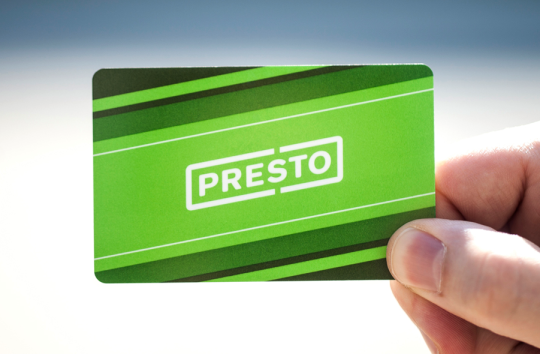
    Toronto now has its own version of the Octopus card and it’s called PRESTO. Technically it launched in 2009, but I only recently noticed the card readers appear at my home subway station (King Station). So tonight I decided to finally pull the trigger and order a card. I’ve been waiting 11 years for this moment 🙂

    And I was doing that, I noticed this message on the website:

    image

    Not surprisingly, we seem to be pushing to get PRESTO rolled out before the world comes to visit. And I think that’s a great thing.

    One of the big benefits of hosting an event like the Pan Am Games or the Olympics is that it creates a hard deadline to get things done, which is something governments often need. It’s a bit like tidying up before guests come over for dinner. You find a way to do it before people arrive.

    There’s a lot of debate about whether or not it makes sense for cities to spend the money on playing host city. But I don’t think we should ignore the fact that they can be a great catalyst for city building. Things get done. And oftentimes done is better than perfect.

    Good news: I’ve been told that the PRESTO system will be compatible with mobile phones and near field communication. Because let’s face it, cards won’t be around that much longer.

  • Community building on the east side of downtown

    Yesterday evening I went to the Toronto Christmas Market in the Distillery District. I had actually never been before, but it was something that I had been meaning to check out for a few years now. And it was wonderful. If you’ve never been, I would highly recommend you go. This past weekend was the opening weekend and it runs all throughout Advent until Sunday, December 21st.

    For those of who might not be aware, the Christmas Market festivity is a longstanding tradition that originated primarily in German-speaking Europe. Accounts of a “December market” were found as early as the end of the 13th century. The Toronto Christmas Market is a slightly more recent tradition (it’s only about 5 years old), but it was already selected as one of the world’s best.

    But Christmas carollers and hot toddies aside, the Market is also a fantastic opportunity to see the Distillery District in all its glory. Every time I visit the Distillery, I can’t help but feel how lucky we are to have a district like this in the city. The architecture and scale of the place is incredible and – alongside the Toronto Islands and Kensington Market, sometimes – it’s pretty much the only car free zone we have.

    However as someone who lived near the Distillery District in its early days, I remember how much of an “island” it was when it first opened. It felt disconnected from the rest of the city and the only way to get people there was to hold a special event. The retailers and galleries struggled and many didn’t last.

    With all the condos that have been built, literally on top of the neighborhood, that has changed dramatically. Today the area has become much more balanced as a mixed-use community. But the real tipping point, I think, will come next year when Toronto hosts the Pan Am Games and the West Don Lands neighborhood starts to come online just to the east of Cherry Street.

    Now all of a sudden the Distillery District won’t feel like the edge of downtown anymore, it will feel more like the middle of it. As my friend Alex Bozikovic of the Globe and Mail pointed out to me this weekend, the Pan Am Games are going to put the east side of downtown on people’s radars. And I would completely agree. Once that happens, the Distillery District will finally start to reach its maximum potential.

  • Cawthra Park revitalization

    I must have been living under a rock because I just discovered this weekend that Toronto is in the midst of hosting WorldPride. I obviously knew that it was Pride Week, but I didn’t realize that we had outbid Stockholm in 2009 in order to be awarded the event. 

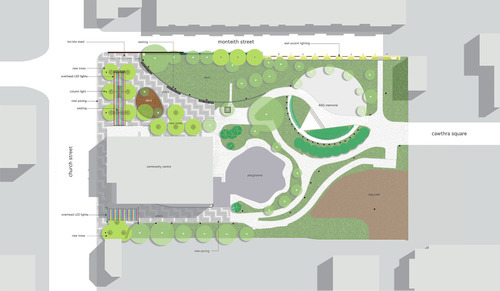
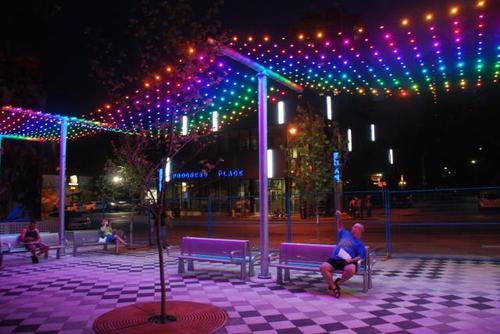
    I also didn’t realize that Cawthra Park near Church Street & Wellesley Street was being revitalized in preparation for both WorldPride 2014 and for the Pan Am & Parapan American Games in 2015 – which Toronto will also be hosting.

    Here’s a site plan of the final design:

    image

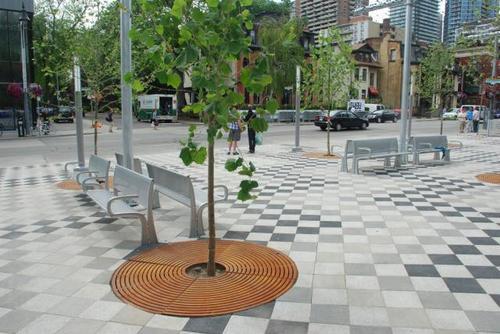
    And here’s what the completed design looks like:

    image

    image

    I like the pavers and I like the overhead LED lights. Those may not seem like big additions, but it’s amazing how those small little details can impact the way a space feels. I think it creates an intimate and inviting space. What do you think?

    Images: thinc design

  • Why the Pan Am Games are good for Toronto

    The Pan American Games are coming to Toronto in 2 years – 559 days to be exact. While not as high profile as the Olympics, some of you may be surprised to learn that the Pan Am Games will involve three times as many athletes as the Vancouver Olympics did.

    However, the big question with these sorts of events is always whether or not they create a lasting economic boon for the host city. History is littered with examples of economic disasters and lingering Olympic debts. I’d love to see a full analysis of what it costs to bid for a game, how much public money has to go up, how much private investment it spurs, and so on.

    At the same time, I suspect that some of the positive externalities might be hard to measure. How do you attach a value to the brand equity you get from hosting a major international sporting event? It’s hard, but for many people around the world the 2015 Pan Am Games could be the event that embeds Toronto into their psyche. 

    But there is another big benefit to playing host. It creates a real deadline. When cities bid for games they make all sorts of promises about the kinds of things they’re going to build and provide. In the case of Toronto, it accelerated the creation of a new mixed-income neighbourhood called the West Don Lands (which will be used to house the athletes during the games).

    “Originally, build out of the 32 hectare (80 acres) West Don Lands was planned to unfold in three strategic phases and take between 10 and 12 years, subject to market conditions. With the Pan Am Games, more than half of the community will be in place for the Games in 2015.” -Waterfront Toronto

    So in effect, we’ve leveraged the games in order to expedite capital projects that were already in the pipeline. I like this, because without a hard and fast deadline, I can almost assure you that these publicly run projects would have fallen behind schedule. Deadlines and goals are good.

    Here’s an example why:

    When I first started my MBA program at Rotman, we did an interesting organizational behaviour exercise involving origami cranes. The class was split into groups and each group was asked to go away and build paper cranes. If you’ve ever built one of these, you’ll know that they can be tough at first.

    But what each group wasn’t aware of was that they were all given different instructions in terms of the number of cranes they were expected to build. Their goals were different. At the end of the exercise, all of the cranes were counted and each group wrote their “production” levels on the board.

    What was discovered was that each group more or less built the exact number of cranes that they were asked to build. This is interesting, because presumably every group had the raw ability to produce the same number of paper cranes. All that changed was the motivation.

    Returning to the case of the Pan Am Games, the mandate is clear: We need to house 10,000 athletes and officials by the summer of 2015, or else we’ll look utterly incapable in front of the world. We have a deadline. And that’s a good thing.