Daily insights for city builders, delivered every morning at 6 AM ET. I’m Brandon Donnelly — a Toronto-based real estate developer and founder of Globizen. I’ve been writing here since 2013.

Tag: oslo

  • The new mobility landscape

    McKinsey published a report last month on the future of electric vehicles and what that will mean for the industry. Many countries, cities, and companies have set some sort of electrification target for 2030. The US is targeting 50% EVs by 2030. Several countries have announced a flat-out end to ICE sales by 2030. And a number of OEMs have committed to the same.

    But there are already cities, such as Oslo, which have reached EV majority. In July of this year, its passenger EV adoption figure was 66%, making Norway a global leader. What is clear is that the electrification of personal transport is well underway. Anecdotally, we are seeing that play out with the number of people now inquiring about electric charging infrastructure in our buildings (here in Toronto).

    This move to electric will have many repercussions, including a major shift in the entire supply chain (which McKinsey outlines in their report). While ICE vehicles and EVs still both have things like tires, EVs require a whole slew of new and now growing components:

    It is also going to force new public infrastructure:

    But in parallel to the electrification of personal vehicles, we are also seeing a number of other trends and shifts. The electrification of public transport (Shenzhen has already electrified its entire bus and taxi fleets). The rise of micro-mobility (things like e-scooters). The ongoing push to discourage driving in urban centers. And the continuing goal of autonomous vehicles.

    What all of this suggests to me is that the electrification of personal vehicles is only part of the story. The entire mobility landscape in our cities is changing and it will probably look a lot different by 2030.

  • Cumulative electric vehicle sales around the world

    When I was shopping for a new car last year I gave serious thought to buying an electric vehicle. In fact, it is what I initially set out to do. But I couldn’t find a model that I liked and I didn’t feel like the charging infrastructure was in place for me to go on snowboarding trips to places like Quebec or Vermont. So I went with an ICE vehicle. But we all know it is only a matter of time before we hit that tipping point, which is why 100% of the parking spots at our Junction House project will be ready for an electric vehicle charging station.

    According to a recent briefing from the International Council on Clean Transportation (ICCT), there were 3.1 million electric passenger vehicles in use around the world at the end of 2017. Almost all of them (98%) were located in China, Europe, Japan, and the United States, and nearly half of them (44%) were located in just 25 cities. Shanghai leads the world (or at least it did at the end of 2017) with 162,000 cumulative sales since 2011. This represents 5% of all global electric vehicle sales during this time period.

    The footnote to this is that most of Shanghai’s electric vehicles are actually plug-in hybrid electric vehicles, whereas in the case of Beijing — which is second only to Shanghai in terms of cumulative sales — it is virtually all battery electric vehicles. Digging even deeper, if you look at the share of electric vehicles sales in each city, it becomes clear that, on a per capita basis, the real leader is actually Norway. Between 40-50% of all cars sold in Oslo and Bergen were electric in 2017.

    Here is a chart from the ICCT:

    What is clear from these leading cities is that there are supportive policies and incentives in place to accelerate the adoption of electric vehicles. The chicken-and-egg dilemma, which is what I ran into, is that you really need the installed charging capacity. The ICCT estimates that the top 25 electric vehicle markets have about 24x the available charging per capita compared to other cities. That certainly helps.

  • A new typology of cities

    Earlier in the week, my friend Rodney Wilts of Theia Partners sent me a JLL report called, World Cities: Mapping the Pathways to Success. I am admittedly only getting around to it now.

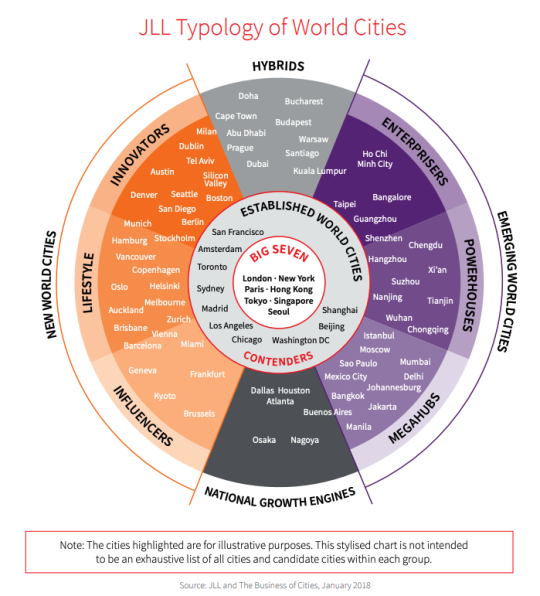
    The report proposes a new typology of world cities that looks like this:

    image

    It is based on 10 overall categories of cities, grouped into 4 main buckets. The first bucket is “Established World Cities”, within which there is the “Big Seven”, and then the “Contenders.”

    The Real Estate Highlights that accompany each category of city is a good place to start if you’re looking to do a quick scan of the report.

    Here’s a taste:

    One-quarter of all capital invested in commercial real estate globally currently lands in one of the “Big Seven” cities. And London and New York are easily at the top.

    Cities that recently graduated from “New World City” status – namely Toronto, San Francisco, Sydney, and Amsterdam – are all struggling to address housing and infrastructure deficits.

    “Lifestyle” cities – such as Vancouver, Auckland, and Oslo – are some of the most active investment markets. Biggest rental growth for prime offices (since 2000) in the “New World Cities” category.

    Click here for the full report.

  • Friluftsliv (or open air living)

    Johnathon Little (husband) and Zoe Little (wife) recently launched a new housing concept out of the UK called Koto, which is supposedly Finnish for “cozy at home.” 

    (Before Koto, Johnathon worked for Snohetta in Oslo.)

    The goal of the company is to create beautiful, small, and prefabricated houses and cabins that allow people to connect with nature. 

    It is inspired by the Nordic concept Friluftsliv. The literal translation is “open air living” but, more specifically, it is about the benefits of nature on our mental and personal wellbeing.

    Their small cabin has a footprint of 15 square meters and their large cabin has a footprint of 40 square meters. Base prices run from about £33,500 to £63,500. A bathroom is optional.

    The most obvious use case for me is that of a bunkie. For more on Koto, check out their website and Instagram.

    Photos: Koto

  • The city is the brand

    Oslo Barcode I by Michel Krämer on 500px.com

    https://500px.com/embed.js

    I was reading the internet this morning and I stumbled upon an interesting urban blogger from Oslo named Erling Fossen. Most of his writing is in Norwegian, but he does have a section called “City Notes” that is in English.

    I enjoyed this paragraph titled, "The city is brand.” It is taken from a post called, “7 lessons from Oslo Urban Arena.”

    As cities compete to attract talents, companies and investment, many cities have branded themselves as either the most creative city in the world, the smartest or the most liveable. In many occasions cities develop slogans to go with the message. But as brand expert Martin Boisen said: No one has ever moved to a city due to a logo. Action speaks louder than logos. Branding cities can actually be helpful. The world is a stage, and your city has a role to play. The first message is to avoid being a copy cat and focus on your own uniqueness. It is also just as important to involve a larger community to make branding work. It takes a village to brand a place. Equally important is to have strong leadership communicating the message. Strong leaders can rock the boat.

    I’ve written about city branding quite a bit here and this has always been my message. An excellent city brand must stem from some form of reality. If you want to be the most creative or the greenest city in the world, then you have to live and breathe that philosophy.

    I also feel strongly about not copying other cities. You might think that having (insert thing here), which was pioneered in (insert city here), will make you world-class. But that’s a pretty banal way of going about things.

    Instead, to reiterate Fossen, focus on your own uniqueness. Then market the hell out of it.