Daily insights for city builders, delivered every morning at 6 AM ET. I’m Brandon Donnelly — a Toronto-based real estate developer and founder of Globizen. I’ve been writing here since 2013.

Tag: online

  • You can now buy a new home, online

    My friend Matthew Slutsky runs a company called BuzzBuzzHome that allows you to search for new construction homes. This week they launched a feature that allows you to put down a deposit on a new home – online – with your credit card. It’s live right now for the Barra on Queen in Kitchener, Ontario.

    I know that Matthew and his team have been working on this for years (I saw earlier demos), and so I wanted to publicly congratulate them on the blog. I’m not sure who their competitors are right now, but this feels to me like one of the first online real estate marketplaces where you can actually just hit “buy now.” Huge accomplishment.

    I am sure many of you will have objections that we will hear about in the comment section below. But I have little doubt that this is the future. People used to say that the masses aren’t going to buy clothes online because of the need to try things on. I own suits that I have purchased online. People will buy real estate online.

    The more important question: When will it go mainstream?

  • A guide to digital marketplaces

    Version One Ventures – which is an early-stage venture capital fund based in Vancouver – recently published a free handbook called, A Guide to Marketplaces.

    Online marketplaces are really fascinating because they are perhaps broader in scope than you might initially think. For example, Uber is a marketplace. There’s a supply-side (drivers with cars) and a demand-side (people needing rides). Uber connects these two groups together and acts as a kind of digital middle person. Uber does not own any of the cars.

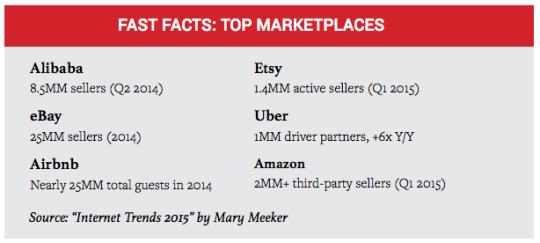
    This is an incredibly power business model and it can and is being applied in many different ways. Here are the top internet marketplaces (via the handbook):

    I have been interested in this space for years because I have been very curious as to why we haven’t seen more innovation when it comes to online real estate marketplaces. Yes, there are platforms like Zillow.com. But Zillow has not done to real estate what Uber is doing to urban mobility.

    My thinking is that it comes down to supply-side aggregation. Online marketplaces in general are hard to get started, which is why investors love them. They have defensibility. But real estate, in particular, is even harder to jumpstart compared to the incumbent models because of what I see as constraints on the supply-side.

    That’s why I am so excited about what BuzzBuzzHome.com is doing on the new construction side of the business. They are aggregating supply.

    If you’d like to download the guide to marketplaces in PDF, click here. It’s a great read and I’m glad that Boris and Angela took the time to assemble. Thank you 🙂

  • What a “buy now” button will mean for the new construction real estate industry

    Colored apartments by Pierre-Yves Babelon on 500px.com

    https://500px.com/embed.js

    Recently it has been in the news that BuzzBuzzHome.com – the new construction real estate site – will be launching a “buy now” feature in the new year (2016).

    This will allow people to buy condos and homes online with their credit card, which means that people will be able to pay the $5,000 deposit online and process all the paperwork that today happens within a sales office.

    This is huge.

    If you’re somebody who has used a computer and the internet before, the process today feels archaic. Typically you go online to register for a project and then somebody will call you to arrange an appointment. If you ask them to email you the price sheet and floor plans ahead of time, they’ll almost always tell you that they can’t do that and that you’ll need to come into the sales office for an appointment. 

    But what about if you end not liking the floor plans and you’re about to waste a few hours of your time? Too bad. The sales funnel requires you to be present in person. This is nothing against the many talented sales professionals working in new construction; it’s just that if I can design and price out a car online and if Mark Cuban can buy a $40 million jet online, then I should be able to shop for a new condo online.

    BuzzBuzzHome has been chipping away at the current model for years and they’ve managed to get a lot more information online than was previously available. When Matthew and Cliff first launched BuzzBuzzHome in the late 2000s it was almost unheard of for developers to put any sort of pricing and floor plans online. Now they at least have some of that on their site. I’m glad they stuck with it.

    Because what’s equally exciting about what BuzzBuzzHome is doing is that in order to offer a “buy now” feature, they also need to have an accurate account of all developer inventory on hand. And so alongside this “buy now” feature they’re also building out a full cloud-based inventory management system for developers. 

    This means that BuzzBuzzHome will soon be managing the supply-side of the new construction marketplace. Think of the data and analytics you can extract from a platform like this. It’s going to bring much greater transparency to this industry.

    But if your business is in any way connected to the new construction real estate market, I would take this morning and think about how the above innovations could impact your business model. I can think of a few winners and losers.

    Some of you might be thinking that people aren’t going to make the biggest purchase of their life online. But I would bet the farm that many people will. I know I would.

  • Earth’s biggest ____store.

    Imagine this sequence of events (and don’t peak by clicking on any of the links).

    The year is 1994.

    You notice that the internet is starting to become a big deal and that more and more products are being sold online. As a result of this trend, you decide to start an online business.

    You write up the business plan and begin operations out of your garage. You then get lucky (or you’re just smart and talented). Within 2 months, sales reach $20,000/week. That’s over a million dollars a year.

    Business continues to grow and within 3 years you’re able to take your company public, raising $54 million at a $438 million valuation. Over the subsequent two years, you’re then able to raise an additional $2.2 billion in debt to fund your continued growth. 

    The year is now 2000.

    You were just named Time magazine Man of the Year. And traditional brick-and-mortar retailers are really taking notice (i.e. suing you). That’s pretty impressive after only 6 years of operation. 

    This company is called Amazon. And that “you” is Jeff Bezos.

    I was reading up about how much of an asshole Jeff Bezos is, and then became interested in the Amazon story. I thought I would share a bit of it with you all here.

  • Shopping: offline vs. online

    According to Sequoia Capital, Americans spent $4 trillion on retail shopping last year – 95% of which was still done in traditional brick-and-mortar stores. I’m actually a bit surprised by how high this number is. I would have thought that a larger percentage of people would be shopping online.

    For me personally, I’d say that my split might be close to 50/50. From furniture to clothes, to even a new bicycle, I buy a lot online, come to think of it. Part of the reason is convenience, but the other reason is that I like having easy access to a broader selection.

    About the only thing I really prefer buying in person is groceries. However even there I’ve been exploring ways to regularize shipments of the items I typically buy. I can’t recall where I read it, but I remember seeing something about less than 1% of groceries in America being bought online.

    Intuitively, the percentage of online sales is only going to rise, particularly given the shift to mobile. Consumers can now shop anytime, anywhere. Real estate companies and retailers certainly need to pay attention.

    But just like the internet didn’t make cities irrelevant, I don’t think it’ll make shopping in person completely extinct. As Sequoia Capital points out in its article, mobile phones are creating new opportunities at the intersection of online and real world shopping.

    So while I don’t know what the future online/offline split might be, I suspect that the two worlds will continue to blur together. I might buy a bicycle online, but when it comes time to service it, I’d like to be able to bring it into a store.