Daily insights for city builders, delivered every morning at 6 AM ET. I’m Brandon Donnelly — a Toronto-based real estate developer and founder of Globizen. I’ve been writing here since 2013.

Tag: online shopping

  • Over 15% of retail sales in the US are now happening online

    Amazon was founded in 1994 and went public in 1997. By 1999, some 5 years after the company was started, only about 1% of total retail sales were being done online in the US. So you have to give it to Bezos, he saw what was coming and he got in early to help create it. This was not so obvious back in the mid 90s. The internet as a whole was still being viewed with skepticism, especially after the dot-com bubble.

    Today, online shopping represents over 15% of total retail sales. (See above chart from Charlie Bilello.) The pandemic pop is over, but it looks like we’ve returned to a pretty clear trendline — up and to the right. I guess the questions now are: When and where does this start to flatline? It doesn’t seem likely that this goes to 100% in the foreseeable future, especially if you include grocery. But it’s going to go a lot higher.

    For myself, if I were to exclude food/grocery, I would say that the vast majority (80-90%) of my retail purchases are done online. Even if I’m in a physical store, I’ll often pull out my phone to price compare. If it’s cheaper on Amazon, I’ll just order it there.

    Here’s another example.

    This past summer when I was in Park City, I discovered the brand Vuori. I had heard of them before, but I had never actually seen or touched their clothes. It’s great stuff. But instead of the store convincing me to buy something, it convinced me that I like the brand and that I should probably shop on their website at some point in the near future. And that’s exactly what I ended up doing. (Sorry Lululemon. You’re still my favorite.)

    All of this is perhaps obvious in a world where 15% of total retail sales are happening online. But I would imagine that the retail landscape and our cities will look very different when this number goes even higher. Our cities were different at 1% compared to today at 15%; so imagine what 50% or 80% might be like.

  • Rebalancing retail sector taxation

    Back in 2006, online shopping in the UK represented about 3% of total retail sales. As of March 2020, right before the pandemic, this number had increased to about 22%. Online shopping then spiked during the pandemic, as we all know, but it has since normalized and the January 2022 figure was about 27.1%. But if you exclude grocery sales (because food is special), I believe the percentage of online sales is now in the range of 35-40% for the UK.

    What is clear is that there is a longstanding shift towards more online shopping. It has just become so easy. However, UK retailers, as well as many others I’m sure, have been arguing that part of the reason for this systemic shift is an unfair tax advantage.

    Physical retailers tend to be located in high-traffic areas and so they are naturally subjected to higher municipal taxes. Online retailers, on the other hand, get to locate their warehouses and distribution centers in lower cost locations and so aren’t taxed at the same kind of rates.

    Because of this perceived imbalance, the UK is now studying the pros and cons of implementing an online sales tax (OST) as a way “to help rebalance taxation of the retail sector.” Tax online so offline seems more attractive.

    But this is a tricky thing. Nobody wants to see our main streets and urban centers void of retail activity. That would be like walking through a financial district that had decided to bury all of its retail activity underground or something. But at the same time, does it make sense to shift taxes to what the market seems to like and want? Though I suppose it could be a lucrative tax since you generally want to target things with inelastic demand.

    What are your thoughts?

    More info on the OST consultation, here.

  • Ecommerce as logistics

    Benedict Evans asks some great questions in this recent post about ecommerce penetration. Instead of just looking at the product itself and/or the way in which we buy it (online versus offline, for example), he focuses on the logistics model that accompanies the transaction.

    What can be parceled and shipped via Amazon? What can be delivered using a bicycle? What requires some sort of special delivery or collection method?

    The point he is making is that different things need to happen for a new fridge to make it to your home, compared to say a Chipotle burrito. And these differences matter when it comes to how we should be thinking about ecommerce and the real estate in our cities.

    Personally, I find it helpful to reframe the questions in this way.

    Here’s an excerpt from the post:

    But if I buy online and then drive to the store to collect it, is that different to phoning and reserving it? We didn’t have a statistics category for ‘telephone ordering’. If I use an app to order pizza instead of phoning the restaurant, has that become ‘ecommerce’ or is it still pizza delivery? 30 years ago, if I drove to Walmart instead of walking to a neighbourhood store, or drove to Best Buy instead of going to a department store, we didn’t call that ‘car-based commerce’. So is this a tech question, or a retailing question, or an urbanism question?

    For the full thing, click here.

    Chart: Benedict Evans

  • Pleasure and product discovery

    Benedict Evan’s most recent blog post, called “Amazon as experiment,” draws some interesting parallels between what Amazon is doing today (and experimenting with) and the beginning of mass retail, namely the invention of the department store. He also talks about some of the shortcomings of Amazon’s model, which isn’t at all focused on (or good at) things such as “pleasure” and product discovery. Here are a couple of excerpts:

    On the other hand, it’s interesting that Amazon seems to be doing as much experimentation as possible around the logistics model—from stores to drones to warehouse robots of every kind—but much less around the buying experience, other than small-scale tests of the Four-Star stores. After all, historically, department stores were about pleasure as much as they were about convenience or price. They changed what it meant to “go shopping” and helped turn retail into a leisure activity.

    This has always been the gap in the Amazon model. It’s ever more efficient at finding what you already know you want and shipping it to you, but bad at suggesting things you don’t already know about, and terrible whenever a product needs something specific—just try finding children’s shoes by size.

    This is probably inherent in the model. For Amazon to scale indefinitely to unlimited kinds of products, it needs to have more or less the same commodity logistics model for all of them. That’s the line it’s never been willing to cross. Amazon doesn’t do “unscalable.” And yet, while we now know there is nothing that people won’t happily buy online, not everything will fit that commodity model. So maybe that’s the real test of Amazon’s pride: can it work out how to let us shop, rather than just buy?

  • Amazon and retail

    This is an excellent talk by NYU professor Scott Galloway about Amazon, online grocery, and many other aspects of the retail landscape. The bits about Amazon’s scale and reach are fascinating. There is about 30 minutes of him speaking quickly and then another 15 minutes of Q&A. If you can’t see it below, click here.

    [youtube https://www.youtube.com/watch?v=_HyiY_m_YxI&w=560&h=315]

  • How ecommerce is growing in rural China

    This piece in the New Yorker about how e-commerce, and in particular JD.com, is transforming rural China is worth a read.

    In typical New Yorker fashion, it’s a good long-form read, but one that you can also listen to if that’s your thing.

    What’s immediately fascinating are how important trust is to JD’s rural expansion strategy and how locals from these rural communities are used to penetrate the social networks.

    Today, Xia oversees deliveries to more than two hundred villages around the Wuling Mountains, including his birthplace. But, in line with JD’s growth strategy, an equally important aspect of Xia’s job is to be a promoter for the company, getting the word out about its services. His income depends in part on the number of orders that come from his region. Across China, JD has made a policy of recruiting local representatives who can exploit the thick social ties of traditional communities to drum up business.

    This is important because:

    “Chinese people don’t easily believe the good will of strangers,” Liu told me. “Why do you think Chinese fight tooth and nail to get on the bus and subway?” He shook his head and laughed. “It doesn’t matter that it’s less efficient or unnecessary. It’s a complete reflex for them, because it’s what they’ve been taught since they were young.”

    When you have some time, here is the full article

    According to the New Yorker, JD.com is the third largest tech company in the world in terms of revenue. They also have the largest drone delivery platform in the world.

  • Notes from the retail apocalypse

    A friend of mine was in Scottsdale last month for an ICSC conference where Garrick H. Brown (VP of Retail Research for the Americas at Cushman & Wakefield) delivered this retail presentation

    My friend flipped it to me this week and below are a couple of slides that stood out as I scanned through it.

    image

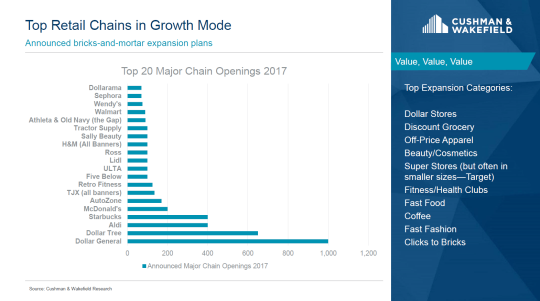
    Apparently over the last five years, a new dollar store has opened every four hours in the US. That’s how quickly this category is growing. A race to the bottom.

    image

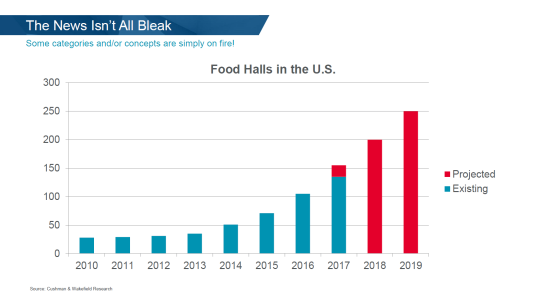
    Food halls are hot and not just in the US. Check out: “5 huge food halls opening soon in Toronto”.

    image

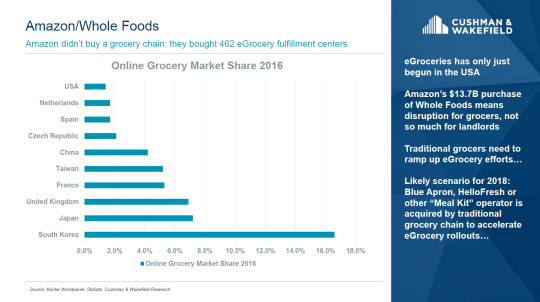
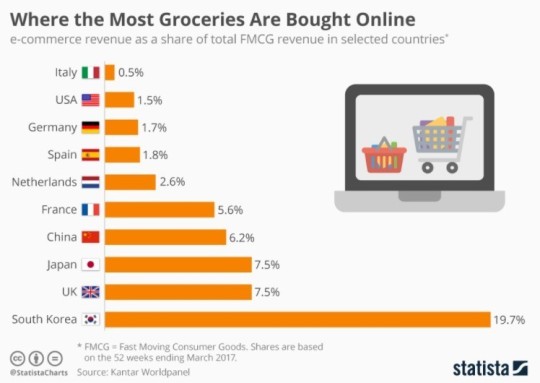
    This is similar to a chart I posted a few weeks ago that pegged online grocery shopping in South Korea at closer to 20%. I’m still fascinated by this market share number and want to better understand what’s driving it.

    image

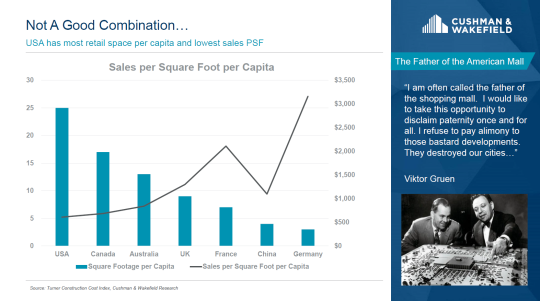
    This is an interesting chart that shows the relationship between retail square footage per capita and sales per square foot per capita. The US has lots of retail space per capita but low sales. Now look at Germany.

    image

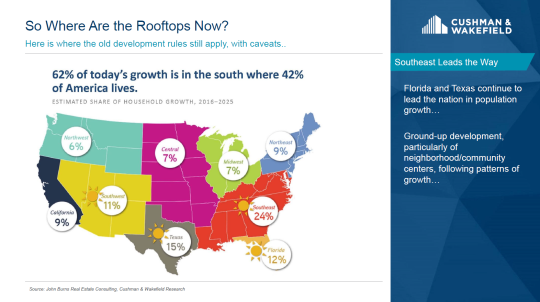
    Finally, this is a chart that shows where household growth is expected to happen from 2016 to 2025. It follows a very clear historical trend of Americans moving from cold places to warmer/hot places.

    image

    For the full presentation, click here.

  • South Korea buys 20% of its groceries online

    The World Economic Forum recently posted the below chart showing that 1/5 of all grocery purchases in South Korea are done online. The calculation is e-commerce revenue as a percentage of total fast moving consumer goods revenue in the country.

    image

    The explanation they give for this high percentage is that South Korea has some of the fastest and most ubiquitous internet access in the world. 

    But as soon as I read this I thought to myself: This can’t be the only reason. When was the last time you really wanted to order groceries online but your internet connection was too slow? 

    Also, if you look at all online shopping (not just FMCG), South Korea no longer shows up as such an outlier. So what’s happening with grocery?

    Without actually knowing the market, I would imagine that there are companies in South Korea who have simply figured out how to offer a great online grocery shopping experience.

    South Korea is also one of the denser countries in the world at about 513 people per km2. That would help with distribution. 

    But then again, the Netherlands is also quite dense (414 people per km2). Why are they only at 2.6%? (For comparison, the US is about 33 people per km2.)

    If any of you are familiar with the South Korea market I would love to hear from you in the comments. If they really are at 20%, I am surprised more people aren’t talking about this.

  • Online shopping and “last mile” real estate

    The Globe and Mail recently published an excellent article on “how e-commerce is driving a real estate revolution.” This is a topic that I’m very interested in: how online manifests itself offline.

    Not surprisingly, the article talks a lot about Amazon, including their 4th warehouse in the Greater Toronto Area, which is an 850,000 square foot facility in Brampton equipped with 350-pound robots (8050 Heritage Road).

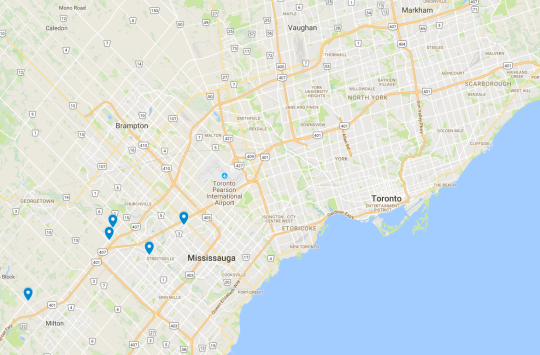
    The first thing I did after reading the article was figure out the location of all of Amazon’s fulfillment centers in the GTA. Amazon doesn’t seem to publish this. But according to TaxJar, they are here (I mapped out the addresses):

    There are two in Brampton at the precise location where Hwy 407 (toll route) and Hwy 401 meet. The other three are distributed along Hwy 401 in Milton and in Mississauga.

    Now let’s get back to that Globe and Mail article:

    – In 6 years, Amazon has leased over 2 million square feet of warehouse space in Canada.

    – Toronto is the third largest warehouse market in North America. It represents 43% of Canada’s total inventory.

    – Average net rents have increased 9.7% over the past year and vacancy rates have dropped to 2.7% (CBRE data). In Vancouver, those same numbers are 5.1% and 3%, respectively.

    – Online shopping is thought to account for about 6.5% of all retail sales in Canada. But in Toronto, 23% of all industrial space is already e-commerce-related (CBRE data, again).

    – CBRE believes that every $1 billion in new online sales per year requires an additional 1.25 million square feet of warehouse space. 

    – Based on online sales projections, Canada needs another 27.5 million square feet of industrial space over the next 5 years. We don’t have that much space in the pipeline.

    – Clear heights are increasing for stacking purposes. Amazon’s new Brampton facility is 45 feet tall / 4 floors. 10 years ago new warehouses were 26 feet tall.

    – Average sale price of warehouses in the GTA has gone from $119.35 psf to $142.19 psf over the last year.

    Perhaps the most interesting takeaway from the article is the discussion around “last mile” distribution hubs. These are fulfillment centers located closer to the city, which are used to offer shorter delivery times: 

    “…instead of having inventory stored for days or months, these fulfilment centres will turn over their inventory in one day, sometimes twice a day.”

    This is something that I addressed in my recent presentation about the “mall of the future” at B+H’s retail design charrette. Where do these physical distribution centers want to be as online sales continue to grow and delivery times continue to compress? Where’s the future growth?

    According to this article, it’s going to be in “last mile” fulfillment real estate – relatively smaller spaces that are located very close or directly in the city center.

    Photo by Samuel Zeller on Unsplash

  • E-commerce jobs are clustering in larger cities

    image

    The New York Times just ran an interesting piece on “how the growth of e-commerce is shifting retail jobs.”

    Here are some of the key takeaways (all US data).

    Online shopping accounts for about 8.4% of all retail sales.

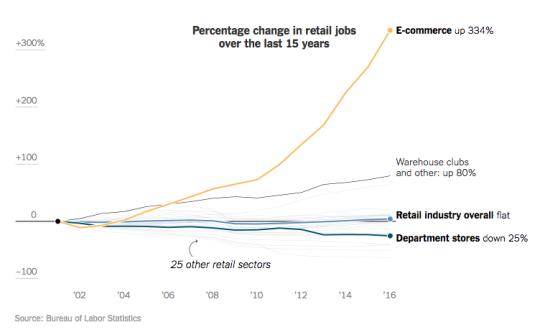
    But e-commerce related jobs are growing way faster than all other forms of retail employment. See above graph.

    That said, e-commerce jobs are still a small portion of overall retail employment. And the rise in e-commerce employment has not been enough to offset the losses in other areas, such as in departments stores.

    Over the last 15 years, e-commerce added 178,000 jobs and department stores lost 448,000 jobs. In this same time period, warehouse clubs added 841,000 jobs! I found it interesting to see department stores on the bottom and warehouse clubs on the top of the graph.

    image

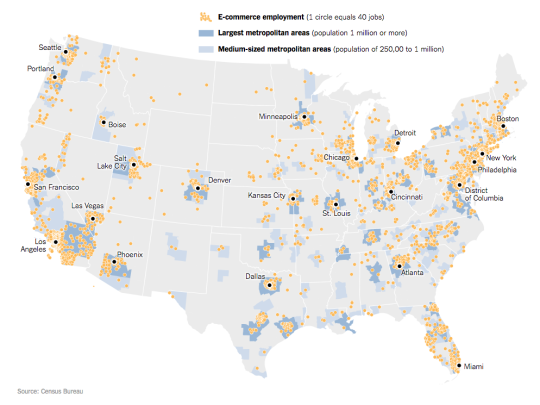
    Finally, e-commerce jobs appear to be concentrating in larger metros. See above map. Each mustard dot represents 40 e-commerce jobs. You’re selling more products with less human capital, and those people are clustering. This is a broader trend.

    According to the New York Times, counties and smaller cities (under 250,000 people) account for almost ¼ of overall retail employment. But when it comes to e-commerce firms the number drops to around 13%.

    Once again it would seem that technology and what we do online have an impact on our cities and towns. And that’s fascinating.

    All images from the New York Times