Daily insights for city builders, delivered every morning at 6 AM ET. I’m Brandon Donnelly — a Toronto-based real estate developer and founder of Globizen. I’ve been writing here since 2013.

Tag: oklahoma city

  • Infinity and beyond

    Earlier this week, Oklahoma City Council approved plans for the 1,907-foot-tall Legends Tower. If built according to these plans, it would become the 5th tallest building in the world and the tallest building in the Western Hemisphere.

    Currently, the tallest building in the US is One World Trade Center at 1,776 feet (581 meters). This is a symbolic height meant to reference the date of the Declaration of Independence.

    To be even more specific, though, the Legends Tower wasn’t approved at 1,907 feet. As I understand it, it was approved with with an unlimited height. Meaning, if the developers wanted to go even taller in the future, they could.

    This is sort of unique. Usually when a new by-law/ordinance is passed, it includes a maximum height in feet/meters. In this case, I guess they’ll just use an infinity symbol and call it a day.

    Here are some quotes from Dezeen:

    “AO is delighted that the Oklahoma City Council has approved the development team’s request for unlimited height for the Boardwalk at Bricktown,” said AO.

    “We are grateful that the City Council has embraced the vision of Matteson Capital and the entire design team to transform the city into a global destination.”

    The obvious question is “will this get built?” And I don’t know the answer to that. But I do think that infinity is just as symbolic as 1,776 feet.

  • Live/work in Oklahoma City

    I am really drawn to live/work spaces like these ones here in Oklahoma City’s new Wheeler District. (Additional project info can be found over here.) We have some examples of this in Toronto, but I wouldn’t say it’s commonly done. And oftentimes they don’t work at all. More often than not, these spaces seem to just get used as strictly residential (which is okay).

    But there are some arguably successful examples that we can point to. CityPlace is maybe one. When the area was first getting developed, retail would have been an extremely difficult use to underwrite. It was a development island. And so live/work suites were introduced at grade along much of the area’s main artery.

    The area did eventually get new dedicated retail, but its live/work suites also started taking on more “work” as demand in the area grew. Today, nobody is going to confuse it with Bloor Street, but importantly, the ground floor was able to change and adapt. And this is one of the great benefits, or at least promises, of live/work: you get additional flexibility.

    Personally, I would love to have a live/work space. I’d use it to incubate new ideas and sell random stuff. And I have a feeling that, given the opportunity, many others would do the same. So I plan to spend some more time thinking and writing about this topic. If any of you have shining examples of live/work successes, please share them in the comment section below.

  • US cities with the highest millennial homeownership rates

    Across the 50 largest metro areas in the US, about 31.9% of millennials — those aged 18 to 34 — owned a home as of 2017. And according to recent census data (via the Redfin), only 5 of these cities had a millennial homeownership rate higher than 35%. They are as follows:

    The top spot goes to Salt Lake City, which sits at just over 40%. It also has the highest share of businesses owned by millennials at 8.4%. Not surprisingly, the cities on this list all have relatively affordable home prices, with Detroit being the most affordable.

    I think you could interpret this list as a bit of a leading indicator for US cities on the rise. Affordability, and walkability, may be the draws today, but as millennials lay down roots, start businesses and earn more money, I am sure we’ll see these cities transform even further.

  • The Oklahoma Land Rush of 1889

    One of our partners sent me a terrific article last week by Sam Anderson on the founding of Oklahoma City

    I have said this before on the blog, but I am deeply fascinated by the origins of cities because, oftentimes, the story isn’t all that lucid. Why right here? As Anderson points out in his article, usually cities “creep into existence.” 

    But not Oklahoma City:

    Oklahoma City was born in an event called, with extreme dramatic understatement, the Land Run. The Land Run should be called something like “Chaos Explosion Apocalypse Town” or “Reckoning of the DoomSettlers: Clusterfuck on the Prairie.” It should be one of the major events in American history. Dramatizations of it should be projected onto IMAX screens with 3-D explosions, in endless loops, forever. Every time you walk into a mall, you should be accosted by fuzzy-headed Land Run characters shouting, “What is America?!” “What does America even mean?!” Because the Land Run was, even by the standards of this very weird nation, absurd. It was a very bad idea, executed very badly. It would be hard to think of a worse way to start a city. Harper’s Weekly, which had a reporter on the ground, called it “one of the most bizarre and chaotic episodes of town founding in world history.” A century later, the scholar John William Reps reviewed the evidence and concurred. The founding of Oklahoma City, he wrote, was “the most disorderly episode of urban settlement this country, and perhaps the world, has ever witnessed.”

    To learn how Oklahoma City went from a population of 0 to 10,000 in about half a day, check out the full article.

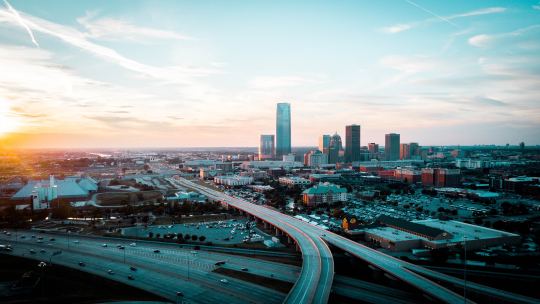
    Photo by Gerson Repreza on Unsplash

  • #WeTheOther

    We may not all agree on things like bike lanes and transit, but if there’s one thing that can generally unite a city it’s playoff sports. 

    I love the solidarity that it creates. You may have nothing else in common with the person sitting next to you at the bar, but suddenly you’re best friends because your team is winning.

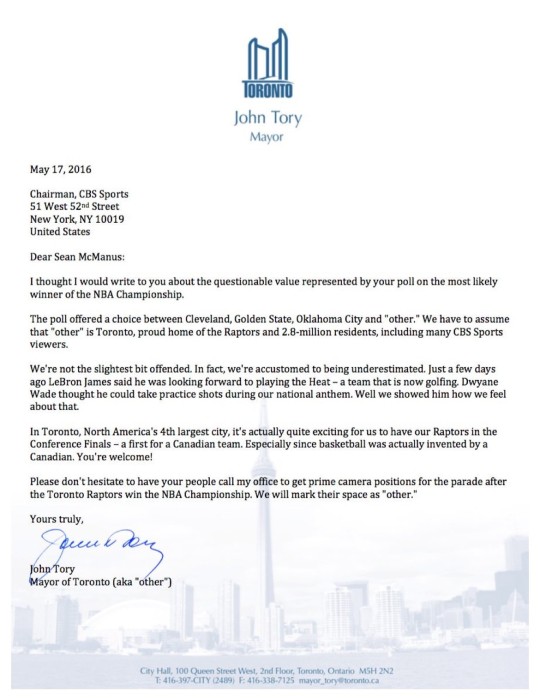
    As I write this post, #WeTheOther is currently breaking the internet after CBS Sports ran a cheeky online poll asking: Who will win the NBA title? The four options were:

    1. Warriors
    2. Thunder
    3. Cavaliers
    4. Other

    For those of you who don’t follow basketball, there are only 4 teams left in the NBA playoffs right now! So in what was likely a deliberate snub to the Toronto Raptors, CBS conveniently obfuscated them in their poll.

    Here’s how Mayor John Tory quickly responded:

    What would sports be without the trash talking?

  • The housing typologies of American cities

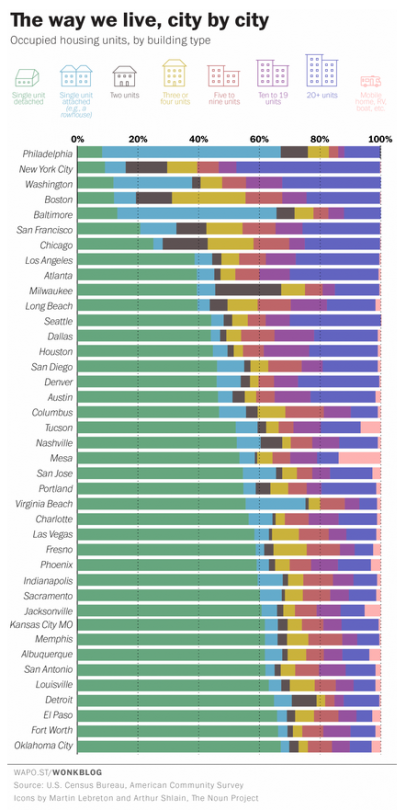
    Yesterday the Washington Post published a great chart showing the housing types of the 40 largest cities, by population, in the US. The list is ordered from lowest to highest according to the percentage of single-family houses in the city (green bar).

    Here’s the chart:

    image

    Not surprisingly, many of the cities at the top of this list (meaning they have the lowest percentage of single-family houses) are in the older east coast cities. 

    It’s also interesting to see just how much the rowhouse dominates the urban landscape in Philadelphia and Baltimore. In Philadelphia, almost 60% of the housing stock is an attached rowhouse.

    Housing is the backdrop for such a big portion of our lives. And when you live in a particular kind of home, it impacts your life whether or not you realize it. The dense rowhouses of Philadelphia and the single-family houses of Oklahoma City are the result of two very different kinds of urban landscapes.

    In Toronto, that backdrop is in the midst of a dramatic change. More and more of us are now living in high-rise condos. That hasn’t always been the case, of course. It’s a recent shift. But it looks like it’ll be a big part of our future.

  • Taking the bus

    According to Salvador Dalí and Margaret Thatcher I’m a loser and a failure. I came across these quotes on Tumblr (via goingurban) this morning:

    “A man of forty who still rides the metro is a loser.” -Salvador Dalí

    “A man who, beyond the age of twenty-six, finds himself on a bus can count himself as a failure.” -Margaret Thatcher

    Now as much as I like dislike buses (and prefer the train varietal), I’ve made it pretty clear that I’m a believer in mass transit.

    If anything, I think these quotes show how much the world has changed, although perhaps only in certain geographies. Depending on where you live (I’m thinking Los Angeles or, maybe, Oklahoma City), it probably still sucks not to have a car.

    That’s too bad.