Daily insights for city builders, delivered every morning at 6 AM ET. I’m Brandon Donnelly — a Toronto-based real estate developer and founder of Globizen. I’ve been writing here since 2013.

Tag: office space

  • Personalities and places

    Here is an interesting study about personalities and places (Journal article here and study here). It is interesting because so many of us are working from home and away from our regular environments. But it is also interesting because a lot of us, here on this blog, are in the business of creating spaces. And these environments have an impact on all of us.

    The researchers for this study started by assessing the personalities of some 2,000 university students. The objective was to determine their baseline temperaments according to the “Big Five” personality traits: openness, conscientiousness, extroversion, agreeableness, and neuroticism. Once that was established, the students were sent out into the world with a location-based app on their phone.

    Four times a day, the participants were asked to enter their current location, as well as answer a few questions about their current state of mind. The big takeway from this study is twfold and is as follows: “People actively select their environments, and the environments they select can alter their psychological characteristics [both] in the moment and over time.”

    The first bit is perhaps not all that surprising. We all have different personality traits and we choose environments that suit what we like. Extroverts, for example, tend to spend less time at home and more time at restaurants, bars, clubs, and at friends’ places. (Presumably this means that quarantine was a lot harder for extroverts.)

    The second part of this finding suggests that once we have actively chosen where we want to be, that environment then impacts how we feel at that exact moment, as well as over a certain period of time. You’ll have to read the study for the nuances around this. But it is fascinating to me because it helps me explain why I feel different now that I’m mostly working from home.

    Beyond poor video call connections and the lack of in-person collaboration, there also seems to be the psychological impact of not being in a particular environment. Not having to commute is a nice feature, particularly for some, but it also means not being around colleagues and not being able to meet for that impromptu craft beer. Turns out those things matter for our mental state.
  • Tech and the North American office market

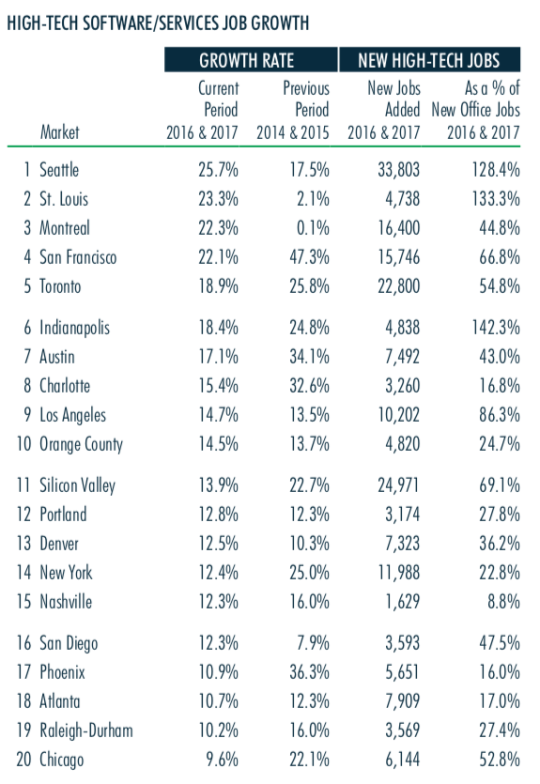
    CBRE recently published this report looking at the impact of the “high-tech software/services industry” on the North American office market. 

    Here are a few highlights:

    – Since 2010, tech has created ~1.1 million jobs in the US at an annual growth rate that is 3x the national average.

    – Seattle currently has the fastest tech job growth in North America. This is the first time in 7 years that San Francisco hasn’t been at the top of their list.

    – Silicon Valley, Toronto, New York, and Los Angeles all added more than 10,000 tech jobs from 2016 to 2017.

    – The biggest “momentum markets”, relying on 2016 and 2017 data, are Montreal, St. Louis, and Seattle.

    – Over the past two years (Q2-2016 to Q2-2018), Atlanta, Los Angeles, Orange County, Seattle, and Portland have all seen double-digit rent growth.

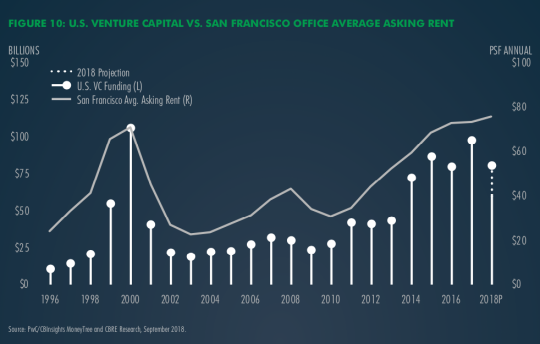
    One figure that also stood out for me was this one here showing the relationship between US venture capital investment and the average asking rent for office space in San Francisco.

    If you’d like to download the full report, click here. You’ll need to sign up for an account with CBRE, but it’s free to do that.

  • New Squarespace HQ

    I am a big fan of the company Squarespace. They have a great and beautiful product. I use them for globizen.com.

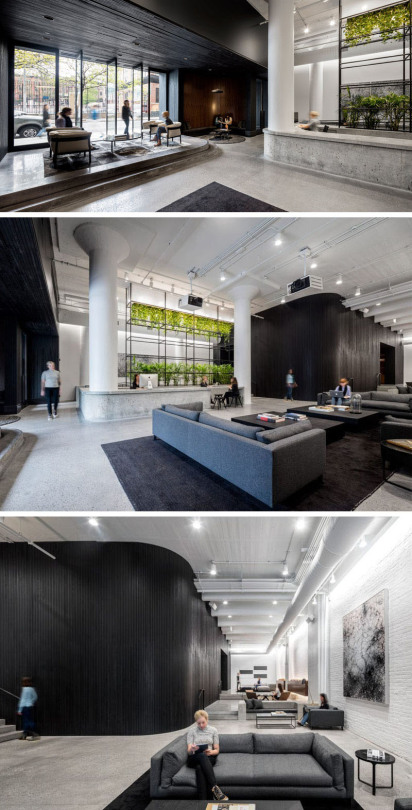
    Recently they moved into a new office in Lower Manhattan (98,000 sf), which was a consolidation of 4 distributed offices. The interiors were designed by New York-based A+I.

    Not surprisingly, it’s a beautiful space:

    image

    (Photography by Magda Biernat via Contemporist)

    But two other things stood out for me. 

    One: The amount of informal working/meeting spaces. I really had to look for the conventional office seating.

    Two: The ground floor presence and the lobby which doubles as a possible event space.

    For consumer-facing companies, I am really attracted to having a street presence and having spaces that can be programmed. It’s a way to engage and plug in to what’s happening beyond the office. Here’s a related example.

    I’m not sure if their narrative is the same as mine, but regardless: cool space.

  • Fluted glass curtain wall

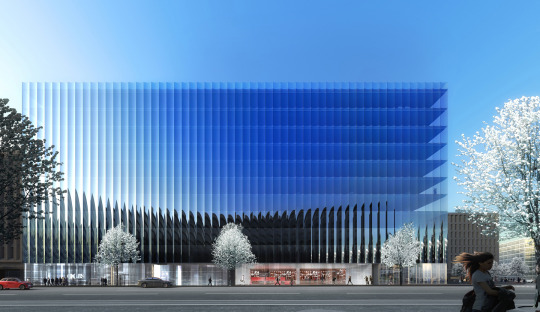
    New York architecture firm REX is working on a new office building in Washington DC that will incorporate a beautiful fluted glass facade. Here’s a rendering of what it is intended to look like:

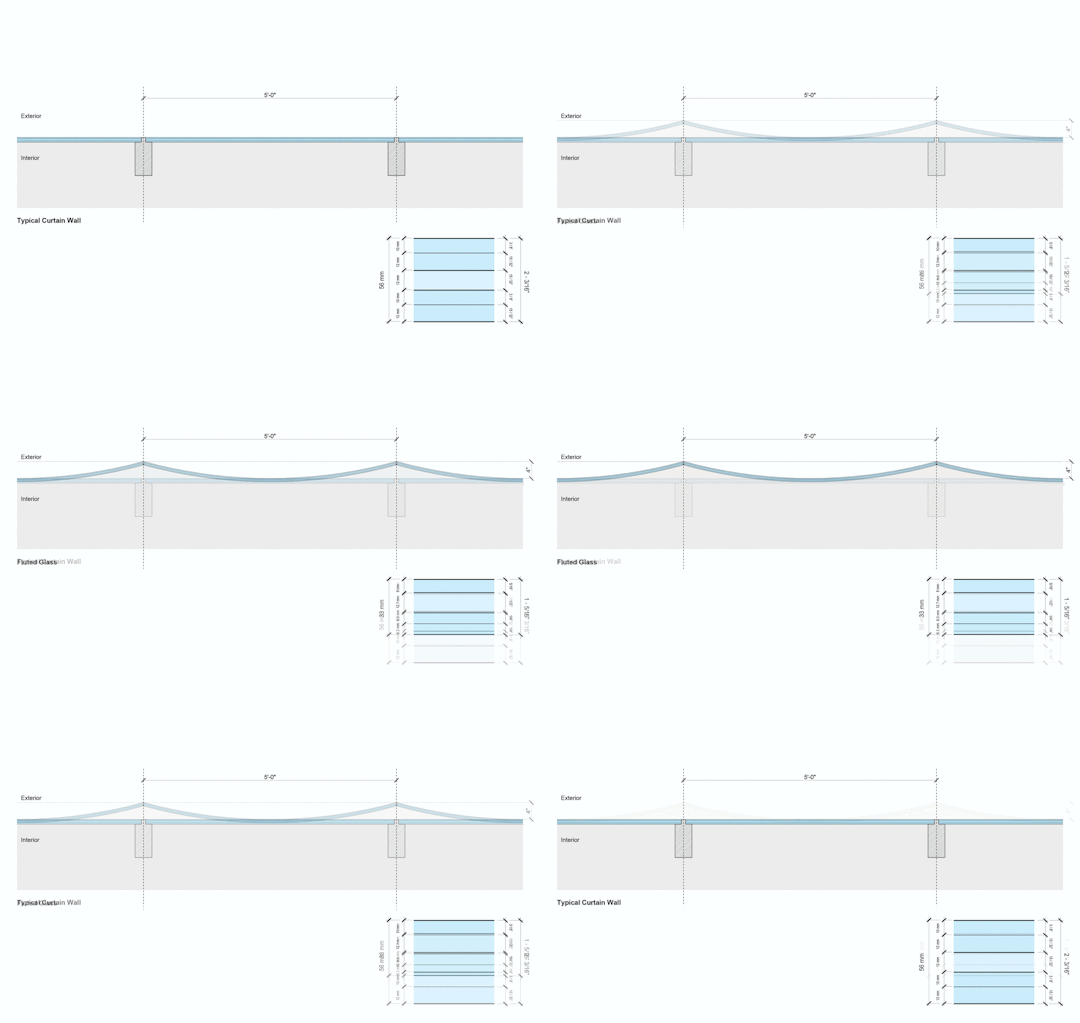
    Here’s what that looks like in plan (it’s a GIF that should show typical curtain wall vs. proposed fluted glass):

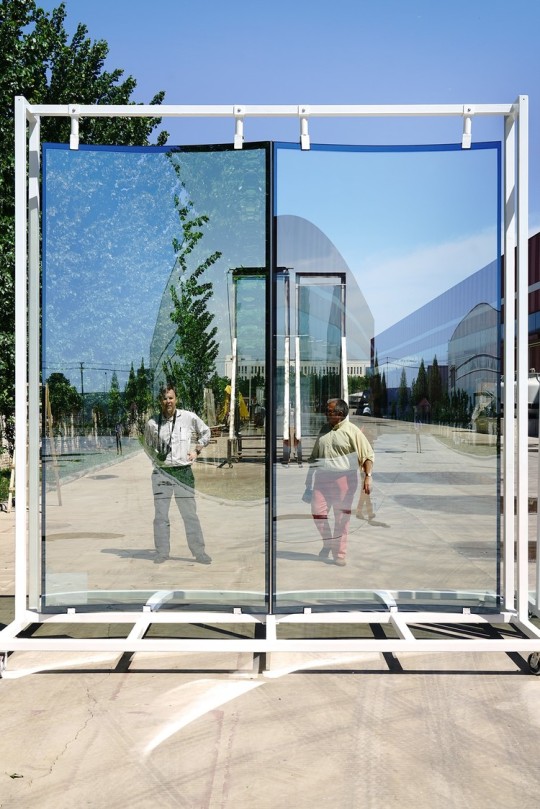
    Here’s a photo of the 1:1 mockup:

    And here’s a description from the architect:

    The façade’s approximately nine hundred identical, insulated-glass panels—3.2 m tall by 1.5 m wide (11’-6” tall by 5’-0” wide)—are subtly curved to a 2.9 m (9’-6”) radius through a heat roller tempering process. The curve yields structural efficiency, which meets wind load requirements and enables a thinner monolithic outer lite than normal, providing greater transparency. 

    Because of the curve’s inherent rigidity in compression, only the top and bottom edges of the panels are supported from the floor slabs, while the mullionless vertical edges are flush-glazed for a minimalist aesthetic that improves sight lines, while gaining usable floor area.

    They are working in collaboration with Front Inc., which if you haven’t heard of, you should check out. They are a design/engineering consultancy that specializes in facades and building envelopes. They work with many of the big name starchitects. The developer of the project is Tishman Speyer.

    It’s worth noting that part of the impetus for the fluted glass facade was to try and innovate within the confines of DC’s draconian zoning – which mandates that no building can be taller than 130 feet. Because of this, developers and architects are usually forced to build out to the allowable area, leaving little room for architectural variation. 

    But in this case, the fluted glass removed the need for thick mullions and also allowed them to extend out beyond the lot area by 4 inches every 5 feet (the curves are considered “architectural features”). So this move has created both architectural variation and more rentable area.

    It doesn’t appear that the building will have any operable windows, but other than that, I think it promises to be quite beautiful. What do you think?

    All images from REX.

  • 133 Wai Yip Street, Hong Kong

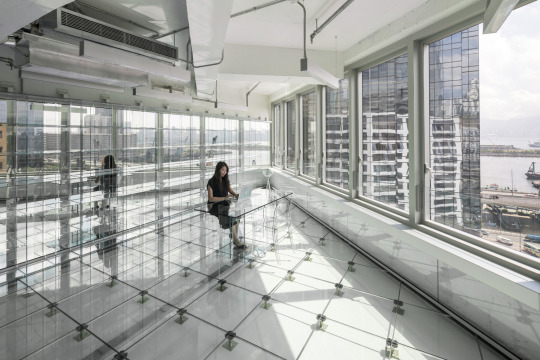
    Dutch architecture firm MVRDV recently converted an old industrial building in Hong Kong into new office space. The overall project size is roughly 200,000 sf. What’s unique about the project is the obsessive focus on transparency and glass.

    Here’s what the interior looks like:

    And here’s how the architect has described the project:

    “We are moving into a transparent society, businesses are becoming more open with the public, and people care more about what goes on behind closed doors. In that way, a clear workspace leaves nothing questionable, nothing hidden; it generates trust.” Tells MVRDV co-founder Winy Maas, “But also it is an opportunity for the building to become a reminder of the industrial history of the neighbourhood, monumentalised in a casing of glass.”

    I have written quite a bit about how I believe we are shifting towards a more transparent world – perhaps even a radically transparent world. And so it’s interesting to see an architect pick up on this broader theme and translate it into physical space.

    The floor is transparent. The partitions are transparent. The furniture is transparent. And you can clearly discern the interfaces between old and new.

    Good architecture, at least in my opinion, should reflect what is happening in our broader society. That’s why I believe that studying the history of art and architecture is really like studying the history of the world.

    For more photos of the project, click here.

    Image by Ossip van Duivenbode via MVRDV

  • Google’s new Mountain View campus [Video]

    Google wants to build a new campus in Mountain View, California. Their objective is to create a space where “people, nature and ideas” can thrive. The architects on the project are Bjarke Ingels and Thomas Heatherwick.

    Last week Google released a video talking about the ambitious project. It is a good watch and only 10 minutes. Click here if you can’t see the video below.

    [youtube https://www.youtube.com/watch?v=z3v4rIG8kQA?rel=0&w=560&h=315]

  • The demand for character office space

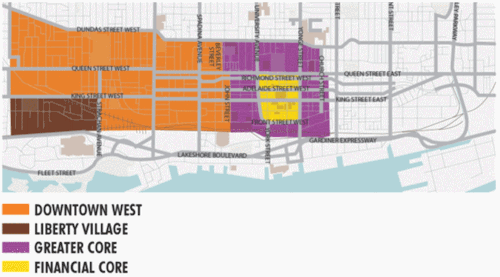
    Last Friday the Toronto Star published an article talking about the growing demand for character office buildings in submarkets outside of Toronto’s core. Specifically, it was talking about the Downtown West and Liberty Village submarkets (citing a report from CBRE).

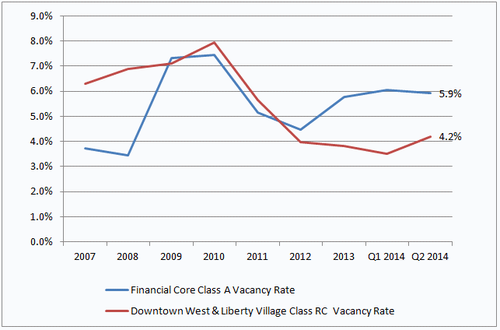
    I’m sure this isn’t news to most of you. Cool loft spaces have been popular for years. But it’s interesting to look at how rents and vacancy rates have changed for these submarkets and product types over time.

    Since 2002, average (net) asking rents for brick-and-beam buildings in the west end have gone from $16.12 to $22.23 per square foot. Almost a 38% increase. By comparison, office space in the core has gone from $28.40 to $32.38 per square foot. A 14% increase.

    And if you look at vacancy rates since 2007, you’ll see that the character office market has really tightened up over the past 4 years or so. There’s growing demand for a limited amount of supply.

    With the growth that the downtown core is seeing and with the rise of Toronto as a creative startup hub, I’m sure we’ll continue to see strong demand for this type of space. But there’s only so much of it to go around. So I think we’ll also end up seeing greater interest in the east side of downtown and also more interesting new builds.

    Images/Charts: CBRE