Daily insights for city builders, delivered every morning at 6 AM ET. I’m Brandon Donnelly — a Toronto-based real estate developer and founder of Globizen. I’ve been writing here since 2013.

Tag: office leasing

  • More than a real estate company — a state of consciousness

    Matt Levine’s most recent Money Stuff article is classic Matt Levine. It is both entertaining and informative. This one is on WeWork – the coworking startup that has committed to 14 million square feet of office space around the world and will have $18 billion in rent payments due over the next decade.

    Here is an excerpt:

    WeWork Cos. is a real-estate company with a couple of innovative twists on the model. First, rather than owning its buildings, it rents them: It leases office space from regular real-estate companies, adds … beer? … or whatever, and then subleases the space to tenants at higher rates. And second, rather than being valued like a real-estate company, it gets valued like a hot tech startup — “the sharing economy,” ping-pong tables, etc. — so it can raise gobs of money from SoftBank Group Corp. at a $20 billion valuation without ever getting particularly close to profitability. And look at all these words:

    “Indeed, to assess WeWork by conventional metrics is to miss the point, according to [Chief Executive Officer Adam] Neumann. WeWork isn’t really a real estate company. It’s a state of consciousness, he argues, a generation of interconnected emotionally intelligent entrepreneurs.”

    Really, what sort of multiple would you put on a state of consciousness?
  • Tim Hortons is moving its HQ to downtown Toronto

    Yesterday it was announced that Tim Hortons would be moving its corporate headquarters from Oakville, Ontario to downtown Toronto. 

    They’ll be taking 6,000 square meters of space in the PATH-connected Exchange Tower and moving all 400 employees by the end of this year.

    I’m more of a Starbucks coffee drinker, but I am interested in this move. Here’s what their president, Alex Macedo, had to say about it (quote from the Financial Post):

    “Consumer trends are changing very fast. We want to remain an innovative company,” he says. “We want to be able to react to guest changing behaviours so we thought being positioned in Toronto would allow us to do that.”

    This is a good follow-up to a post I wrote back in April 2015, which talked about the trend of companies moving from the suburbs to downtown Toronto. I guess that is still happening.

  • Moving downtown

    Last month it was announced that Amazon will be taking 127,000 square feet across 5 floors in a new office tower in Toronto’s emerging South Core neighborhood. The space will be used for about 800 employees and they’re expected to take occupancy this fall.

    At the same time, I learned that Amazon will be joining Apple (positioned 6 floors below them in the same tower) and Cisco in South Core.

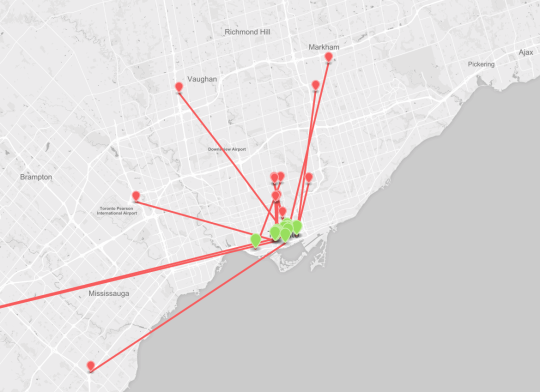
    On top of all this, a friend of mine then tweeted out a list of major tenant re-locations here in the city. The data is from CBRE and the timeframe is from 2009 to 2014 (Q1).

    The first thing I noticed when I looked at the data is that there’s a clear trend towards downtown. Perhaps that was the point of the study, but it’s still interesting nonetheless. 

    From Google and Deloitte to eBay and Aol, every single tenant in the CBRE list is or will be moving downtown (or to the shoulders of downtown).

    Here’s what that looks like from a regional scale (red marker is where they were; green marker is where they are going):

    image

    And here’s what it looks like zoomed in closer:

    image

    This, of course, is a trend that has been happening for years. But I still think it’s worthwhile repeating how clearcut it seems to be. 

    Companies know that their greatest asset is human capital. And they have quickly realized that a lot of young smart people want to live and work in dense walkable communities. They’re simply moving to where people already want to be.

    So here’s a question for the Architect This City community: On a scale of 1 to 10, how important is a company’s location when determining whether or not you’d like to work for them? Let’s talk about it in comment section below.