Daily insights for city builders, delivered every morning at 6 AM ET. I’m Brandon Donnelly — a Toronto-based real estate developer and founder of Globizen. I’ve been writing here since 2013.

Tag: office development

  • Timing matters in development

    Early on in my career, I worked on a new office development where the decision was made to start construction having only pre-leased 25% of the building. (It may have actually been closer to 22% if my memory serves me correctly.)

    Our big constraint at the time was that this first tenant had to be out of their current space by a certain date, and the only way we could meet their deadline was to immediately start construction. Otherwise, we knew we would lose them to another development or to an existing building.

    To convince ourselves that this was a reasonable thing to do, we looked at all of the upcoming lease expiries in the market, and then came to the conclusion that there would be enough demand in the coming years to fill the rest of the building.

    Still, we were taking a leap of faith, even if it was an informed one. And it meant running the project entirely on equity until we could secure a construction loan. Thankfully, in this particular instance, our hypothesis proved true. The lease expiries did end up creating the demand we were hoping for and so we were able to fill the rest of the building.

    The project was a success.

    But that was then. And in hindsight, this move feels scary. What would have happened had we made this exact same decision at the end of 2019? Things would have been very different. Not because of a fundamentally different decision on our part, but because of a black swan event that was truly impossible to predict. Our timing would have been bad.

    This is just one example of the many risks associated with the building of buildings. Development never happens in a vacuum. You’re always solving for a long list of constraints. And sometimes you need to solve for things that you don’t even know exist yet.

  • To yield or not to yield

    If you’re building a multi-family rental building, you’re almost certainly building it “on spec.” What this means is that you’re building an empty building and, once it’s done, you will then work to rent it out. (Nobody rents an apartment years in advance.) In this scenario, you will know what your costs are once the building is complete, but you won’t really know what your revenue will be until you start leasing. If demand is strong and the market has moved since you started building, maybe your rents will be a pleasant surprise. If the market has moved in the opposite direction since you started building, your rents might be an unfortunate surprise. The laneway house I recently completed is an example of a spec rental building. I built it without a tenant, but I assumed that I could rent it out upon completion. That proved to be true, but mind you it was only one unit. So it was relatively low risk.

    If you’re building an office building, it is bit more common to have some pre-leasing in place. Early on in my career, I worked on an office development where we started construction with about 25% of the leasing complete. This wasn’t enough for construction financing, but we saw that demand was strong and we needed to start right away in order to meet our lead tenant’s occupancy timing. And so we made the decision to go. We ran on equity for the first bit of construction, but once we completed enough leasing we were able to place our construction facility and lower the project’s overall equity requirement. We took a chance and everything ended up working out okay. But it could have not worked out. What would have happened if a pandemic hit after we started construction? Leasing activity would have completely stopped.

    If you’re building a condo building (at least in this city), you’ll likely be pre-selling your suites. You don’t necessarily have to do this. There are examples of well-capitalized condo developers building on spec without any pre-sales whatsoever. (Build, lock in your costs, and then sell.) But generally most developers will pre-sell, secure their construction financing, and then begin construction. In some ways this lowers your risks, as well overall systemic risk in the market. It also lowers your equity requirement as a developer. But it does create another possible risk. Once you pre-sell, you’re effectively locking in and capping your revenues. So you better have a very good handle on your costs. Otherwise you could be exposing yourself to cost escalations without any way to claw back some of your margins.

    The other thing to consider is whether you want to yield or not. Is it better to sell all of your suites as soon as possible (bird in hand) or sell only what you need, holdback the rest, and hope that prices increase going forward? I don’t think there is a right or wrong answer here. Some developers don’t want any market risk and so they take the bird in hand when they can. Other developers prefer to profit maximize and/or safeguard themselves against unforeseen costs, and so they sit on inventory. If you have unsold suites, you can always push revenues. Either way, what is hopefully clear from this post is that development is risky. This is just one example of some of the decisions that need to be made. There are countless others. Sometimes you’ll get it right. And sometimes you won’t. Hopefully the former happens more than the latter.

  • A dumpster fire in San Francisco

    This past week, San Francisco’s Proposition E was approved by 55% of voters. The measure works by limiting new office development if (or when) the city falls short of its affordable housing target for the year.

    If the city only builds 25% of its housing target (currently set at 2,042 affordable units per year), then only 25% of its annual allocation of office space can be built the following year. (I just learned that large scale office development in San Francisco has been limited to 875,000 sf per year as a result of a Proposition dating back to 1986.)

    San Francisco currently skews heavily in favor of jobs. The city creates about 8.5 jobs for every unit of new housing. And over the last decade, SF has only averaged about 712 affordable housing units per year and has never once met its target.

    So at the moment, San Francisco looks destined to start building a lot less office space. And considering that new office space actually helps to fund affordable housing, I am struggling to understand why the goal seems to be to constrain job growth.

    California State Senator Scott Wiener called Prop E a dumpster fire:

    Call me old fashioned, but I tend to think that if the goal is to build more affordable housing, you should do things that, you know, encourage the actual construction of affordable housing.

    Photo by Eduardo Santos on Unsplash

  • Fluted glass curtain wall

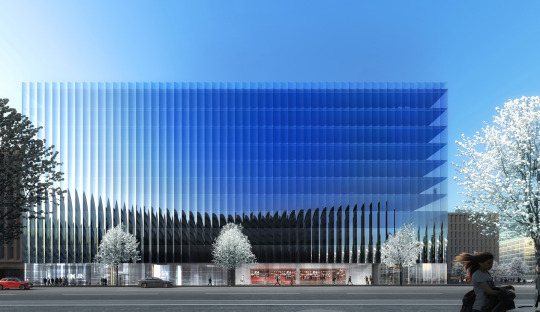
    New York architecture firm REX is working on a new office building in Washington DC that will incorporate a beautiful fluted glass facade. Here’s a rendering of what it is intended to look like:

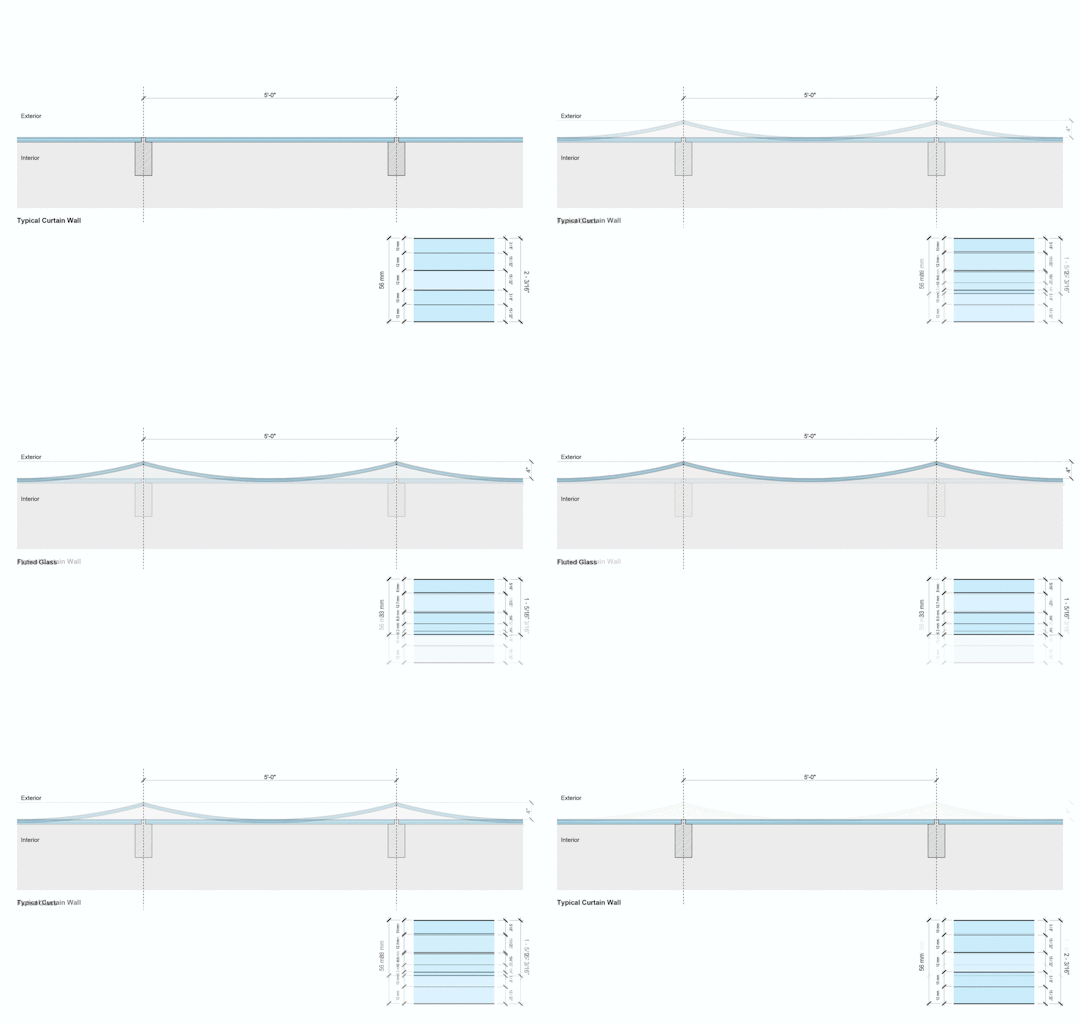
    Here’s what that looks like in plan (it’s a GIF that should show typical curtain wall vs. proposed fluted glass):

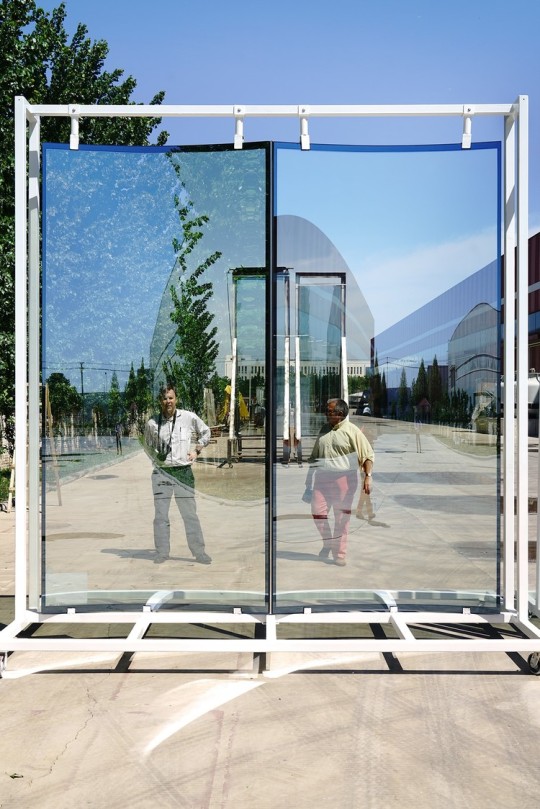
    Here’s a photo of the 1:1 mockup:

    And here’s a description from the architect:

    The façade’s approximately nine hundred identical, insulated-glass panels—3.2 m tall by 1.5 m wide (11’-6” tall by 5’-0” wide)—are subtly curved to a 2.9 m (9’-6”) radius through a heat roller tempering process. The curve yields structural efficiency, which meets wind load requirements and enables a thinner monolithic outer lite than normal, providing greater transparency. 

    Because of the curve’s inherent rigidity in compression, only the top and bottom edges of the panels are supported from the floor slabs, while the mullionless vertical edges are flush-glazed for a minimalist aesthetic that improves sight lines, while gaining usable floor area.

    They are working in collaboration with Front Inc., which if you haven’t heard of, you should check out. They are a design/engineering consultancy that specializes in facades and building envelopes. They work with many of the big name starchitects. The developer of the project is Tishman Speyer.

    It’s worth noting that part of the impetus for the fluted glass facade was to try and innovate within the confines of DC’s draconian zoning – which mandates that no building can be taller than 130 feet. Because of this, developers and architects are usually forced to build out to the allowable area, leaving little room for architectural variation. 

    But in this case, the fluted glass removed the need for thick mullions and also allowed them to extend out beyond the lot area by 4 inches every 5 feet (the curves are considered “architectural features”). So this move has created both architectural variation and more rentable area.

    It doesn’t appear that the building will have any operable windows, but other than that, I think it promises to be quite beautiful. What do you think?

    All images from REX.

  • Google’s new Mountain View campus [Video]

    Google wants to build a new campus in Mountain View, California. Their objective is to create a space where “people, nature and ideas” can thrive. The architects on the project are Bjarke Ingels and Thomas Heatherwick.

    Last week Google released a video talking about the ambitious project. It is a good watch and only 10 minutes. Click here if you can’t see the video below.

    [youtube https://www.youtube.com/watch?v=z3v4rIG8kQA?rel=0&w=560&h=315]