Daily insights for city builders, delivered every morning at 6 AM ET. I’m Brandon Donnelly — a Toronto-based real estate developer and founder of Globizen. I’ve been writing here since 2013.

Tag: ny times

  • How old do you have to be to live downtown?

    The North American rule of thumb is that young people — specifically people in their 20s — are the most likely to to live in an urban neighborhood. After that it’s all down hill and, broadly speaking, the percentages decline. But at some point, much later in life, the data suggests that there is a reversal and people start to return to urban neighborhoods, albeit not to the same extent. Part of the explanation for this is that as people age they start to look to more walkable neighborhoods where they don’t need to get a car to get around.

    But in this recent NY Times article, Jed Kolko points out two interesting trends. One, the “urban boomer” appears to be on the decline in the US. In 1990, about 21.6% of Americans aged 54 to 72 lived in an urban neighborhood (categorized by density). As of 2018, this number had dropped to around 17.8%. And two, the age at which there is a reversal (and people start returning to denser neighborhoods) is also increasing. Perhaps because people are living longer.

    Jed’s conclusion: American boomers, today, are actually less urban than previous generations.

    Graph: New York Times
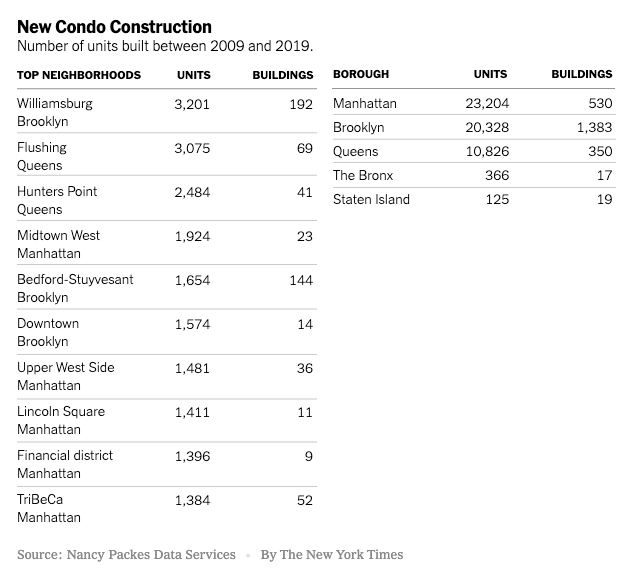
  • Number of condo units built in New York City between 2009 and 2019

    A decade of ultra luxury condos. The New York Times published this story over the weekend talking about how the luxury condo boom of the 2010s transformed New York City, and in particular Brooklyn.

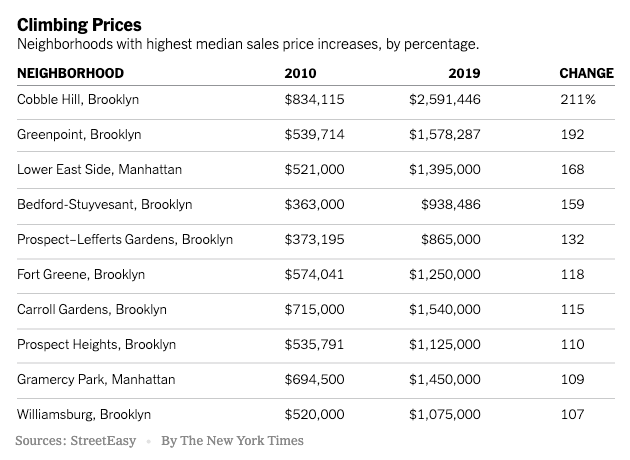
    Below are two tables from the article: (1) The number of units built between 2009 and 2019 across the five boroughs and the city’s top neighborhoods, and (2) the neighborhoods with the highest median sale price increase.

    The overarching theme is that New York built too many “super-high-end condos” geared toward global capital flows. According to one developer interviewed for the article (Gary Barnett of Extell Development), it was unprecedented.

    Apparently, the problem segment remains the $5 million to $10 million market. There’s simply too much inventory, and that has developers both delaying launches and going with much smaller (and hence more affordable) unit mixes.

    One stat that stood out for me was the new condo premium over resales. In 2011, the average sale price of a new condo in the city was about $1.15 million, which represented about a 9% premium over resale pricing.

    While it is typical to see a premium over resales (the same is true in Toronto), the average price of a new condo in 2019 rose to $3.77 million, representing a 118% premium over resales.

    For the rest of the article, click here.

  • Immaculate construction

    Emily Badger’s recent piece on “how ‘developer’ became such a dirty word” has been getting passed around within the industry over the last few days. I had a chuckle when I read this bit:

    The notion that development is inherently bad, or that developers are inherently bad actors, seems to ignore that the communities residents want to protect from developers were once developed, too, and often by people who made money at it. (That is, unless you believe in “immaculate construction.”)

    The article hits on a number of points that are absolutely true. There’s generally a lack of understanding around the economics behind new housing. And the cost structures, today, are dramatically different compared to the suburban-industrial complex.

    To provide one example, our cost consultant, Finnegan Marshall, recently shared with me a chart (dated April 2019) that broke down the various government fees that typically make up every new condo suite in Toronto.

    What it showed is that between 20-24% of the price of a new condo is generally compromised of government fees and taxes that span all three levels of government. This includes everything from development charges (impact fees) to parkland dedication.

    Similarly, the article quotes one developer from Montgomery County who estimates that the impact fees alone for his projects are usually upwards of $60,000 per housing unit. (This is pretty cheap compared to Toronto.)

    I raise this as an example because development charges/impact fees have become an important source of revenue for cities across both Canada and the US. They often offset lower property taxes. (Whether this is appropriate is an entirely other debate.)

    And so I find it paradoxical that many homeowners would like to simultaneously see lower property taxes, no new development, and more public services and infrastructure.

    Photo by EJ Yao on Unsplash

  • Zoned for detached single-family housing

    We are in West Virginia now, where the only kind of housing that we have come across is — not surprisingly — low-density, detached, and single-family.

    Indeed, approximately 75% of the residential land across the entire US is estimated to be zoned for detached single-family homes. Using data from UrbanFootprint, the NY Times recently published a series of city maps outlining the percentage of land dedicated exclusively to this housing type.

    In some cases, such as on residential corner lots in Portland, duplexes are allowed. But generally speaking, the pink corresponds to detached single-family housing. About 15% of residential land in New York City is zoned for this, compared to about 94% of the land in San Jose.

    Interestingly enough, none of the residential land in Manhattan is zoned to accommodate detached single-family housing.

  • The taxi medallion bubble

    In 1937, New York created taxi medallions as a way of dealing with the sheer volume of unlicensed cabs in the city. About 12,000 were initially sold. They cost $10. And you needed one, fastened to your car, in order to operate a taxi service.

    In 2002, the price of a medallion had risen to about $200,000, though its value had been fairly stable since about 1995. Below is a graph from a recent NY Times investigation on taxi medallions. At their peak, in and around 2014, they were worth over $1 million.

    The common narrative is that ride sharing services simply killed the value of medallions. They disrupted the taxi business. While it is certainly true that mobile apps have forever changed the way we navigate our cities, the above investigation by the NY Times has revealed something potentially more impactful:

    The medallion bubble burst in late 2014. Uber and Lyft may have hastened the crisis, but virtually all of the hundreds of industry veterans interviewed for this article, including many lenders, said inflated prices and risky lending practices would have caused a collapse even if ride-hailing had never been invented.

    At the market’s height, medallion buyers were typically earning about $5,000 a month and paying about $4,500 to their loans, according to an analysis by The Times of city data and loan documents. Many owners could make their payments only by refinancing when medallion values increased, which was unsustainable, some loan officers said.

    So at the same time that Uber was being vilified in the media for destroying the taxi business, the industry itself was working to manipulate medallion prices and shill unaffordable debt onto new immigrants. An interesting read from the NY Times.

  • The Trump family real estate empire

    He is tall, lean and blond, with dazzling white teeth, and he looks ever so much like Robert Redford. He rides around town in a chauffeured silver Cadillac with his initials, DJT, on the plates. He dates slinky fashion models, belongs to the most elegant clubs and, at only 30 years of age, estimates that he is worth “more than $200 million.” 

    Judy Klemesrud, New York Times, 1976

    Last week the New York Times published a special investigation looking at the Trump family’s real estate empire and the suspect tax schemes that they allegedly employed over the years to preserve, grow, and pass it down. 

    According to the Times, all of which has been rebuked by a lawyer for the president, Donald Trump received at least $413 million in today’s dollars from the family empire. 

    I just finished reading the investigation in its entirety. It’s a long one. But if you’re interested, you can do the same here. If you’d prefer the Coles Notes version (Cliff Notes for you Americans), have a scroll through the headlines in this article instead.

  • We are all being manipulated by behavioral economics

    Ever notice how whenever you’re taking an Uber the driver usually gets another fare just before he (Uber drivers are overwhelmingly male) is about to drop you off? That’s on purpose.

    Earlier this month the New York Times published an interactive feature describing how Uber uses behavioral economics (or psychological tricks) to encourage its drivers to work longer, take more fares, and so on.

    Here’s a quick sidebar note about behavioral economics from Francesca Gino of Harvard Business School:

    According to the traditional view in economics, we are rational agents, well informed with stable preferences, self-controlled, self-interested, and optimizing. The behavioral perspective takes issue with this view and suggests that we are characterized by fallible judgment and malleable preferences and behaviors, can make mistakes calculating risks, can be impulsive or myopic, and are driven by social desires (e.g., looking good in the eyes of others). In other words, we are simply human.

    And now back to Uber. One tactic they use is goal setting. People are drawn to goals. This translates into driver messages like this one: “You’re $10 away from making $330 in net earnings. Are you sure you want to go offline?”

    But the experiment I found most interesting from the NY Times piece is the one that Lyft completed where it discovered that showing drivers lost/dropped fares was a far more powerful motivator than showing completed rides. In other words: Look at all this money you’re losing out on by not driving!

    This finding is in line with something I’ve written about a few times before on this blog: prospect theory. One of the tenets of this theory is that “losses hurt more than gains feel good.” We, humans, tend to focus more on the former.

    Of course, Uber is not alone in employing behavioral economics. Every app on your phone is being continuously optimized so that it gets as much of your attention as possible. But where is the line between encouragement and manipulation?

    If you’re interested in this topic, check out this HBR article called, Uber Shows How Not to Apply Behavioral Economics.

  • New York YIMBY

    Yesterday a friend of mine sent me this NY Times article covering a site called New York YIMBY.

    I’ve spoken about the term YIMBY before and this site is exactly that: a site dedicated to “saying yes in my back yard” to new development in New York. It was founded by 23 year old Nikolai Fedak and currently receives 75,000 monthly visitors. He has plans to expand to other cities and I’ve already emailed him to see if he has any plans for a Toronto YIMBY.

    At a time when it’s common to hate on developers and new developments, it’s refreshing to see a site dedicated to the exact opposite. That’s not to say that all developments are good (New York YIMBY has no problem blasting the ones that suck, as it should), but it’s certainly framing development as a positive thing for cities. 

    In growing cities like New York and Toronto, development is going to happen. And so I would rather we focus on how to make it happen in the best way possible instead of just saying no.