Daily insights for city builders, delivered every morning at 6 AM ET. I’m Brandon Donnelly — a Toronto-based real estate developer and founder of Globizen. I’ve been writing here since 2013.

Tag: new york university

  • What’s next for cities? Probably more of the same.

    I am surprised, although maybe I shouldn’t be, by how quickly many seem to be allegedly turning their back on cities. According to the New York Times, cities were “losing their allure” well before this pandemic, and this might just be the tipping point. The underlying argument: Density is bad. We should probably all move somewhere bucolic, where the cost of housing is less and work isn’t so stressful. Zoom only when necessary.

    But as the chief economist for Indeed, Jed Kolko, rightly points out in the article, how people behave (and think) during a global pandemic is probably not a great indicator for how they will want to live their lives when this is all over. It’s also not clear that urban density is really the contributor of spread. Hyper-dense cities such as Seoul and Hong Kong have been performing relatively well. (Joe Cortright has some thoughts on this.)

    Once we get to the other side, we will see the data and we will get a better understanding of this current situation. And then in hindsight, we will find ways to rationalize the outcomes to ourselves. In the interim, I’m not about to bet against cities. Here’s how Paul Romer, professor at New York University, put it in this recent interview in City Journal:

    “I think the underlying economic reality is that there is tremendous economic value in interacting with people and sharing ideas. There’s still a lot to be gained from interaction in close physical proximity because such interaction is a large part of how we establish trust. So I think that, for the rest of my life, cities are going to continue to be where the action is.”

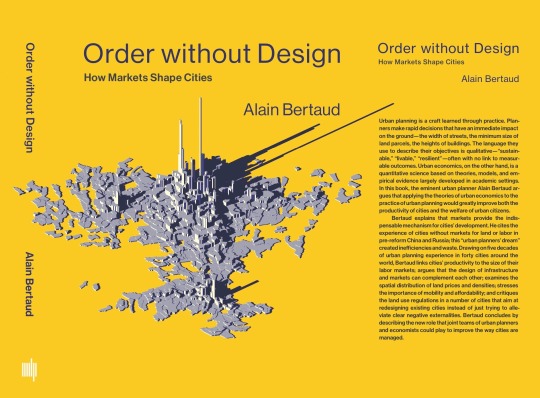
    Photo by bady qb on Unsplash

  • Atlas of Urban Expansion

    Since 2012, a team at New York University has been working on something called the Atlas of Urban Expansion. What they are doing is collecting and analyzing data related to the quantity and quality of urban growth around the world. Everything from population densities to how well the streets were laid out during each geographic expansion.

    The Atlas defines a city as having at least 100,000 people, which is a commonly used benchmark. According to this definition, there were 4,245 cities on the planet as of 2010. Included in their study is a representative sample of 200 of them, all of which can be found here.

    They are also, rightly, looking at each city in terms of its extrema tectorum — the limits of its built-up area. This is as opposed to using administrative boundaries, which wouldn’t be as relevant in a study like this.

    I really like the animations that they created depicting urban growth from 1800 to 2014, because they show: (1) where each city started (the dark nucleus); (2) how different urban shapes emerge as a result of geography, transport, and other factors; and (3) how land consumptive many of our cities have become in recent years.

    Image: Atlas of Urban Expansion

  • Order without Design

    Alain Bertaud has a new book coming out later this year from MIT Press called, Order without Design: How Markets Shape Cities. If you’re based or happen to be in New York, there’s a book launch on Tuesday, December 11, 2018 at NYU. You can RSVP here

    The book argues that, “operational urban planning can be improved by the application of the tools of urban economics to the design of regulations and infrastructure.” I haven’t read it yet and it’s not available until December, but I’ve just added it to my reading list.

    I am of the opinion that none of us involved in the built environment should be working in insolation, without some understanding of the myriad of other forces shaping our cities. Cities are too complex and important for narrow views.

    From what I’ve read about this book, it subscribes to that philosophy. And so I’m giving it a place in the queue.

    Image: NYU

  • Invisible walls

    image

    This is an interesting working paper by a team of researchers at NYU’s Marron Institute of Urban Management. The paper examines the relationship between urban density and organized violence, first in Colombia and then within a sample of 200 global cities.

    The finding is that organized violence actually increases the population density of the surrounding areas within a city because it creates a kind of “invisible wall” – effectively a no-go zone.

    This makes perfect intuitive sense, but it’s not something I ever considered. Geography and other natural constraints typically drive density. Think about the island of Manhattan. But so too can invisible walls.

    For the full working paper, click here.

    Photo by Joel Duncan on Unsplash

  • Thoughts on inclusionary zoning

    Ontario is looking to pass legislation that would allow municipalities in the province to implement something known as inclusionary zoning. If passed and should municipalities decide to use this tool (Toronto almost certainly would), developers would then be required and/or incentivized to include some percentage of affordable housing in their new market rate developments. 

    Politically, inclusionary zoning tends to be popular. It’s believed to be a way for governments to create new affordable housing using relatively small public subsidies. Not surprisingly though, the development industry generally hates IZ. It’s another cost that needs to be added to the development pro forma – though some municipalities rightly offset these additional costs with additional density, breaks on levies, and so on.

    What I always think about when this topic comes up is the broader economic impact of the land use policy. Because I’m suspect that it’s as simple as: mandate affordable housing; get more affordable housing for free. Generally there are always trade-offs.

    So here’s some reading material for you all this morning.

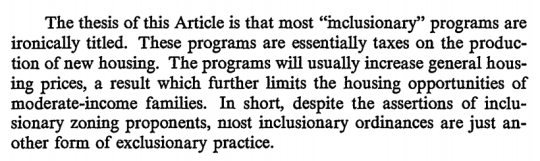
    In a classic paper (1981) by Yale Professor Robert C. Ellickson – called The Irony of Inclusionary Zoning – he argues that these practices can actually increase general house prices:

    image

    As a counterargument Owen Pickford over at The Urbanist argues that IZ simply reduces land prices as a result of the new tax. Land, after all, is the residual claimant. Therefore, he believes it’s an effective affordable housing policy. (I’m not so sure I believe that land prices would decrease in practice.)

    There’s also debate about the effectiveness of inclusionary zoning to actually deliver affordable housing at a meaningful scale. City Observatory wrote a post that looked at the total number of units produced (through IZ) across a number of American cities and the results were spotty. It should, however, be noted that not all inclusionary zoning policies are mandatory.

    Finally, the Furman Center for Real Estate & Urban Policy at New York University published a housing policy brief back in 2008 that looked at this exact topic. While they admit that the data is scarce, they come to the conclusion that IZ had no meaningful impact on the prices and production of single-family housing in San Francisco, but that IZ seems to have slightly decreased production and slightly increased pricing in the suburbs of Boston.

    What this last point suggests is that inclusionary zoning policies are not all created equal. So like all difficult questions, the answer to this one is likely: it depends. If anyone can point me to better data on inclusionary zoning, I would love to see it.

  • [Video] Gang of Four

    Scott Galloway, professor of Marketing and Brand Strategy at NYU Stern, recently delivered a presentation on the Gang of Four: Apple, Amazon, Facebook, and Google. These dominant companies are also often referred to as the “Four Horsemen.”

    The video is about 16 minutes long and I would highly recommend that you give it a watch.

    It’ll be like drinking from a firehose, but there are so many fascinating takeaways. You’ll also quickly discover how far reaching the societal impacts of these companies have been and will likely be in the future.

    If you can’t see the video below, click here.

    [youtube https://www.youtube.com/watch?v=jfjg0kGQFBY?rel=0&w=560&h=315]

  • The crisis of success

    I’m back and it feels great. I missed blogging the past 2 days. Though, there was something nice about not touching a computer all weekend.

    This morning I got up extra early and listened to a brief conversation between Aaron M. Renn of The Urbanophile and urbanist Richard Florida. The topic is New York’s “Great Reset”, and the impetus was a recent report (of the same name) that was put out by New York University.

    The conversation starts by talking about the resilience of New York City and its ability to accept and then reinvent itself in the wake of “creative destruction.” Destruction such as the financial crisis of 2008/2009. 

    But they then go on to talk about the challenges that New York, as well as many other cities, are now facing. Challenges brought about, not by failure, but by their tremendous success. Challenges such as income inequality and the dwindling middle class.

    The overarching premise is that we are still in the early stages of a new urban and creative economy. And that there’s lots of work to be done in order to figure out how to make it an inclusive one.

    There’s even mention of former Toronto mayor, Rob Ford.

    You can listen to the talk below. If you can’t see the embedded play button, click here.

    [soundcloud url=”https://api.soundcloud.com/tracks/221338706″ params=”color=ff5500″ width=”100%” height=”166″ iframe=”true” /]

  • L.A.T.

    In case you needed one more piece of evidence that household and family dynamics are changing, here’s a relationship arrangement that you may not have heard of but that’s seemingly growing in popularity: living apart together.

    Essentially, it’s when a couple is together, but has decided to live in two separate places, which could mean down the street, in another neighbourhood, or in a completely different borough.

    This may sound odd, but:

    “The arrangement has surprising appeal, perhaps because it protects against the constant churning in people’s domestic lives,” said Mr. Klinenberg, a sociology professor at New York University. “Many people who live alone are in relationships that are quite meaningful. And the arrangement is especially attractive in New York, which has such a thriving public culture and little stigma about how people live their lives.”

    This certainly reinforces the trend towards more and more people living alone – creating an obvious impact on housing typologies. But it’s not something I see as being desirable. Perhaps because I haven’t been divorced 3 times and become sufficiently jaded towards the institution of marriage.

    What do you think of this? Would you do it?