Daily insights for city builders, delivered every morning at 6 AM ET. I’m Brandon Donnelly — a Toronto-based real estate developer and founder of Globizen. I’ve been writing here since 2013.

Tag: new year

  • Happy new year

    We checked into a hotel in Montréal last night and I discovered this room service robot sitting next to the elevators. I have been told that if you ask it nicely, it will deliver champagne to your room. But I have yet to confirm this invaluable service.

    Montréal is one of my all-time favorite cities. I have been coming here regularly since I was a teenager and I have always felt uniquely drawn to it. It is the history, the urban grandeur, and the way that it feels effortlessly sexy. Not many cities are like this.

    So I’m happy to be ringing in the new year with family in this great city. Happy new year, everyone.

  • The Great Dispersion

    It’s that time of year again. It’s time to make predictions for the upcoming year and time to look back on the ones we all got wrong from a year prior. I don’t recall many people (if any) predicting that a pandemic would cripple the global economy.

    I like how Scott Galloway put it in his 2021 predictions post. It’s obviously better to be right than wrong, but it’s okay to be wrong. The value in writing down your thoughts is that it forces you to think. It’s the reasoning that matters. (It’s one of the reasons why some people write blogs.)

    A key theme in Galloway’s predictions post is something that he calls “The Great Dispersion.” This involves two things: (1) The physical distribution of products and services over wider areas and (2) the bypassing of gatekeepers and other intermediaries (which is something the internet has always been good at).

    You could interpret this as being directly antithetical to cities. Urbanism, after all, is all about agglomerations. But I think it’s more nuanced that that. Cities have generally always had both centralizing and decentralizing forces. The two can co-exist.

    I will get into this in more detail in my own 2021 predictions post. But in the mean time, I would encourage you check out what Scott Galloway recently published, over here. And if any of you have any thoughts about what’s in store for us in 2021, please leave a comment below.

    Don’t worry, it’s okay if you’re not right.

  • The re-allocation of capital (and predictions for this decade)

    I have stayed at two hotels over the last month where I did not need to interact with a human as part of the check in process. And in one of those two instances I didn’t even need to interact with a computer at the hotel.

    My room key was issued to me through an app and I used that (and Bluetooth) to open my hotel room door (after the app, of course, notified me that my room was ready).

    This is prediction #2 in Fred Wilson’s annual roundup of what is going to happen next in the world. Automation is reducing the costs associated with operating many businesses. Who is going to be the beneficiary of this consumer surplus?

    The other prediction that should interest most of you — because the impacts would be widespread — is this one here regarding climate change:

    The looming climate crisis will be to this century what the two world wars were to the previous one. It will require countries and institutions to re-allocate capital from other endeavors to fight against a warming planet. This is the decade we will begin to see this re-allocation of capital. We will see carbon taxed like the vice that it is in most countries around the world this decade, including in the US. We will see real estate values collapse in some of the most affected regions and we will see real estate values increase in regions that benefit from the warming climate. We will see massive capital investments made in protecting critical regions and infrastructure. We will see nuclear power make a resurgence around the world, particularly smaller reactors that are easier to build and safer to operate. We will see installed solar power worldwide go from ~650GW currently to over 20,000GW by the end of this decade. All of these things and many more will cause the capital markets to focus on and fund the climate issue to the detriment of many other sectors.

    For the rest of Fred’s predictions, click here. These are always great reads.

  • New York City’s retail vacancy problem

    The New York Post has some interesting articles, here and here, on the growing retail vacancy problem in NYC. (Thank you Michael for the link in the comments this week.)

    The vacancy rate on Amsterdam Avenue in the Upper West Side is said to be around 27% and it is said to be around 20% on a stretch of Broadway in Soho. It has become such a problem that Mayor Bill de Blasio wants to implement some sort of retail vacancy tax:

    “I am very interested in fighting for a vacancy fee or a vacancy tax that would penalize landlords who leave their storefronts vacant for long periods of time in neighborhoods because they are looking for some top-dollar rent but they blight neighborhoods by doing it,” he said on WNYC. “That is something we could get done through Albany.”

    But this is based on the assumption that greedy landlords are simply holding out for exorbitant rents. It doesn’t consider the fact that, maybe, there is simply too much retail space:

    Only a few grasp the true scope of the problem. Vornado Realty Trust titan Steven Roth said we can only cure the national plague through “the closing and evaporation” of up to 30 percent of the weakest space — which would take five years.

    All of this, of course, has me thinking about the future of ground floor main street retail. What are your thoughts?

  • The emotional journey of creating anything great

    Welcome to 2017. (We better have flying cars by 2020 or I’m going to be pissed.)

    I found the following chart on Howard Lindzon’s blog. It’s called “The Emotional Journey Of Creating Anything Great" and it’s getting shared around town right now.
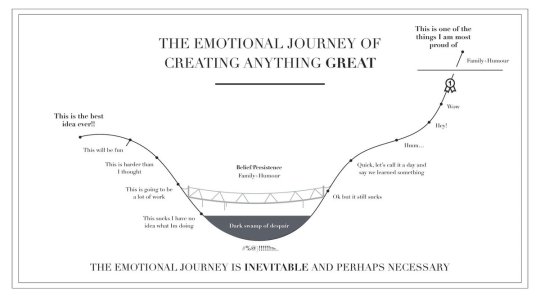
    I’m sure that you’ve seen other similar charts before, but it doesn’t hurt to drive home this point, particularly as all of us kickstart the new year and promise ourselves that we’re going to be better, faster, stronger.

    The point of this chart is that when you’re creating anything new and great, there will always be the period of time that this diagram refers to as the “dark swamp of despair.” This is where you question your life decisions and wonder if you’re wasting your time trying to create this new and great thing.

    I never fully appreciated this phenomenon until I worked on a startup. Though for me, it felt more like a manic depressive rollercoaster. One week I was killing it and the next week I was in a dark swamp of despair searching for a way out. 

    And it’s because when you’re creating something new, you have few, if any, points of reference to reassure yourself that you’re on the right path. If it is truly great, then it’s probably something novel. And if it’s new, then by definition it hasn’t been done before. So it is unknown whether it’s truly a dark swamp of despair or if it just feels that way right now because things are tough.

    Because of the emotional nature of this journey, I have found myself really questioning the worth of things like caffeine and alcohol. I used to think the former made me more productive – the latter certainly doesn’t – but I’m not so sure that is the case. So as an experiment, I cut out coffee last month.

    I don’t believe in new year’s resolutions, so that’s not what all of this is about. It’s far better to talk about the things you’ve remained committed to, than to talk about the things you’re planning to do.

    This is simply a reminder that there will always be ups and there will always be dark swamps of despair. The key is to have the confidence and conviction to charge through those swamps any way you can. Onward my friends. I’m really looking forward to 2017 and I hope you all are as well.

  • Are you challenging yourself personally?

    I’m not a huge believer in new year’s resolutions, as I much prefer the idea of continuous goal setting and improvement. But I like Mark Zuckerberg’s tradition of pursuing one “personal challenge” every year. One year it was to learn Mandarin. And this year it was to build a personal artificial intelligence tool. If you’re interested in AI, you can learn about the experience and his takeaways in this post.

    I am definitely interested in AI, but right now I’m actually thinking about his approach to personal challenges. This is a time of year when many of us are looking back at what we accomplished over the last 12 months and thinking about what we would like to accomplish in the next 12 months, as well as beyond. I know that I was doing some of that this past weekend. 

    I managed to check off many/most of the items on my 2016 list, but full disclosure: some of them are getting punted to 2017. I also modified certain items. I originally wanted BARED (Becoming A Real Estate Developer) to be a book, but instead it transformed into a new blog series. My most recent BARED post can be found, here.

    However, as I look back at all of the lists I’ve been making, I realize that virtually all of the goals are work related. They’re about completing this, growing that, and so on. That’s obviously important, but what about personal growth? Sure, one could argue that learning Mandarin is actually a prudent business move, but Zuckerberg claims to have been motivated more by personal reasons. And that’s great.

    So I’m revisiting my lists and thinking about ways in which I can challenge myself to grow not just as a professional, but also as a person. Right away, photography comes to mind as an obvious personal challenge, but I’d like to give it a bit more thought. If Mark Zuckerberg can find the time, then there’s no reason that you and I can’t as well.

    Do you have your own set of lists that you keep?

  • Tweet of the Week: The Creation of Manchester

    I may never do another “Tweet of the Week” on ATC, but I couldn’t resist sharing this one of New Year’s Eve on Well Street in Manchester’s city centre.

    //platform.twitter.com/widgets.js

    The photo was taken by Joel Goodman and first appeared in this online picture gallery.

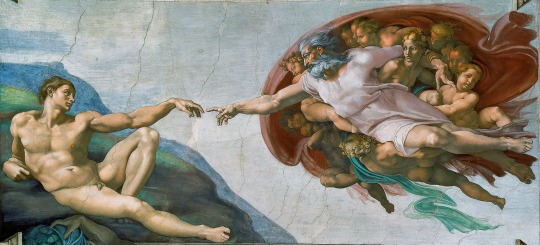
    But then Roland Hughes of the BBC remarked that its composition was similar to a Renaissance painting and that the guy in blue laying in the middle of the street, reaching for his beer, could be thought of as a parody of the reaching God in Michelangelo’s The Creation of Adam. So he tweeted it out. Since then it has gone viral.

    For those of us who weren’t in Manchester on New Year’s Eve, we clearly missed one epic party.

  • That’s a wrap

    Today is the last day of 2014.

    It felt like a frenetic year for me, and so I have to say that I’ve been really enjoying this holiday break. I needed the downtime. I needed the time to think and strategize. And I got all of that this holiday. (The only thing that would make this break even better would be some more snow on the mountains.)

    I’m super excited for the new year and what’s ahead, but before getting into that, I thought it would be worthwhile to look back at what happened in 2014.

    I was initially going to list out some of my thoughts, but then I figured that a better way would be to simply list out the most read Architect This City posts. That way it’s my (daily) thoughts, but curated according to what readers cared about most this past year.

    Click here for the top 15 most read Architect This City posts of 2014. I’ve listed them on a “topics” page that I plan to update every year.

    If you’re looking for some other 2014 themed reading material, I recommend also checking out the best #cityreads of 2014 by CityLab; the best articles of 2014 from ArchDaily; and what just happened? by venture capitalist Fred Wilson.

    Happy new year everyone! Thanks for reading. See you in 2015.

    Image: Family and friends lunch at Pizzeria Libretto, University