Daily insights for city builders, delivered every morning at 6 AM ET. I’m Brandon Donnelly — a Toronto-based real estate developer and founder of Globizen. I’ve been writing here since 2013.

Tag: new housing

  • Price of a new condominium in Toronto increased 12.5% over the last year

    This morning BILD and Altus Group released their January 2019 new home sales figures for the Greater Toronto Area.

    Here are the highlights:

    • 1,362 new homes sold in January 2019 across the GTA. This is up 14% compared to last January.
    • Of these, 942 (~69%) were condominiums (includes low, mid, and high-rise, as well as townhouses). And 420 (~31%) were single-family homes (includes detached, semi-detached, and freehold townhouses).
    • Condominium sales volume is sitting only about 5% below the 10-year average and the benchmark price increased this month to $803,638, which represents a 12.5% year-over-year increase.
    • On the other hand, single-family home sales are down about 53% from the 10-year average and the benchmark price decreased by about 8.1% compared to last year. It is sitting at $1,130,046.

    While there continues to be a bifurcation in the new home market, we are seeing improvements across the board and the data is consistent with Altus’ prediction that 2019 will see an increase in overall sales.

    It is also important to consider how geography might factor into the above numbers. Here are the January sales numbers for the last three years broken down by region within the GTA:

    Just under 80% of the new condominiums sold last month took place in Toronto, whereas only about 1.2% of the single-family homes sold last month took place in the city. You can count them on one hand. There were only 5.

    So rather than just look at this in terms of housing type, I think the other way to interpret the data is that it could suggest strong and continued demand for centrally located and transit-oriented communities.

    And that just so happens to translate into a condominium.

    Photo by Eugene Aikimov on Unsplash

  • Housing supply and displacement in San Francisco

    Joe Cortright recently wrote about a study by Kate Pennington (UC Berkeley), which looked at the impact of housing production on legal eviction in San Francisco. The goal was to figure out if new housing supply actually causes displacement.

    To do this, Pennington went block-by-block and looked at new housing projects, as well as over a decades’ worth of eviction notices. 

    The relationship between the two was found to be “statistically indistinguishable from zero.” In other words, the “monthly probability of an eviction notice” does not change when new housing supply is completed nearby.

    Some have been critical of her findings and some have questioned whether legal eviction notices are, in fact, the right proxy for displacement.

    But I agree with Joe Cortright in that this still feels like a meaningful relationship to understand, especially when we’re talking about a tight housing market like San Francisco’s.

    Photo by Matthew Cabret on Unsplash

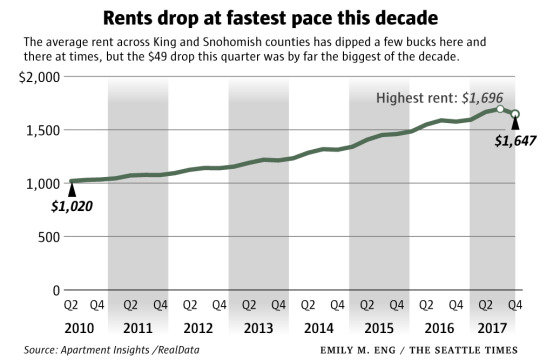
  • Why are apartment rents in Seattle dropping?

    This week I saw it reported that in this decade alone, the Seattle area is set to deliver more new rental apartments than it did in the prior 50 years combined. 

    And as a result, the sentiment is that new housing supply is finally starting to keep pace with demand and put downward pressure on rents. 

    Do you remember who was the crane capital of the US a year ago? They may still have that title.

    In some of the most desirable neighborhoods of Seattle – where much of the new supply is coming online – rents dropped 6% compared to the prior quarter. At the county level, this last quarter was by far the biggest drop of the decade according to the Seattle Times.

    Funny how that works.

    It’s also worth noting that the US as a whole is building far more rental apartments than condominiums. Here is a post I wrote in August 2015 which pegged condos as a percentage of overall multifamily construction at around 5.5%. That’s a tiny percentage.

  • 2017 was a record year for housing starts in Canada, but…

    According to Bloomberg (using data from CMHC), 2017 was a surprising record year for housing starts in Canada: 219,675 units. This is the most since 2007 and is up from 197,916 units in 2016.

    The explanation: job growth (nearly 400,000 new jobs) and population growth were both more robust than expected.

    Multiple unit project starts are also up significantly with 142,840 units starting in 2017. This is a 15% increase from the prior year. Of these units, 102,516 of them were “apartment-like homes.”

    But all of this is nationwide data. Look at what happened in Toronto and Vancouver:

    The increased activity mostly sidestepped land-constrained Toronto and Vancouver, the country’s two most expensive markets, but was robust in the suburbs and less pricey surrounding cities. Starts in Toronto fell 1 percent to 38,738 in 2017, while declining 6 percent in Vancouver to 26,204 units.

    This is not because of a lack of demand. It’s becoming systematically more difficult and more costly to build new housing in these two markets.

  • The year of the condo

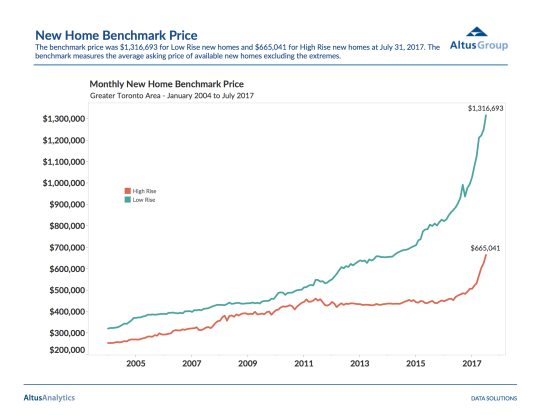
    Over the past 5 years or so, real estate headlines in the Greater Toronto Area have often focused on the rapid appreciation of low-rise housing. High-rise housing simply wasn’t appreciating at the same rate – at least in aggregate terms.

    But 2017 has brought a different story. 

    If you look at BILD’s “New Homes Monthly Market Report” (data provided by Altus Group as of July 2017), you can see that high-rise pricing is now on a similar trajectory to low-rise pricing.

    Here is that graph:

    image

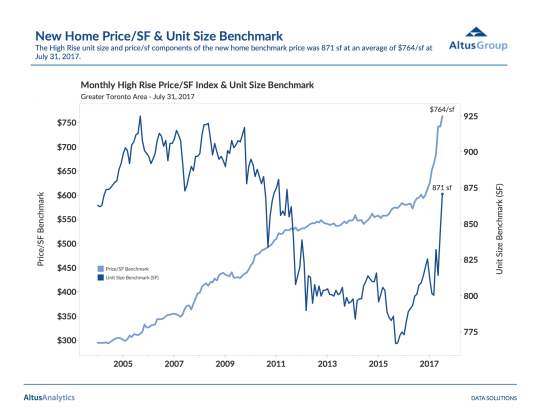
    This sharp uptick in pricing is also apparent when you look at the average price per square foot of new high-rise inventory. As of July, it was $764 psf across the GTA. See below.

    At the same time, average unit sizes have also jumped up to 871 square feet. So not only are new high-rise homes becoming more expensive on a normalized basis, they are also getting bigger, which further increases prices.

    image

    I recognize that we’re only seeing data up to the end of July, but, from the looks of it, 2017 is shaping up to be an extraordinary year for the condo.

    Of course, part of the reason this is happening is because remaining inventory for both low-rise and high-rise product is hitting 10-year lows. We’re back to the topic of supply.

    If you’re curious how some of these numbers have changed from the month prior (June 2017), check out this post.

  • Market vs. subsidized

    Miriam Zuk and Karen Chapple of the University of California, Berkeley, recently published a research brief called Housing Production, Filtering and Displacement: Untangling the Relationships

    It’s a nuanced look at the impact of both market-rate and subsidized housing production on affordability and displacement within the San Francisco Bay Area.

    The report is essentially a response to the debate around whether increasing market-rate housing production alone can address affordability and displacement concerns, or whether the only way to do it is through subsidized housing. What they found was that both matter, but…

    “What we find largely supports the argument that building
    more housing, both market-rate and subsidized, will
    reduce displacement. However, we find that subsidized
    housing will have a much greater impact on reducing displacement
    than market-rate housing. We agree that market-rate
    development is important for many reasons, including
    reducing housing pressures at the regional scale and housing
    large segments of the population. However, our analysis
    strongly suggests that subsidized housing production is even
    more important when it comes to reducing displacement of
    low-income households.”

    If you’re interested in this topic, I recommend reading the full brief. It’s only 12 pages. I particularly liked the information around filtering and how new housing steps down over time to ultimately serve lower-income households.

  • More thoughts on inclusionary zoning

    Alan Ehrenhalt recently published a balanced piece in Governing that largely reflects my own views on inclusionary zoning. It’s called: Why Affordable Housing Is So Hard To Build.

    His argument is that there are lots of cities trying to build more affordable housing, but that most strategies have not yet proven to be all that successful.

    I’ve written a few posts on inclusionary zoning. The most recent is this one. And though I believe that a mix of incomes is a critical component of good city building, I am having a hard time believing that inclusionary zoning is the silver bullet that will get us there. Admittedly, it sounds like a great idea. But how does that translate into reality?

    Here’s a snippet from Alan’s article (shout out to Daniel Hertz of City Observatory who seems to get cited in almost every article I read these days):

    Just about every city that has tried an inclusionary zoning law in recent years has had a similar experience. In some cases, the results have been much worse. According to BAE, Chicago’s inclusion law produced $19 million in 11 years, but only 760 affordable units. Thirteen years of inclusionary zoning in Seattle brought the city $31.6 million in fees and a grand total of 56 units. As the urbanist Daniel Hertz wrote recently, inclusionary zoning has been “more powerful as a symbol than as a way of helping people.”

    Of course, the devil is in the details. Many inclusionary zoning policies allow cash in lieu of actual housing:

    San Francisco actually has had an inclusionary zoning law since 2002, and it has been a flop. It mandates a 12 percent affordable set-aside, but allows developers to escape the mandate by paying a fee to the city. As in Arlington, this is what they have done. A study by the research firm BAE Urban Economics found in 2014 that after 12 years the San Francisco law had brought in $58.8 million in developers’ fees and had generated 1,560 units. That’s better than nothing, but it’s a drop in the bucket for a city facing an affordability problem in virtually every neighborhood.

    All this said, I’m still not so sure that it’s as simple as eradicating the cash in lieu option and forcing mandatary inclusionary zoning. As Alan rightly points out in his article, if we set the bar too high, then all of a sudden it starts making some market rate housing infeasible to build. 

    And if this ends up lowering the overall supply of new housing, then we could be hurting affordability while at the same time trying to mandate more of it. Does that make sense? Clearly this is not as simple as it may seem.

    I get the appeal for cash poor cities. It sounds like free affordable housing. But I’m always suspect of “free” lunches. In any event, I think we can all agree that this is an important discussion to be having.

  • Why multi-family developers are shifting their customer focus

    One aspect of the Toronto housing market that I’ve been paying close attention to is the adoption of multi-family dwellings by both long-term end-users and families. 

    I’ve written about this before (here and here, over a year ago) and have argued that here in Toronto we are at an inflection point. Multi-family dwellings – both rental and condo – are evolving to now target these new customer segments. Whereas previously, the new construction multi-family housing market was heavily geared towards investors and first-buyers. And often it was simply a stepping stone towards a single family home.

    Now, every city and real estate market is different. And I have heard many people in U.S. cities say that Millennials are simply deferring what we saw with previous generations. At the end of the day they (or we, I’m a Millennial) are going to move to the suburbs and buy that car. The current trends we are seeing around city living and reduced driving are just that – short-term current trends.

    But I think it’s worth reiterating: I do not believe that the status quo is what’s happening right now in Toronto. And I’m sure it’s also happening elsewhere. Time and time again I speak to developers in this city who are starting to shift at least some, and in some cases all, of their focus towards end-users, families, and larger units – particularly for new mid-rise product in the “neighborhoods.”

    And if you think about it, this makes perfect sense. 

    The average price of a detached single family house in Toronto is well north of a million dollars. So when a developer brings to market a 1,200 sf family sized apartment at $600 psf ($720,000) or even at $700 psf ($840,000), that home now becomes a relatively “affordable” option in many desirable areas of the city. Particularly if you value location amenities and your time (i.e. shorter commutes) over raw quantity of space. I know I certainly do.

    I know this isn’t going to appeal to everyone. But there is a big market here. Get ready.

    What are you seeing in your city? Let us know in the comment section below.

  • What tax policy could be doing to home sizes in Ontario

    Golden City (of Toronto) by Evgeny Tchebotarev on 500px.com

    https://500px.com/embed.js

    In yesterday’s post I made a remark that we have antiquated tax policies here in Ontario that encourage the building of smaller new construction condominiums. There seemed to be a lot of interest in that comment, and so I’d like to talk about that today.

    Some people thought I was referring to development charges, but I was actually thinking of the GST/HST New Housing Rebate in Ontario

    The way it typically works in Ontario is that when buy a new construction home, the price you pay is inclusive of HST (harmonized sales tax) and net of any applicable rebates, such as the rebate program mentioned above. 

    This means that the price you see on your agreement is usually the price you pay. I say usually only because there are ways that you could disqualify yourself from the New Housing Rebate program. But that’s a different post.

    So what does this mean in practice?

    Let’s say you went out and bought a new construction condo for $368,200 (there is a reason I’m picking what seems like an arbitrary number). If there was no such thing as the New Housing Rebate program, then the sales tax owing on this home would be the full 13%. And that would mean that the price paid before any taxes is actually $325,841 (x 13% = $368,200). This is an important number because it represents revenue to the developer.

    But since there is a New Housing Rebate program, the effective tax rate actually works out to be 5.20% for this particular sale price, which means that the price paid before any taxes is now $350,000 (a nice whole number). And so because of rebates and because they are now paying less HST, the developer’s revenue number has increased. It has gone from $325,841 to $350,000.

    The way this logistically works is that purchasers usually assign the New Housing Rebate benefits to the developer who then processes all the paperwork. This is what I mean when I say that the “sticker price” is inclusive of HST and net of any rebates – it already factors in the possible deductions.

    So far things are looking good. And I want to be clear that I don’t have concerns with the New Housing Rebate program in its entirety. In fact, it’s a hugely important part of the new home industry. Without it, many projects would simply not be feasible to build.

    However, as the price of the new home increases (which typically happens as the home gets bigger), the rebates start to fall off. The federal portion of the rebate maxes out at a base purchase price of $350,000 (which is why I chose that number) and the Ontario portion maxes out at a base purchase price of $400,000.

    What all this means is that as the unit sizes get bigger and more expensive, the effective tax rate is no longer at 5.20%, as was the case in the example I gave above. It increases. And if you hold prices constant for the purchaser, it means that the developer’s revenues now start to drop.

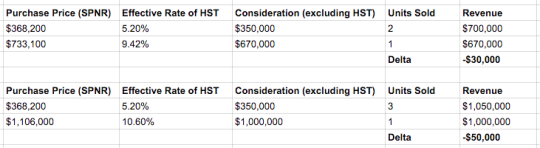
    To illustrate why this matters, consider the following chart:
    image

    In the first scenario, the developer builds and sells 2 units for a price of $368,2000. This translates into revenue of $700,000. However, if the developer instead decides to combine those 2 units and sell the larger single unit for $733,100 (roughly double the price) then the effective rate of HST goes up and revenue drops by $30,000.

    The second scenario is similar to the first one except that instead of 2 units, it’s 3 units which then get combined into one. Here revenue drops even further – by $50,000.

    Now, you could argue that there are some cost savings associated with building fewer suites, but I don’t think it would offset the differentials shown above, especially if you multiply those revenue numbers across an entire project. So what this all means is that it can be more profitable for developers to build smaller units priced below the thresholds mentioned above, as opposed to a smaller number of larger units. 

    Again, I’m not saying that HST rebates are bad. They’re critical to the industry. I love them. But I do believe we should be thinking about the possible implications that the current set up could be having on what we’re building and in particular on unit sizes.

    If you’d like to learn more about how the rebates work, check out this PDF from the Canada Revenue Agency. I tried to keep things simple in this post.