Daily insights for city builders, delivered every morning at 6 AM ET. I’m Brandon Donnelly — a Toronto-based real estate developer and founder of Globizen. I’ve been writing here since 2013.

Tag: new home

  • Best innovative suite design

    Junction House won “Best Innovative Suite Design” at the 39th BILD Awards (2019) last night. A big congrats to the team. Below is the floor plan that won. It is a 2 bedroom suite from our two-storey House Collection (JH_2B_H1).

    This design is fundamental to Junction House. It is why the project is called what it is. The goal was to create a suite that felt less like a condo, and more like a low-rise single-family home. Credit to Superkul Architects, and the rest of the team, for figuring it all out. There was a long list of requirements.

    We wanted dedicated kitchen (+ island), dining, and living areas. (The living area is also wider than what you’d typically find.) We wanted a terrace with (standard) water and BBQ connections. We wanted the bedrooms upstairs for privacy/separation. We wanted both of them to have direct window exposure. And we wanted a master ensuite bathroom with a double vanity.

    The House Collection includes some of my favorite suites in the building, which is why — full disclosure — I’m going to be moving into one of them. If you’d like more information about Junction House, reach out to Paul Johnston and his team at info@junctionhouse.ca or at 416-900-6076.

  • Junction House featured in the Toronto Star

    This morning the Toronto Star published a profile piece on one of Junction House’s earliest purchasers: Barbara Martinez. Barbara downsized from a house to a 1-bedroom condominium in Roncesvalles, but then realized that she still wanted space to entertain and have guests over. So she decided to buy a 3-bedroom penthouse at Junction House with an approximately 350 square foot terrace. That’ll work. It is truly one of the nicest suites in the building, and will come equipped with a view of the Toronto skyline that looks something like this (see background projection below):

    I am quoted in the article as saying that mid-rise condominiums in Toronto’s neighborhoods naturally tend to attract a different set of buyers compared to, say, a downtown tower. That is true and we are seeing it play out at Junction House. Yes, we have 1-bedroom suites that are perfect for young professionals and/or investors, but we also have some spectacular 2-storey suites (the House Collection) and larger single-storey suites for people just like Barbara. Congratulations on your new home purchase!

    Photos: Steve Russell for the Toronto Star

  • Exploring KING Toronto

    Today I stopped by the Exploring KING exhibit that is currently on at 134 Peter Street. It is an exhibition celebrating the design of KING Toronto.

    It explains how the design came about. Note all the different unit layouts on the floor.

    It includes (foam) study models that go as far back as 2015. That’s four years of design iterations.

    It has samples of the glass blocks that will be used on the building’s facades.

    Related article: Glass blocks, that staple of 1980s kitsch, are trendy again. Sorry, it’s behind a paywall.

    It has a VR setup that allows you to explore the building’s inner courtyard. It’s going to be a fun space.

    And there’s even a KING Toronto candle for sale. (Aromatic woods with spicy overtones.)

    I thought the overall exhibition was very well done and I am thrilled to see architecture and design so front and center. It is an exciting time to be living in this city.

  • Increasing housing supply in Ontario

    The Government of Ontario is currently working on a Housing Supply Action Plan that they hope will address “the barriers getting in the way of new ownership and rental housing.”

    Through initial consultations, they have already identified 5 key themes (my words below):

    1. The approvals/entitlement process for new housing is too slow
    2. There are too many restrictions on what is allowed to be built (that is, we should be encouraging more “gentle density” and “missing middle” type infill)
    3. Development costs are too high
    4. Tenants need protection; regulation is making it increasingly difficult to be a small landlord
    5. Overall housing innovation

    The province is also looking for public input and is currently running this online survey. It is open until January 25, 2019. And I would encourage all of you to complete it and help shape the action plan.

    My understanding is that the plan should be ready by Q2-2019.

  • You can now buy a new home, online

    My friend Matthew Slutsky runs a company called BuzzBuzzHome that allows you to search for new construction homes. This week they launched a feature that allows you to put down a deposit on a new home – online – with your credit card. It’s live right now for the Barra on Queen in Kitchener, Ontario.

    I know that Matthew and his team have been working on this for years (I saw earlier demos), and so I wanted to publicly congratulate them on the blog. I’m not sure who their competitors are right now, but this feels to me like one of the first online real estate marketplaces where you can actually just hit “buy now.” Huge accomplishment.

    I am sure many of you will have objections that we will hear about in the comment section below. But I have little doubt that this is the future. People used to say that the masses aren’t going to buy clothes online because of the need to try things on. I own suits that I have purchased online. People will buy real estate online.

    The more important question: When will it go mainstream?

  • Why multi-family developers are shifting their customer focus

    One aspect of the Toronto housing market that I’ve been paying close attention to is the adoption of multi-family dwellings by both long-term end-users and families. 

    I’ve written about this before (here and here, over a year ago) and have argued that here in Toronto we are at an inflection point. Multi-family dwellings – both rental and condo – are evolving to now target these new customer segments. Whereas previously, the new construction multi-family housing market was heavily geared towards investors and first-buyers. And often it was simply a stepping stone towards a single family home.

    Now, every city and real estate market is different. And I have heard many people in U.S. cities say that Millennials are simply deferring what we saw with previous generations. At the end of the day they (or we, I’m a Millennial) are going to move to the suburbs and buy that car. The current trends we are seeing around city living and reduced driving are just that – short-term current trends.

    But I think it’s worth reiterating: I do not believe that the status quo is what’s happening right now in Toronto. And I’m sure it’s also happening elsewhere. Time and time again I speak to developers in this city who are starting to shift at least some, and in some cases all, of their focus towards end-users, families, and larger units – particularly for new mid-rise product in the “neighborhoods.”

    And if you think about it, this makes perfect sense. 

    The average price of a detached single family house in Toronto is well north of a million dollars. So when a developer brings to market a 1,200 sf family sized apartment at $600 psf ($720,000) or even at $700 psf ($840,000), that home now becomes a relatively “affordable” option in many desirable areas of the city. Particularly if you value location amenities and your time (i.e. shorter commutes) over raw quantity of space. I know I certainly do.

    I know this isn’t going to appeal to everyone. But there is a big market here. Get ready.

    What are you seeing in your city? Let us know in the comment section below.

  • What tax policy could be doing to home sizes in Ontario

    Golden City (of Toronto) by Evgeny Tchebotarev on 500px.com

    https://500px.com/embed.js

    In yesterday’s post I made a remark that we have antiquated tax policies here in Ontario that encourage the building of smaller new construction condominiums. There seemed to be a lot of interest in that comment, and so I’d like to talk about that today.

    Some people thought I was referring to development charges, but I was actually thinking of the GST/HST New Housing Rebate in Ontario

    The way it typically works in Ontario is that when buy a new construction home, the price you pay is inclusive of HST (harmonized sales tax) and net of any applicable rebates, such as the rebate program mentioned above. 

    This means that the price you see on your agreement is usually the price you pay. I say usually only because there are ways that you could disqualify yourself from the New Housing Rebate program. But that’s a different post.

    So what does this mean in practice?

    Let’s say you went out and bought a new construction condo for $368,200 (there is a reason I’m picking what seems like an arbitrary number). If there was no such thing as the New Housing Rebate program, then the sales tax owing on this home would be the full 13%. And that would mean that the price paid before any taxes is actually $325,841 (x 13% = $368,200). This is an important number because it represents revenue to the developer.

    But since there is a New Housing Rebate program, the effective tax rate actually works out to be 5.20% for this particular sale price, which means that the price paid before any taxes is now $350,000 (a nice whole number). And so because of rebates and because they are now paying less HST, the developer’s revenue number has increased. It has gone from $325,841 to $350,000.

    The way this logistically works is that purchasers usually assign the New Housing Rebate benefits to the developer who then processes all the paperwork. This is what I mean when I say that the “sticker price” is inclusive of HST and net of any rebates – it already factors in the possible deductions.

    So far things are looking good. And I want to be clear that I don’t have concerns with the New Housing Rebate program in its entirety. In fact, it’s a hugely important part of the new home industry. Without it, many projects would simply not be feasible to build.

    However, as the price of the new home increases (which typically happens as the home gets bigger), the rebates start to fall off. The federal portion of the rebate maxes out at a base purchase price of $350,000 (which is why I chose that number) and the Ontario portion maxes out at a base purchase price of $400,000.

    What all this means is that as the unit sizes get bigger and more expensive, the effective tax rate is no longer at 5.20%, as was the case in the example I gave above. It increases. And if you hold prices constant for the purchaser, it means that the developer’s revenues now start to drop.

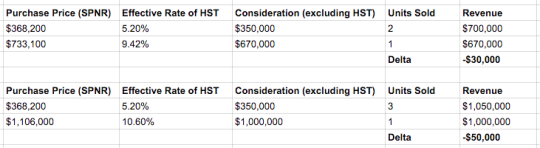
    To illustrate why this matters, consider the following chart:
    image

    In the first scenario, the developer builds and sells 2 units for a price of $368,2000. This translates into revenue of $700,000. However, if the developer instead decides to combine those 2 units and sell the larger single unit for $733,100 (roughly double the price) then the effective rate of HST goes up and revenue drops by $30,000.

    The second scenario is similar to the first one except that instead of 2 units, it’s 3 units which then get combined into one. Here revenue drops even further – by $50,000.

    Now, you could argue that there are some cost savings associated with building fewer suites, but I don’t think it would offset the differentials shown above, especially if you multiply those revenue numbers across an entire project. So what this all means is that it can be more profitable for developers to build smaller units priced below the thresholds mentioned above, as opposed to a smaller number of larger units. 

    Again, I’m not saying that HST rebates are bad. They’re critical to the industry. I love them. But I do believe we should be thinking about the possible implications that the current set up could be having on what we’re building and in particular on unit sizes.

    If you’d like to learn more about how the rebates work, check out this PDF from the Canada Revenue Agency. I tried to keep things simple in this post.
