Daily insights for city builders, delivered every morning at 6 AM ET. I’m Brandon Donnelly — a Toronto-based real estate developer and founder of Globizen. I’ve been writing here since 2013.

Tag: new home sales

  • Attainable housing is in short supply

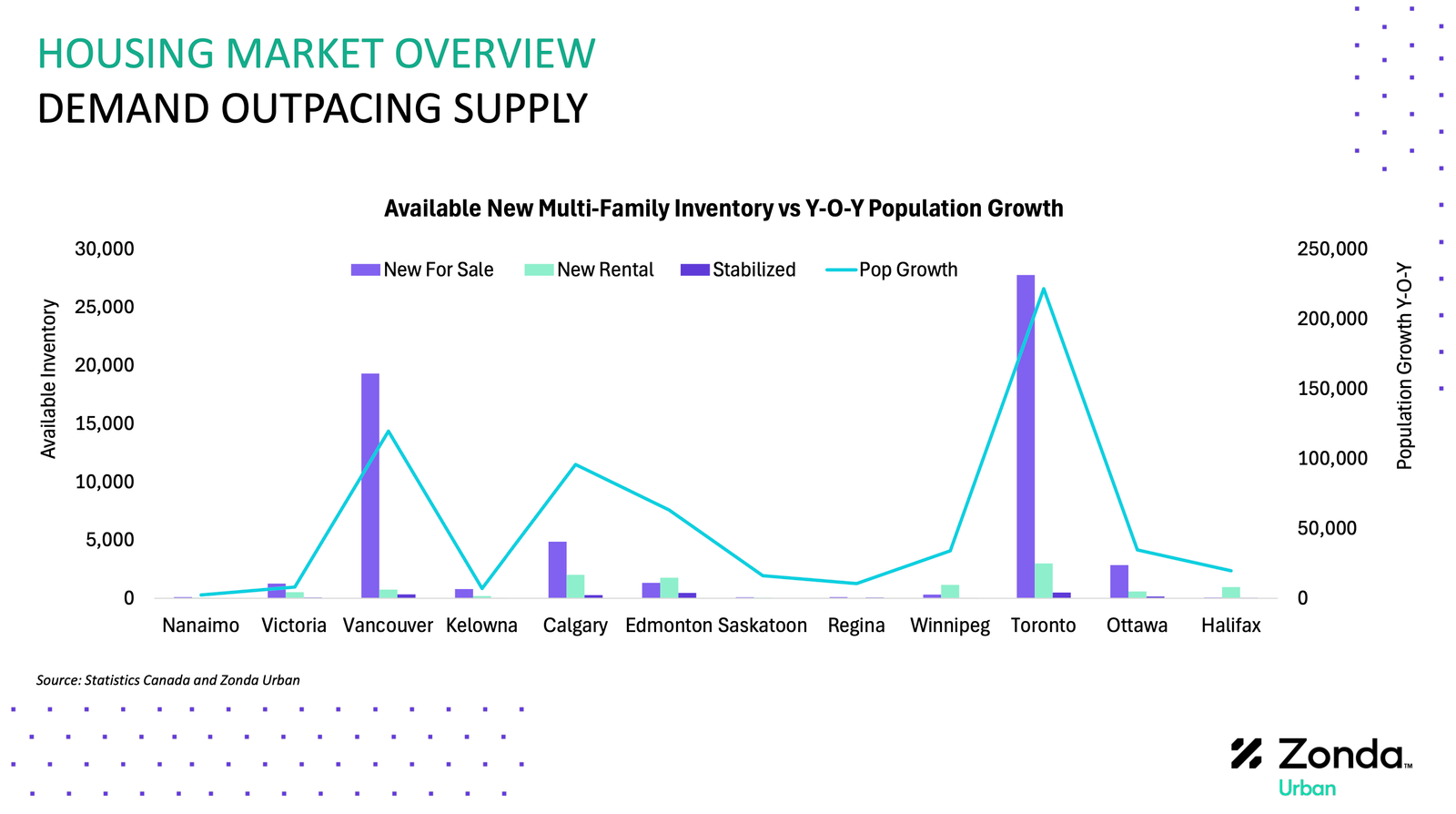
    Approximately 41% of the YTD population growth in Canada this year has been in Ontario. Here’s a slide from a recent presentation by Zonda Urban:

    So there’s an argument to be made that demand is still outpacing new housing supply in most of our major markets:

    Why then are new home sales continuing to slide? A reasonable answer would be that — by design — this new housing isn’t attainable to most:

    The result seems to be a long-term structural shift toward more rental housing:

  • 1,688 new condominiums were sold last quarter in the Toronto region

    Urbanation just released its Q2-2024 condominium market survey for the Greater Toronto & Hamilton Area (GTHA), and we should probably talk about some of the data:

    • The new condominium market reported 1,688 sales in the quarter. Outside of Q2-2020 (the pandemic), this is the lowest in the past 20 years. Note: This number is self-reported by developers.
    • Of the 3,625 homes launched for pre-sale during the quarter, only about 17% got absorbed/sold. That’s about ~616 homes, which isn’t very much when you spread it out across the region’s projects.
    • Unsold inventory increased to 25,893 homes. Urbanation equates this to 34 months of supply, versus a more “balanced level” of 10-12 months. This number breaks down to 15,157 homes in pre-construction projects, 9,788 homes in projects under construction, and 948 homes in recently completed buildings.
    • This is higher than Urbanation’s 20-year average, but the way I see it is that the ~15k homes in pre-construction projects could very quickly evaporate. If those projects don’t get to construction (and most probably won’t in the short term), then that inventory will disappear from the market. On the other hand, the ~11k homes under construction or recently completed is a hard number. These homes exist, or will soon exist, and they’ll need to get absorbed at some point.
    • There are also going to be homes that are currently sold, but where buyers ultimately say “yeah, I’m not going to be able to close.” So there will be some non-zero percentage of homes that will need to be reabsorbed. I don’t know what this percentage will be, but if it’s something like 5%, that’s not nothing. (See below for the number of condominiums under construction right now.)
    • Not surprisingly, average asking prices for unsold homes only declined about 2.6% over the past year. Prices have remained markably sticky. And this is how you know that development happens on the margin. Because developers are infinitely better off selling homes and starting construction, compared to holding lots of unsold inventory and starting construction, whenever. The fact that developers aren’t dropping prices to sell more homes demonstrates that they can’t. They’re hitting the floor of financial feasibility.
    • Finally, last quarter saw 727 new condominium homes start construction. In theory, this could have been a single tall building, though that probably wasn’t the case. As new starts fall, the number of condominiums under construction will naturally also fall. The current number is 87,508 homes, which is almost 19,000 less than a year ago. I expect this number to keep coming down.
  • A lot less new housing

    During COVID, every developer was terrified that their costs were going to run way from them. According to this recent Globe and Mail article, residential building costs increased 55% since 2020. At the same time, city fees were being increased and some people, for whatever reason, believed this would not have an impact on home prices. Developers will always seek to profit maximize and charge whatever the market will bear, so why bother trying to reduce costs? This is/was one school of thought.

    Despite this cost fear, the market managed to keep up for a period of time. Capital was cheap, as we all know. And that kept things going, until it was no longer the case. According to the same Globe article, there are 83 residential projects and 28,428 homes that have not launched (sales) over the last two years in the Greater Toronto Area because of market conditions. This year alone, the number is estimated at 14,000 homes. So supply has fallen off, and that’s because demand and buying power have fallen off.

    But let’s think of this in economics terms. Price and quantity demanded are usually inversely correlated. Meaning, if the price of something goes up, demand will go down. And if the price of something goes down, demand will go up. So in theory, there are still prices that will get 28,428 people excited to buy a new home. I mean, if I were to list a condo in downtown Toronto for $500 psf right now, I’m pretty sure that most with the means would jump at the opportunity.

    The problem is that whatever these prices are, they are largely beneath the floor price of where most developers can build to today. Developers weren’t bluffing, costs really are too high now. And when this happens, the answer is simple: you can’t build. A new equilibrium will eventually be found. But in the short-term, we should all expect new housing supply to remain limited. And because there’s always a lag with real estate, the effects of this shortage will be felt in the years to come.

  • Cost-plus pricing

    Today, Urbanation released its Q4-2018 market highlights report for the Greater Toronto Area. 

    The general media will pick up these numbers and tell you that there’s been a precipitous decline in the number of new condominium sales. But the reality is that 20,028 units were sold in 2018, which is actually in-line with 10-year averages for this region. 2017 was a particularly frenetic, and unsustainable, year.

    The average pre-construction sold price for a new condominium in the former City of Toronto (the core) was $1,117 psf last year, and $921 psf across the broader region. These numbers represent significant double digit increases from the year prior. But again, what I don’t think many people appreciate is that the cost environment has also changed dramatically over the last few years.

    Construction costs are way up, as are development charges and a myriad of other pro forma line items. The above numbers are simply a result of cost-plus pricing. Here’s where costs are at and here’s where we need to be to make the project feasible. Margins haven’t increased; in fact, they’ve probably been squeezed for many developers.

    I think this is an important topic that deserves more transparency and visibility. So I’m hoping to work with a developer friend of mine and publish something more substantial in the coming months.

  • New high-rise home prices up 39.5% year-over-year

    February data (2018) for the new home market in the Greater Toronto Area was released this past week by BILD and Altus. I seem to have gotten into the habit of writing about this every month.

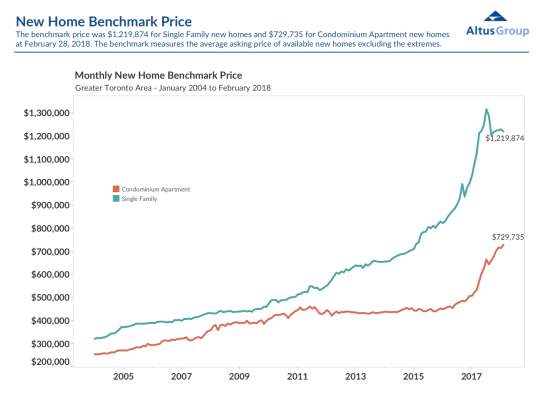
    The benchmark price for new low-rise single-family housing was down slightly from January to $1,219,874, but still up 12.8% from a year prior.

    The benchmark price for new high-rise housing was up a whopping 39.5% year-over-year to $729,735. But part of this is being driven by an equally dramatic increase in average unit sizes.

    Here is the relevant graph:

    image

    The story continues to be about tight supply, historically low developer inventories, and a lack of affordable low-rise product. 

    As I have argued many times before on this blog, I believe these factors — and in particular the last one — are, at least partly, driving this recent pop in high-rise pricing. People are priced out and now searching for substitutes.

    So my prediction continues to be that we will see a convergence (i.e. diminishing spread) between new low-rise and high-rise pricing.

    That will also bring about design and product changes on the high-rise side.

  • Only 2 new single-family homes sold in Toronto last month

    Altus Group just released its January (2018) sales figures for the new home market in the Greater Toronto Area.

    – 1,251 new homes sold last month. 886 of these (or 70.8%) were condominium apartments (everything from stacked townhouses to high-rises).

    – This is down from 2,429 homes in 2017 and 2,118 homes in 2016.

    – Almost half of the new home sales (609 homes) came from Toronto alone. And almost all of these (607 homes) were condominium apartments. Only 2 new single-family homes sold in the city last month.

    – Benchmark price for single-family homes was $1,229,454, which is a 19.6% increase from January 2017.

    – Benchmark price for condominium apartments was $714,430, which is a 40.8% increase from January 2017.

    That last increase really stands out. I did a double take.

    But as we’ve talked about before, low supply and high prices seem to be pushing more buyers toward condos – and larger ones at that.

    Recently we’ve been seeing an increase in both average unit sizes and prices per square foot.

    According to Altus, sales of new single-family homes in the GTA last month were the lowest for a January since before 2000.