Daily insights for city builders, delivered every morning at 6 AM ET. I’m Brandon Donnelly — a Toronto-based real estate developer and founder of Globizen. I’ve been writing here since 2013.

Tag: new condo market

  • Development charges are an insidious problem

    Here is a recent chart from Mike Moffat showing how much development charges have increased in the City of Toronto from 2009 to today:

    We’ve, of course, seen this before. Back in 2020, I shared an article that developer Urban Capital published where they did a cost comparison between a project they had done in 2005 and a project they were doing in 2020. What they uncovered was that development charges alone had increased by 3,244%! The most of any line item in their pro forma.

    Development charges over the last real estate cycle have been an insidious problem. Meaning, the industry knew they were crazy high, and we were all trying to be vocal about it, but let’s face it — the general public doesn’t have a lot of sympathy for developers complaining about high fees. They are also largely hidden from purchasers and renters. The charges just get lumped in.

    If our industry could figure out how to be more transparent and separate out these charges, much like a sales tax, I think it would go a long way to showing consumers what they’re actually paying when it comes to new housing. And then maybe something positive would happen. Because this is a major reason why new housing has gotten so expensive in this region.

    Can you imagine if property taxes had increased by 3,244% over the last 15 years? I can’t. Because no one would have ever allowed that to happen.

    For better and for worse, the current market is going to serve as a rude awakening for municipalities. We’ve reached the breaking point. The housing market is, as we’ve talked about, in a “state of economic lockdown.” And when people don’t buy new homes, it means developers no longer have the money to pay development charges.

  • Over-building and then under-building: Is Toronto headed for a severe shortage of new rental housing?

    As we know — because here’s the data — this is the current state of affairs:

    The GTA condo market is in a state of economic lockdown. The math doesn’t make economic sense from both the demand side (investors) and the supply side (developers), leaving the market at a standstill.

    The above excerpt is from a recent CIBC Capital Markets article by Benjamin Tal (CIBC) and Shawn Hildebrant (Urbanation). And what it ultimately means is that the supply of new condominiums in the GTA is falling and will continue to fall for the foreseeable future. Below are two charts, from the same article, that show that.

    Because of this, I actually think that, if you need or want a place to live, right now is a near ideal time to buy a condominium, especially if it’s from developer inventory (in an already completed project) or it’s a resale. Of course, most people won’t want to do this because they’d rather buy when most other people in the market want to buy. This is how markets tend to go.

    It has been a while since the GTA has gone through one of these real estate cycles, but it is typical: developers are prone to both over-building and under-building. It simply takes too long to build a building, and so it is natural for there to be moments when supply and demand don’t exactly line up.

    Pre-selling condominiums is — in theory only — supposed to protect against too much overbuilding. But as we have spoken about many times before, it can be challenging for end users to buy a new home so far in advance. And so the new condominium market has come to rely on investors who want to buy early and then either sell later or rent later.

    According to the above article (and MLS data), the share of newly completed condominiums used as rentals reached a peak of 34% in 2023. So a third of new condos. My gut tells me that the actual number is much higher. Many rentals never reach MLS. Overall, I think it’s very safe to assume that the majority of new condominiums are owned by investors.

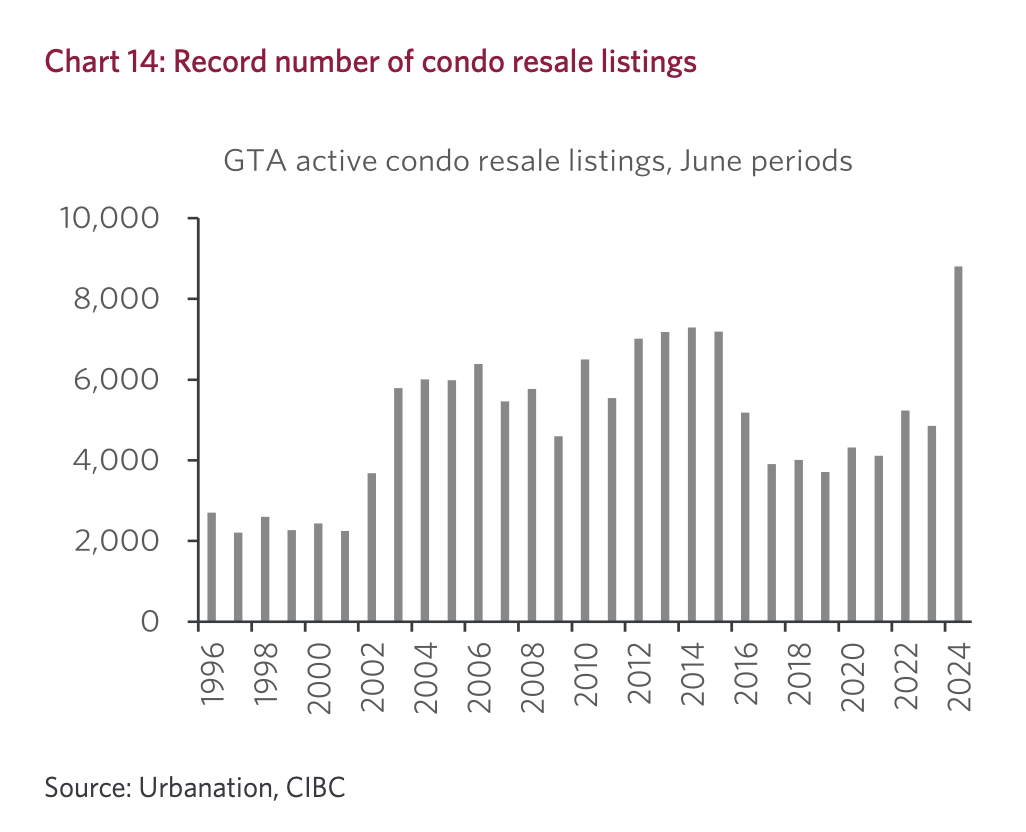
    But right now, fewer investors want to own condominiums, which is why the number of resale listings has spiked this year:

    This is, again, why I think right now is an excellent time to buy a condo. You know, be greedy when others… Regardless, this inventory will need to get absorbed and that will ultimately happen. Some of it will go to end users and some of it will go to investors who can make sense of the rental math and/or want to take a long view on Toronto. But if more goes to the former, we will be losing a lot of new rental housing.

    At the same time, while all of this is going on, construction starts are likely going to remain depressed (chart 3 above). It’s impossible to know how long this lasts, but at some point we will reach a moment in the cycle where we are under-building new housing. Maybe we’re already there. Development simply can’t turn on fast enough when demand spikes. There will almost always be a lag.

    So, since the majority of new condominiums have been serving as new rental housing, there’s a strong case to be made that at some point we will run into a potentially severe shortage of rentals. Condo investors are sometimes vilified in the media, but we will soon find out what happens when you take a big chunk of them out of the housing market.

  • Cost-plus price floor

    Oftentimes, it feels like there is a perception that developers price new housing with the fattest of margins. Meaning, if only developers were less greedy, housing could be more affordable. But as we have spoken about many times before, real estate development is a competitive industry; therefore, projects happen on the margin.

    Ordinarily, the prices you see are the result of a cost-plus pricing strategy. Developers figure out what it will cost to build and develop, they add on a margin that they think their investors will accept, and then they determine what sticker prices they need to make the project financially feasible.

    I’ve been writing about this approach for many years, but today it’s even more obvious. According to Urbanation’s Q1-2024 condominium report, new unsold condominium inventory in the GTA is currently sitting at approximately 23,815 units. This is up 30% YoY and is equal to about 23 months of supply. Two years ago in Q1-2022, this number had reached an 18-quarter low of 8,726 units.

    Developers are highly motivated to sell and move their projects forward. Time is a killer, especially today. So the logical explanation for this rising inventory is simply that they can’t sell it. Their cost-plus pricing doesn’t overlap with what most buyers in the market are willing to pay. Like I said, development happens on the margin.

    In theory, there is always a price where buyers would be willing to transact. If I listed a beautiful condominium for $100k today, many people would want to buy it. Supply would quickly run out. The problem is that no developer can build for this. There is always a very real price floor and, right now, that floor doesn’t seem to be low enough for many buyers.

  • New condo sales totaled 5,385 units last quarter

    Urbanation released its Q1-2021 quarterly condo market update for the Greater Toronto Area at the end of last month. And there’s some good stuff in it. New condo sales totaled 5,385 units in the first quarter of this year, which is higher than the 10-year average of 4,924 units and only slightly below sales from a year ago (Q1-2020). By and large, the numbers are starting to feel a bit pre-pandemic-like.

    If you remember what happened back in the second quarter of last year, there was a quick shift in demand toward the suburbs and outskirts of Toronto. Part of this was driven by affordability. But I guess part of this was also driven by the fact that some people seemed to think that our cities had never before experienced a health crisis and were going to somehow die. Or perhaps it was because Zoom is so much fun (and not at all exhausting) and that this time was destined to be different. Either way, I never understood this.

    Fast forward a year and the core is not surprisingly coming back. The oldest part of the city (former City of Toronto) saw 2,886 new condo sales in the first quarter of this year. This is actually higher than sales in Q1-2020. New condo openings in downtown Toronto sold for an average price of $1,419 per square foot. And overall absorption was about 76% in the quarter, which is the highest it has been since 2017.

    Some of you may be looking at these numbers and thinking WTF. But when developers look at the costs in their pro forma, as well as what’s on the horizon — ahem, inclusionary zoning — it’s usually that same feeling. So it’s hard to imagine average prices and rents going anywhere but up.