Daily insights for city builders, delivered every morning at 6 AM ET. I’m Brandon Donnelly — a Toronto-based real estate developer and founder of Globizen. I’ve been writing here since 2013.

Tag: networks

  • A universal language for global trade

    This article by Ryan Petersen is a good history lesson on how shipping containers came to be. Here is an excerpt:

    The idea for containerization came from a trucker, not a shipper. Malcolm McLean started out hauling empty tobacco barrels with his family in North Carolina in 1935. At that time, entire trucks would drive onto ships, wasting both a ton of potential cargo space, plus a chassis that could be on the road moving goods. McLean developed plans to use the so-called trailerships for travel from North Carolina to New York, but U.S. regulations didn’t allow one person to own both a trucking and a shipping company at the same time. So McLean did what any innovation-minded entrepreneur would do: He dumped the trucking company, took out a $22 million loan, and, in January 1956, bought two World War II T-2 tankers. 

    The magic of shipping containers is that they created a standard. Now all of a sudden you had standardized boxes that were intermodal. They could fit on ships, rail, and trucks. Ryan refers to containers as the “unsung hero of logistics.”

    He also likens them to the HTTP standard that helped give us the internet that we know today. Before HTTP, computers could only communicate with each other if they were on the same local network. Now we are, of course, connected globally.

    But while containers standardized a part of our physical infrastructure, there’s a lot that remains fragmented and manual:

    The same way data passes between devices via the internet, goods pass between ocean ports, airports, warehouses, and other entities to reach their final destination. Without a logistics standard to act as a request-response protocol, all the players — suppliers, drayage, ports, warehouses, buyers — have to stitch their networks together manually. 

    Information gets lost; layers of redundancy, designed as backups given low visibility, slow the exchange: connections end up being very brittle. Let’s say there’s a shipment scheduled to arrive in Long Beach on Tuesday. But which terminal exactly and what pier number? What time is pickup? How long before late charges are incurred? Finding these answers is labor-intensive and imprecise. Logistics managers end up consulting different sources on websites, via email, or in person. 

    The dirty secret of the industry is that no one really knows where their stuff is.

    I’ll be honest in that I was expecting the article to transition into talk of blockchains. But that’s okay. The underlying message remains the same. Better software and more standardization is needed to improve our physical world.

    For some added context: Ryan Petersen is the founder of a company called Flexport.
  • Attract and extract

    Chris Dixon’s recent piece on why decentralization matters is currently making the rounds online. It clearly explains the first two eras of the internet and how the third era is developing as we speak. Cue decentralized cryptonetworks.

    I particularly like how he describes the relationship that centralized platforms – like Facebook – have to their users and to their complements (other businesses, software developers, creators, and so on). 

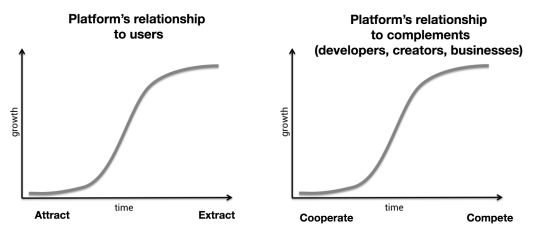
    Here are two graphs from his article:

    In the early days it’s all about cooperation and doing everything you can to attract users. The platform gets more valuable the more users are on it and so the immediate goal is to build up the network effects and lock people in.

    But as the platform grows, the relationship flips (top of the S-curve). In Dixon’s words, it becomes a zero-sum game whereby to continue growing the platform starts extracting data from its users and competing with its complements.

    The promise of cryptonetworks is that they will do away with many of these negative externalities, but at the same time empower the kind of sophistication that we see today with centralized platforms.

    The venture capitalists are circling because a fundamental shift in the architecture of the internet will mean disruption. I’m following it because I want to understand how it may apply to real estate and the built environment.

  • Multi-modal cities are the new reality

    CityLab published an article last week on multi-modal cities that caught my attention (because it used a picture of Toronto with about 3 or 4 streetcars stacked up along Queen Street). The premise of the article is that all of this car vs. transit debate is actually missing the bigger picture: our cities are multi-modal and we need to be planning for that.

    That’s not to say that the shift away from cars isn’t a good thing. It is. But it’s not as simple as saying that, instead of driving, people should now only take transit. In today’s cities people walk, bike, take streetcars, take buses, take subways, take taxis, take private shuttles, use Uber, and, yes, they still drive.

    From my own experience, this is absolutely how I get around Toronto today. I walk to the gym. I ride my bike whenever I’m going somewhere downtown. I take the subway to my office in midtown because it’s far and I would be too sweaty if I biked there. I use Uber and Hailo when I’m going out at night. And I drive when I need to go to the suburbs or leave the city.

    But the key takeaway here is that we now have a much tougher challenge on our hands. When we were only optimizing for cars – however detrimental to our cities that was – we only had one mode to plan for. Now we have several. Some of which are public and some of which are private.

    However we also have access to technologies that we didn’t have before. We are networked in ways that weren’t possible before and we’re at the dawn of many profound mobility changes, such as driverless cars. (Have you read about Tesla’s new Autopilot feature yet?)

    So as I’ve said before, I really believe that we need to look at this, not as a war on the car, but as a war on inefficiency. The problem we are trying to solve relates to mobility: What’s the best way to move lots of people around dense urban regions? Stop focusing so much on the technologies and focus more on the people.

    Image: Flickr

  • What makes a city a smart one?

    There’s a lot of buzz around the idea of a “smart city.” IBM is involved. Cisco is involved. And so are many others. But what exactly is a smart city? 

    In the Electric City talk below, Adam Greenfield provides his definition, while at the same time being critical of the ones we currently use today, such as this one: It’s the missing link – the connective tissue – between the real estate and technology sectors. (Personally, I find this definition really interesting.)

    He also goes on to argue that the way we’re largely thinking about smart cities today is incorrect. We’re far too centralized and administrative in our thinking. Instead, we should be focused on leveraging the crowds of people in our cities that are now virtually all networked.

    He then goes on to list 5 technological preconditions to any smart city:

    1. Broadband connectivity
    2. Low-cost smartphones or personal devices
    3. Commitment to open municipal data
    4. Cheap public interfaces
    5. Cloud computing infrastructure

    If you’re interested in this topic, I suggest you watch his talk. It’s only about 10 minutes long. Click here if you can’t see it below.

    [youtube https://www.youtube.com/watch?v=9keDwTBmZ3o?rel=0]

    Update: This post was revised to reflect the fact that Adam Greenfield is “sharply critical” of the real estate + technology definition of a smart city.

  • How mobile apps are going to help us build better cities

    image

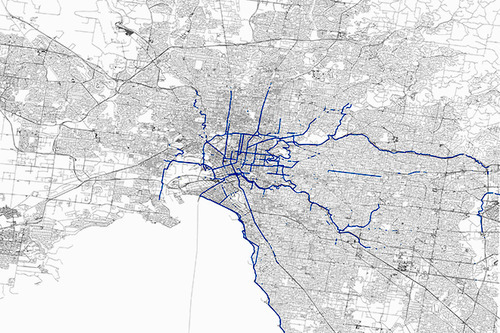
    Some of you might know that I’ve recently started using a mobile app called Strava. It’s a platform that allows you to track your runs and bike rides, as well as those of your friends. It tells you your speed, elevation changes, and it also maps your trips–among many other things. Here’s what my 50 km ‘Ride for Heart’ looks like from last Sunday.

    But what’s even more interesting is how cities are starting to use the data this app collects:

    For $20,000 a year, transportation planners and others can access Strava Metro, which provides an unprecedented look at where and how people are biking. It can tell them where they speed up and slow down, for example, or where they might stay in the street or ride on a crosswalk. That information can reveal where bike lanes or traffic calming measures would be useful, and if those already installed are effective.

    It’s a perfect example of how “tech” is infiltrating so many other sectors. Mobile technology and networks are generating huge amounts of data and it’s happening at an increasing rate. We’re gaining insights into the way people live that simply wasn’t possible before. Some of this information will inevitably be misused, but a lot of it will be used to improve the way we live our lives.

    I know that the City of Toronto also has its own proprietary cycling app and is hoping to collect similar sorts of data from it. But intuitively, I don’t think they’ll be able to compete with the scale of a platform like Strava. Though I certainly applaud the initiative.

    The information age is an exciting time.

    Image: Strava via Wired