Daily insights for city builders, delivered every morning at 6 AM ET. I’m Brandon Donnelly — a Toronto-based real estate developer and founder of Globizen. I’ve been writing here since 2013.

Tag: network

  • The new AirTags and Apple’s global mesh network

    Apple recently released a new tracking device called AirTag. It is similar to the small Tile devices that have been in circulation for many years in that they help you find misplaced items like your keys or a bag. They locate your stuff and work like this. I pre-ordered a 4-pack of them last month but they aren’t scheduled to arrive until June. Maybe it’s because I got custom engravings on the back of them.

    Perhaps the most obvious use case for these new AirTags is to place one inside of your checked bag(s) when you travel. There’s nothing worse than an airline losing your luggage and you not knowing where it is. So I can see myself using one of these every time I travel. Hopefully that will be very soon.

    But the other really interesting thing about these devices is that they run on Apple’s “Find My” network, which is the same network that allows you to find your other iOS devices if you happen to misplace them. This is essentially a decentralized mesh network that is powered by all of Apple’s devices around the world, as opposed to some big telco network.

    According to Wikipedia, there is believed to be about 1 billion Apple devices around the world that are capable of transmitting anonymous signals. Your phone may be doing it right now. What this means is that these new AirTags are being located not by way of a cell network, but by way of some dude with an iPhone standing nearby to your AirTag.

    Why I find this so interesting is that the internet has way of decentralizing things and also cutting out intermediaries. We’ve seen that happen with travel agents and we are now seeing it take place with cryptocurrencies and blockchains. These new AirTags feels like a microcosm of that trend. They are running on a giant global network that has been created one device at a time.

  • Helium launches new decentralized wireless network

    San Francisco-based Helium launched a new wireless communication standard today that it is calling “LongFi.” It has 200x the range of WiFi and operates at 1/1000th the cost of a cellar modem. It is perfectly suited to IoT (Internet of Things) devices, such as the electric scooters that are proliferating across our cities. Helium’s goal is to build out the “world’s first peer-to-peer wireless network.”

    What’s potentially very exciting about this technology is that it represents decentralized network infrastructure. Anyone can install a Helium Hotspot in their home (to grow the network). And if you do that, you’ll be rewarded with tokens, which, in theory, will have some value going forward. Another way to think of a Helium Hotspot is as “the equivalent of bitcoin mining for network infrastructure.”

    Put yet another way, it’s a new kind of wireless protocol and an entirely new business model — which is often how startups end up beating entrenched incumbents. Here is a short description from Union Square Ventures (an investor in the company) on how the Helium network will work:

    Hotspots, the backbone of the Helium network, can be deployed by anyone, anywhere, simply by plugging into an existing router.  The Helium network will be assembled, over time, by a broad community of volunteers, civic organizations, commercial partners, and ideally a new class of entrepreneurs building out connectivity in new cities and towns.

    Economic activity in the Helium network is coordinated through a new type of blockchain that uses “proof of coverage” (proving that a Hotspot is actually located in physical space) to secure the network and incentivize deployment where it is needed most.  We believe that the Helium network has the potential to become one of the most decentralized blockchain networks in existence, due to physical location as the underpinning of the economic and security model.

    This is a good example of the potential of the blockchain technology. We are still waiting for mainstream consumer applications to be built on top of it, but many people within the industry believe we’re only a few years out from that. I’m going to try out a Helium Hotspot as soon as they’re available in Toronto.

    Images: Helium

  • In defense of the gig economy

    Bill Gurley – who by the way is an investor in Uber – has an interesting piece up on his blog about the thing he loves most about Uber. It is the ability for the network to level load on its own. And here’s what he means by that:

    In spite of all the ink that journalists, analysts, and pundits have spilled on Uber over the years, no mainstream article has focused on what I consider to be the most elegant feature of this now ubiquitous, high growth global service — no driver-partner is ever told where or when to work. This is quite remarkable — an entire global network miraculously “level loads” on its own. Driver-partners unilaterally decide when they want to work and where they want to work. The flip side is also true — they have unlimited freedom to choose when they do NOT want to work. Despite the complete lack of a “driver-partner schedule” this system delivers pick-up times that are less than 5 minutes (in most US cities (with populations over 25K) and in 412 cities in 55 other countries. The Uber network, along with Mr. Smith’s invisible hand, is able to elegantly match supply and demand, without the “schedules” and “shifts” that are the norm in most every other industry.

    When surveyed, most people seem to prefer a job where they set their own schedule and get to be their own boss, compared to a steady 9 to 5 job with benefits and a fixed salary. Assuming that’s true, then this is a feature worth talking about.

  • Attract and extract

    Chris Dixon’s recent piece on why decentralization matters is currently making the rounds online. It clearly explains the first two eras of the internet and how the third era is developing as we speak. Cue decentralized cryptonetworks.

    I particularly like how he describes the relationship that centralized platforms – like Facebook – have to their users and to their complements (other businesses, software developers, creators, and so on). 

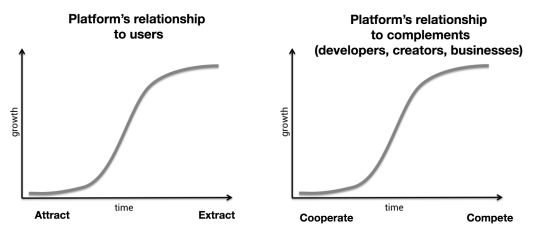
    Here are two graphs from his article:

    In the early days it’s all about cooperation and doing everything you can to attract users. The platform gets more valuable the more users are on it and so the immediate goal is to build up the network effects and lock people in.

    But as the platform grows, the relationship flips (top of the S-curve). In Dixon’s words, it becomes a zero-sum game whereby to continue growing the platform starts extracting data from its users and competing with its complements.

    The promise of cryptonetworks is that they will do away with many of these negative externalities, but at the same time empower the kind of sophistication that we see today with centralized platforms.

    The venture capitalists are circling because a fundamental shift in the architecture of the internet will mean disruption. I’m following it because I want to understand how it may apply to real estate and the built environment.

  • Transit Flow

    This is a map of the Bay Area Rapid Transit network:

    And this is an elegant visualization by Ray Luong of ridership levels over the course of one day: February 4, 2016. If you can’t see the embedded video below, click here.

    [youtube https://www.youtube.com/watch?v=owGgbAS7Wq8?rel=0&w=560&h=315]

    Note how the lines speed up as they go through the Transbay Tube connecting San Francisco and Oakland. That’s actually what happens. Within the 10 km-long tube, the trains reach ~130 km/h, which is more than twice as fast as the average speed throughout the rest of the network.

  • The landscape of electric charging stations

    The car had a profound impact on the landscape of our cities (and that’s probably the understatement of the year). Not only did it force the decentralization of our cities (i.e. sprawl), but it dotted the landscape with gas stations and other things that cars required.

    According to the Verge, the first gas station was built in 1905 in Missouri. And it was really thought of as a side business for pharmacies and other business owners. But as of 2012, there were 121,466 gas stations throughout the United States. It obviously became a big business.

    But as we make the transition from gasoline cars to electric ones, we’re going to need a new network of “refill” stations. In fact, this network is probably more important than the cars themselves if the goal is widespread adoption.

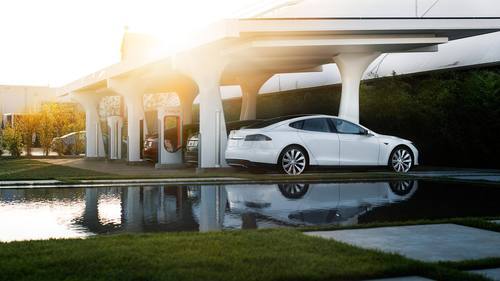
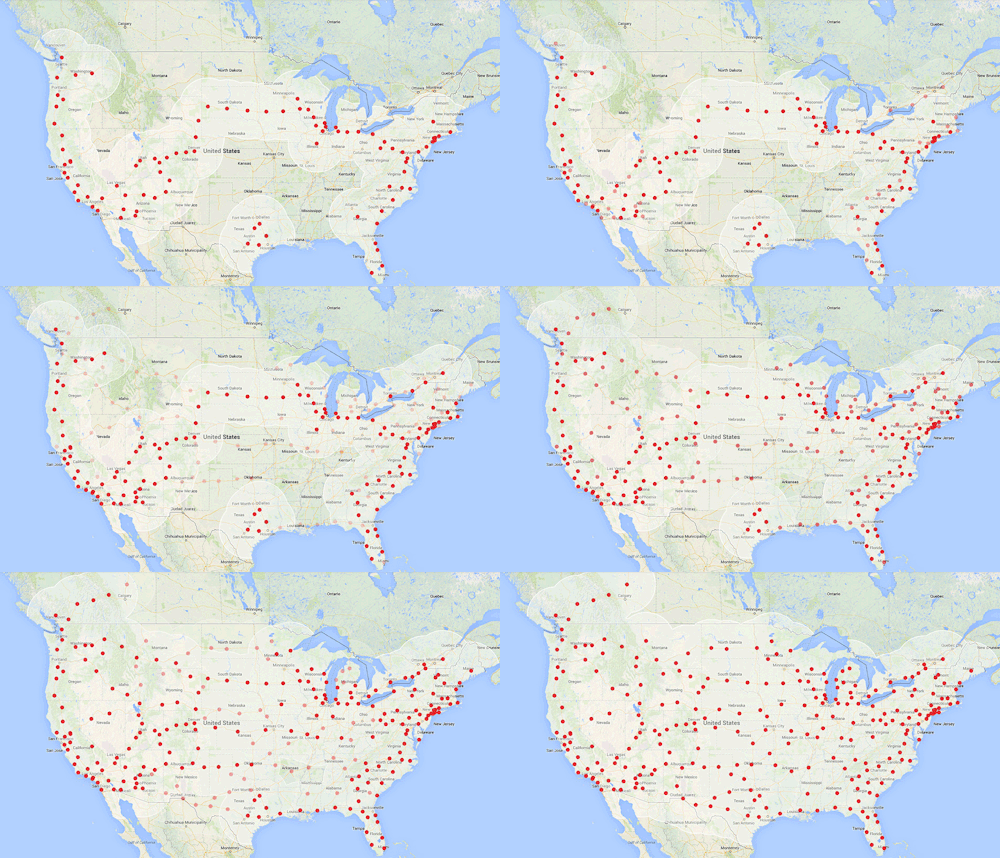
    Below is an animated GIF depicting Tesla’s plans to blanket North America with its Supercharger stations by the end of 2015. By then they will have covered off 98% of the US population and many of the most densely populated parts of Canada.

    But there are two important differences when it comes to comparing Supercharger stations vs. traditional gas stations.

    First of all, these won’t be the only places where drivers will be able to recharge. People will also charge their Tesla at home. In fact, I would assume that for regular city driving, most people would do just that. It’s far more convenient to just drive home, plug in your car, and have it recharge while you’re sleeping (just like we already do with our smartphones). And if this is the case, then these Supercharger stations will be primarily used for long drives, which means we probably won’t need as many within our cities.

    Secondly, these Supercharger stations are free to Tesla drivers (provided you purchase that option with your car). This is really interesting, because it changes the economics of the industry. Selling gas is no longer a profit center. 

    But what I wonder – especially now that Tesla has open-sourced its technologies – is how these free Supercharger stations will ultimately fit into the broader electric vehicle market. Will other manufacturers create Tesla Supercharger compatible cars? Or will we see a rival set of charging stations emerge?

    My sense is that Tesla is doing what it can to ensure it becomes the standard.

  • The super-linear relationship between human interactions and city size

    image

    The MIT Senseable City Lab recently teamed up with a few other research groups to investigate the relationship between human interactions and city size. If you happen to be a member of the Journal of the Royal Society Interface, you can download the full report here. But in true ATC fashion, I’m going to give you the Coles Notes version here.

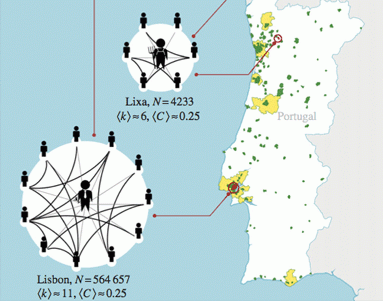
    What the study did was look at billions of anonymized mobile phone data in both Portugal and the UK in order to determine how our real life social networks change with city size. And what they found is a pretty consistent relationship:

    [T]his study reveals a fundamental pattern: our social connections scale with city size. The larger the town you live in, the more people you call and the more calls you make. The scaling of this relation is “super-linear,” which means that on average, if you double the size of a town, the sum of phone contacts in the city will more than double – in a mathematically predictable way.

    What’s interesting about this finding is that it starts to explain how cities–and the clustering of people–can act as fertile ground for the exchange of ideas and knowledge. The bigger the city the more people you probably know.

    But what I’m curious about (I don’t have the report) is if there’s some kind of upper limit. Presumably this “super-linear” relationship tapers off after a certain city size, because there has got to be limits to the number of people we can maintain productive relationships with.

    According to British anthropologist Robin Dunbar, that number was 150 people.