Daily insights for city builders, delivered every morning at 6 AM ET. I’m Brandon Donnelly — a Toronto-based real estate developer and founder of Globizen. I’ve been writing here since 2013.

Tag: netherlands

  • Amsterdam wants fewer drunk and annoying people

    Back in 2014, Amsterdam became the first city to have what is referred to as a “night mayor.” And at the time, including here on this blog, this was generally viewed as a pretty progressive thing to do. It recognized that there is an important nighttime economy and that, with the right leadership, it be harnessed for broader economic development purposes. As a result, many cities followed suit and appointed their own night mayors. (Toronto did not, despite my repeated posts.)

    But fast forward to today and things feel different. Night mayors aren’t talked about as much in city building circles. And Amsterdam is actually trying to limit overall tourism growth. It is working to relocate its Red Light District to outside of the city center and it hopes to reduce the amount of people who come to the city just to misbehave. To be clear, it still wants tourists; it just wants more people who do things like go to museums:

    The Netherlands’ capital plans to launch a deterrence campaign later this month aimed at tourists who go wild during their visits. In addition to new ads, the city has proposed rules in its infamous Red Light District, such as a ban on smoking marijuana in the street, earlier weekend closing times for bars, clubs and sex-work establishments and reduced alcohol sales. 

    Amsterdam’s liberal rules for drugs and prostitution have long attracted travelers looking to let loose, but officials say they are taking it too far and harming the quality of life for residents. 

    This is an interesting situation because usually the problem is, “how do we get more tourists to come and visit our city? Should we maybe build a casino or a Ferris wheel or something else equally as big?” Instead, the problem here is, “we have way too many drunk and annoying tourists. How do we swap them for more cultured visitors?” Of course, one solution is to just tell people that they are annoying and that they should stop coming. And that’s generally what the ad campaigns plan to do.

    An alternative approach might be to celebrate all of the other things that one can do in Amsterdam.

  • Rotterdam Rooftop Walk

    A new brightly-colored rooftop installation opened up this week in Rotterdam. It includes a 30-meter-high aerial bridge that connects a few of the city’s rooftops. Designed by Rotterdam Rooftop Days and MVRDV, the “Rotterdam Rooftop Walk” is designed to bring awareness to the city’s rooftops and demonstrate how they might be used as an added layer of public infrastructure within the city. The installation will run from May 26 to June 24.

    This is a neat idea and not just because I like bright orange things. Rooftops are, by and large, underutilized assets within our cities. It behooves us to do more (I just wanted to say behooves). But I think it’s important to keep in mind that aerial bridges and rooftop spaces can come in many different forms. I think you could argue that there are aerial bridges designed to enliven forgotten spaces (like this example here) and there are aerial bridges designed as a solution to appalling and inhospitable ground planes.

    Sometimes these inhospitable spaces are because of extreme climates and sometimes it is because we forgot how to design spaces that are actually enjoyable for pedestrians. The former of these two scenarios is, I guess, more excusable. But I do think that many cities lack the kind of densities needed to animate multiple layers of public spaces. Often you need to pick where you want to focus people’s attention.

    Still, bright orange walkways. Neat.

  • The Netherlands is short 330,000 homes

    The price of an existing home in the Netherlands increased 14.6% in the first 6 months of this year alone, according to this recent FT article. This is in comparison to 6.1% for existing homes across the EU on a year-over-year basis. Some economists estimate that the Netherlands is short about 330,000 homes right now and that it needs to build at least 1 million more over the next decade to better align supply and demand. I know that there is a lot of debate about the extent to which supply alone can solve problems of affordability. And indeed there are other factors at play here, such as low interest rates. But 330,000 is a lot of missing housing and numbers like this are not unique to the Netherlands. Most big cities have a supply of housing that is highly inelastic because of how difficult we make it to build. Most of us recognize this. But it remains a problem.

  • Holding back the sea, in Venice, maybe

    Venice has been keeping flood records for 150 years, though it is generally understood that the city has been regularly flooding since the very beginning. It usually happens between the fall and the spring and the earliest record is believed to be from the 6th century.

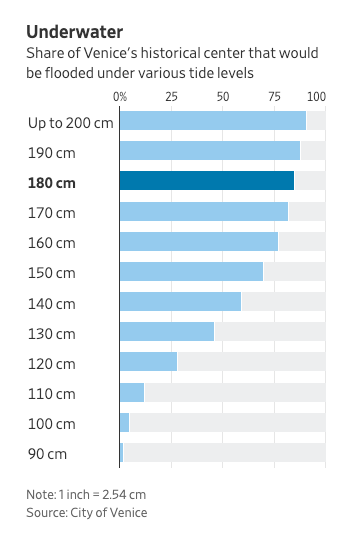
    This past week, Venice saw its acqua alta (or high water) peak at 187cm (6’2″) above its normal level. This is the second highest number on record and is just below its 1966 peak. At these numbers, about 80% of the historic center is underwater. Here is a chart from the WSJ explaining that:

    Venice has been working on a flood management project called MOSE since the 1980s. The name is an acronym, but there’s a deliberate biblical reference here. Remember when Moses parted the red sea?

    The project has been mired in engineering delays and corruption scandals, and so it’s not yet operational. If it were, it would have, in theory, protected the city this past week. 2022 is the anticipated completion date, but I don’t know if that’s realistic or not.

    The system consists of 78 mobile gates that fill with water and sit flat on the seabed when the tide is low. When a high tide is predicted, the gates are then to be pumped with air so that they rise (hinged on one side) and close off the three inlets that connect the Venetian Lagoon to the Adriatic Sea.

    As I was reading about this project and everything else that has been going on in Venice this past week, I became curious about how exactly the Dutch have been managing to hold back the sea. I mean, a big chunk of the Netherlands sits below sea level.

    If you’re also curious, here’s a video that explains how they do it.

  • South Korea buys 20% of its groceries online

    The World Economic Forum recently posted the below chart showing that 1/5 of all grocery purchases in South Korea are done online. The calculation is e-commerce revenue as a percentage of total fast moving consumer goods revenue in the country.

    image

    The explanation they give for this high percentage is that South Korea has some of the fastest and most ubiquitous internet access in the world. 

    But as soon as I read this I thought to myself: This can’t be the only reason. When was the last time you really wanted to order groceries online but your internet connection was too slow? 

    Also, if you look at all online shopping (not just FMCG), South Korea no longer shows up as such an outlier. So what’s happening with grocery?

    Without actually knowing the market, I would imagine that there are companies in South Korea who have simply figured out how to offer a great online grocery shopping experience.

    South Korea is also one of the denser countries in the world at about 513 people per km2. That would help with distribution. 

    But then again, the Netherlands is also quite dense (414 people per km2). Why are they only at 2.6%? (For comparison, the US is about 33 people per km2.)

    If any of you are familiar with the South Korea market I would love to hear from you in the comments. If they really are at 20%, I am surprised more people aren’t talking about this.

  • The Edge — The World’s Greenest Building

    When I was in grad school, I used to search around online and make lists of real estate developers that I felt were philosophically aligned with my own view of the world. I didn’t want to work for just any developer, I wanted one that cared about design, technology, sustainability, and so on.

    One of the developers on my list was OVG Real Estate in Amsterdam. They describe themselves as “the largest real estate technology company in The Netherlands” and they have recently completed The Edge, which is being called the greenest office building in the world. It received a 98.36% sustainability score from BREEAM-NL.

    The building uses 70% less electricity than the “typical office building” and uses solar panels on its rooftop, as well as on some neighboring university buildings, to produce more energy than it consumes. The building is also a great example of the Internet of Things. Anchor tenant Deloitte created its own mobile app so that employees can control lighting, climate, and so on.

    The building also has an on-site gym. I’m a big fan of mid-day workouts.

    There’s a lot going on with this building, so here’s a video from Bloomberg describing how it functions (click here if you can’t see it below):

    [youtube https://www.youtube.com/watch?v=JSzko-K7dzo?rel=0&w=560&h=315]

    Photos of the building here.

  • #LoveWins in the United States

    https://500px.com/embed.js

    By now, I am sure that all of you know that the U.S. Supreme Court made a landmark ruling yesterday (Friday, June 25, 2015). In a 5-to-4 vote, it was decided that the U.S. Constitution guarantees the right to same-sex marriage.

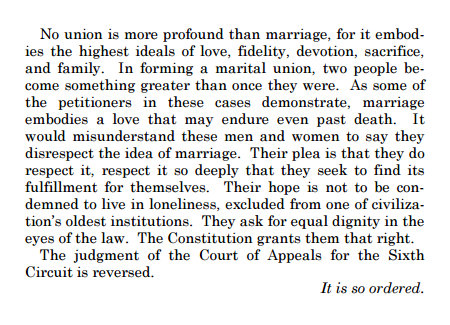
    Here is Justice Anthony Kennedy’s closing paragraph. What a great read.

    image

    With this decision, the United States joins the Netherlands, Belgium, Spain, Canada, Norway, Sweden, and many other countries who already allow same-sex marriages nationwide. And I am delighted to see that happen with Canada’s neighbor.

    I am also proud to say that it has already been a decade (2005) since Canada became the 4th country in the world – and the 1st country outside of Europe – to allow same-sex marriages. Not because it had a direct impact on my life, but because it is the right thing to do.

    It is the right thing to do because it creates “equal dignity” among all men and women (as Justice Kennedy states above) and because it’s the right thing to do for our economies.

    I believe that the strongest economies are the ones that can remain open and tolerant to new ideas and all kinds of people. 

    Cities like Toronto and New York (as I’ve argued before) became successful precisely because they opened themselves up to new ideas and new people (immigrants).

    But many studies show that as people age, “openness” declines. We become less intellectually curious and our preference for variety wanes. Perhaps this is where the expression “set in your ways” comes from and why political orientation often correlates with age.

    Thankfully the U.S. wasn’t so set in its ways that it couldn’t provide equal dignity to its citizens.

  • How a 5,000-stall bicycle parking garage works in Delft

    This past February, a new central train station opened up in Delft in the Netherlands. As part of the train station, there’s an underground parking facility for 5,000 bicycles.

    Here’s a video of how it all works:

    [youtube https://www.youtube.com/watch?v=UuhLv1AN0bE?rel=0&w=560&h=315]

    Isn’t it amazing what you can achieve when you decide to make something a priority?

  • Rotterdam reinvents the urban food market

    image

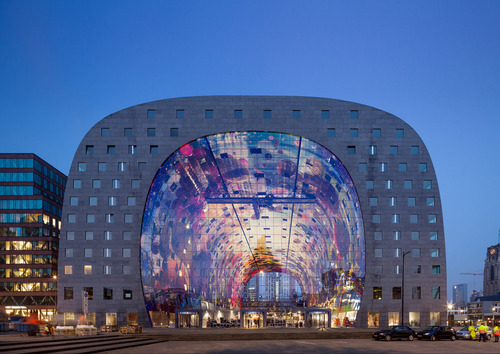
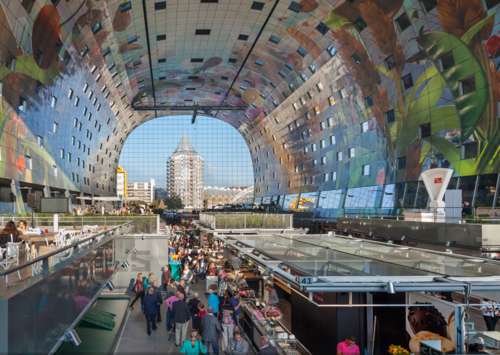
    Every now and then a piece of architecture comes along that makes you feel like your city should be more beautiful – or at least very least: bolder. In this case, it’s the new Market Hall in Rotterdam, which has been making the rounds on the internet since it opened last week. It may not be everyone’s cup of tea, but I find it really exciting.

    Designed by Dutch architecture firm MVRDV, the Market Hall is a 1.1 million square foot mixed-use building consisting of residences (102 rental apartments and 126 for sale apartments), a food market, a supermarket, a public space, and a 1,200 stall parking facility. But before I say anymore, here’s the money shot:

    image

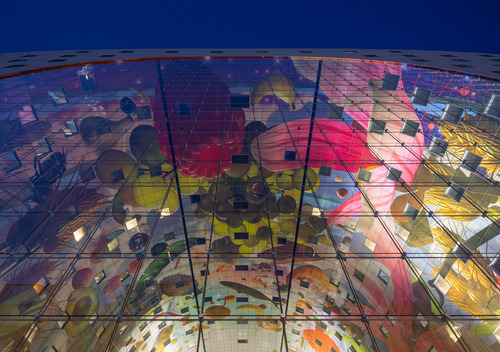
    And here’s what it looks like from the inside of the market:

    image

    In the middle of the building is the food market. At night when it closes up, it then becomes a well-lit public space. The entire central area is enclosed, but well connected visually to the outside through a big and fancy glass facade.

    The apartments wrap the central market and were constructed using standardized modules (despite the unique form). The spaces that require natural light face outward and all the spaces that do not require natural light (by Dutch law), such as the kitchens, face inward towards the market. 

    There’s a grocery store 1 level below grade (to help supplement the market) and all parking and loading is done underground. This means that the building itself has no real backside. Most buildings typically have an ugly loading and “back of house” area – the building’s ass if you will. In this case, the entire perimeter of the building is urban and accessible.

    Finally, on the ceiling of the market is a massive mega-mural designed by Dutch artists Arno Coenen and Iris Roskam. Click here for a 360 degree panorama. It’s wild. 

    So what do you think of this building? Would you like to have it in your city? And would you consider living in one of its apartments? I would.

    Images: MVRDV

  • [vimeo 76207227 w=500 h=281]

    Biking in Toronto means dodging cabs that don’t signal and closely watching parked cars for doors that might be about to open and could catapult you up and into the air. We have little in the way of dedicated cycling infrastructure. In fact, our incompetent mayor actually celebrates the removal of bike lanes

    Despite all this, Toronto has a fairly robust cycling culture. There’s no shortage of bearded hipsters riding around on fixies with a U-lock in their back pocket. However, it’s nothing in comparison to the city of Groningen in the Netherlands, where over 50% all of trips are made on a bicycle.

    If you’re into cycling or want to be converted, I recommend you take 15 minutes to watch the above video. The hoards of cyclists are interesting to see and they provide good background on how Groningen got to where it is today. Hint: It involves dramatic measures from a leftist city government.