Daily insights for city builders, delivered every morning at 6 AM ET. I’m Brandon Donnelly — a Toronto-based real estate developer and founder of Globizen. I’ve been writing here since 2013.

Tag: net zero

  • Project Profile: 1925 Victoria Park Road, Toronto

    A recent development proposal at 1925 Victoria Park Road (Toronto) by Well Grounded Real Estate (developer) and Partisans (architect) is noteworthy for a number of reasons:

    • The 12-storey, 168-suite residential mid-rise building is proposed to be built out of mass-timber.
    • It is targeting Toronto Green Standard Tier 4, which is a voluntary, difficult-to-achieve, and expensive sustainability target. It is the equivalent of net-zero and I believe the only projects to date that have achieved this level in the city are public projects.
    • The circulation spaces are exterior single-loaded corridors that face an internal courtyard. This approach is very common in some cities, but almost non-existent in Toronto. Usually because someone will cite our winters as being a problem and because double-loaded corridors are typically the most efficient (rentable area / gross construction area). But the benefits are that you don’t need to heat/cool these corridor spaces and you open up the possibility of suites with windows on both ends.
    • The design doesn’t generally follow the typical “pyramid-shaped confection” that has come to define Toronto mid-rise buildings, though it does seem to generally conform to the 45 degree angular planes that we love to obsess over. Instead, it is starting to resemble a typical European courtyard building. Good. For some more commentary on this, check out John Lorinc’s recent piece in the Globe and the Mail.

    This is unquestionably an ambitious project. And ambition is what cities need. So I am pleased to write about it today on the blog. If you’d like to learn more, check out their project website.

    Image: Partisans

  • What am I paying more for?

    So here’s the thing. The whole reason we are all talking about how to build more sustainably is that there isn’t often a quantifiable ROI for doing so. If building a net-zero building cost less than building a regular building, everybody would be building one. But that is not the case, which is why our industry, and others, are grappling with how to justify the added costs, even though we all know it’s absolutely the right thing to do.

    The questions we are asking ourselves look something like this: If I spend X% more on this build, what kind of rent premium could I command? And in some cases this premium is quantifiable and in some cases it matters a great deal. For instance, in the case of a new office building, you might need to spend the extra money so that you can attract the right tenants. While in other cases/asset classes, you might feel as if there’s no rent premium and nobody will ever pay more.

    But I like how Seth Godin thinks about it in this recent post: people never pay extra. If you’re paying more for an electric car, for example, you aren’t actually paying extra. What you are paying is a price that you feel is fair for what you are receiving. And what is it that you’re receiving? Well, in this case, you’re getting an electric car, but you’re also buying in Seth’s words, “sustainability, community awareness, cachet, status, safety, quiet, and the feeling of being an early adopter.”

    These things have value to some people. And as long as you can deliver on your promises, extra isn’t extra at all. But perhaps more importantly, this early adoption can help encourage change. Electric cars are becoming cheaper and cheaper, and I think it’s pretty clear that they will soon replace combustion engine vehicles. This model of starting at the top of the market and then moving down seems to have worked.

    Now, the auto industry isn’t perfectly comparable to the building industry. They have been good at improving productivity and bringing down costs, and we have been awful at it. Depending on how you measure it, construction productivity growth over the last half century is sitting somewhere between flat to some negative number. But I don’t think this dubious achievement changes Seth’s message. Think about what you’re offering. Maybe extra isn’t extra.

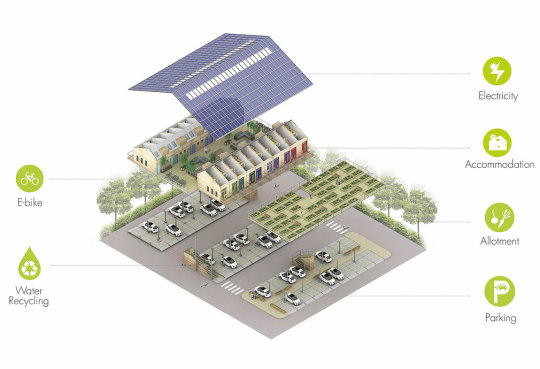
  • Low cost energy efficient homes perched atop of surface parking

    A regular of this blog recently suggested (in the comments) that I take a look at the London-based design firm ZED Factory. ZED stands for Zero Energy Development.

    The first project that caught my attention was ZED Pod. ZED Pod is a small, low cost energy efficient modular home that is designed to sit atop of surface parking lots. In other words, it’s a way to repurpose under-utilized surface parking without compromising existing parking ratios. All you really need are the air rights. And since the “land” is cheaper, the homes can be cheaper. They can also be easily relocated if the parking lot were to get developed in the future (though they are designed as permanent structures).

    image

    In some ways, there is something perverse about the way that driving and parking have such a profound impact on the urban landscape. Even when it’s buried underground and hidden from sight, the structural column grid needed to layout efficient parking will often carry up through the building impacting suite layouts. We’ll even restrict housing supply when parking requirements can’t be met. Should it be parking or people who come first?

    But cars aren’t going away. And ZED Pod is a clever way of dealing with an existing urban condition – however suboptimal it may be. I found the concept interesting and I thought you all might as well.

    Image: ZED Factory

  • Do homes need to become more of a product?

    Yesterday evening I moderated a panel on innovation in real estate at the Rotman School. The panelists included Subhi Alsayed (Innovation Manager at Tridel); Michael Lio (President of buildABILITY Corporation); Alison Minato (VP of Sustainability at The Minto Group); and Tad Putyra (President and COO, Low Rise Development at Great Gulf).

    Though the general consensus was that the real estate industry is terrible at innovation, it was comforting to hear that a number of both low-rise and high-rise developers are working on and/or towards building “net zero” homes. A net zero home is a home with no net energy consumption. What this means is that the home produces as much as energy as it consumes.

    The general strategy with these homes is to design the building so that it’s as energy efficient as possible (as in R-40 walls and triple-pane glazing) and then use renewable energy sources (such as solar) to fulfill any remaining energy needs. Of course, the next step would be homes that actually produce more energy than they consume so that they become net contributors to a city’s energy grid. But let’s not put the cart before the horse.

    There are a number of challenges to achieving this goal—one of which is on the consumer side. Many of the panelists mentioned that consumers simply don’t care enough about building performance and energy efficiency. Instead of worrying about air tightness, they’re worried about cosmetic things, like granite countertops and hardwood floors. That’s not to say that these pieces aren’t important, but they’re only one aspect of a home.

    So what’s the solution? Do developers and home builders need to get better at consumer education? Or should utility companies be the ones shouldering this responsibility? After all, improving energy performance means lower utility costs.

    One thought that came to mind (and I’m testing this for the first time with the Architect This City community), is that maybe homes need to become more of a product. Today, developers often market projects and communities ahead of themselves. But maybe that’s not the best way to drive innovation within the real estate industry.

    For example, think about how car brands segment the market. When you buy a Mercedes, you expect a certain level of performance and quality. You probably don’t know about every little technological innovation in the car, but you assume that they’re pretty damn good.

    With a new home on the other hand, you’re buying (insert generic name) on the Park or the Residences of (something regal sounding). The developer’s brand is secondary. And maybe that’s the wrong approach. Maybe it’s making consumers believe that the only thing that matters is whether you’re getting stainless steel appliances and granite countertops.

    Maybe consumers need to know whether or not they’re buying from the Mercedes developer or from the Ford Pinto developer. After all, consumers make decisions based on heuristics. They need to be able to say to themselves:

    “This home is $50,000 more, but it’s from the Mercedes developer so I can justify it. I’ll have less problems in the future, I’m sure.”

    Instead, consumers are saying to themselves:

    “This home is $50,000 more. Why is that? They both have stainless steel appliances and granite countertops. I’ll just go for the cheaper one.”

    I refuse to believe that the real estate industry can’t be as innovative as other industries. There’s always a way. We just need to figure it out.

    What are your thoughts?