Daily insights for city builders, delivered every morning at 6 AM ET. I’m Brandon Donnelly — a Toronto-based real estate developer and founder of Globizen. I’ve been writing here since 2013.
This is a telling map from Jens von Bergmann. It shows the changes in population density across Toronto from 1971 to 2021 (measured in people per hectare). What is obvious is the spikiness of our city. We have been very effective at adding lots of people downtown, along the central waterfront, and in certain other pockets. But at the same time, we have let our older inner city neighborhoods move in the opposite direction and lose people.
The irony of this outcome is that we have long created policies that refer to these areas as being “stable” neighborhoods. The idea was that they weren’t supposed to change, at least not too much. But what this data shows is the opposite. By restricting growth, we actually created the right conditions for them to lose people as demographics changed and household sizes got smaller, among other things. We created unstable neighborhoods.
Thankfully, we have started to change course and allow some intensification. We’re not there yet, but I do believe that the next 50-year map will look quite different than the one you see here.
I love the Junction. I’m planning to move to the Junction. And we have a development project in the area called Junction House. So know that I am entirely biased when I talk about this neighborhood.
One spot that wasn’t on the list is the Italian restaurant, Nodo. Big fan of this place. Great pastas. Great negronorum. Yes, the plural of negroni is allegedly negronorum.
Many people only think of it as civilized airport travel. But it also provides an incredible inner city service. It shows you the potential of Regional Express Rail in this region. We need more of this.
We’ll be providing an update on Junction House very soon and I’ll be sure to blog it. So stay tuned.
Recently we’ve been talking about California’s Proposition 13 and how it may be creating a disincentive for longtime homeowners to move. They’re enjoying below market property taxes, and so they stay put, even if they may have too much house.
But this concept of “overhousing” isn’t unique to California. The Globe and Mail just ran a piece talking about how Toronto’s designated “Neighborhoods” are losing people as the nests empty out, seniors remain put, and the broader city booms.
The rate of depopulation that created the spare bedrooms in Toronto’s low-rise neighbourhoods is stark: “Since 2001, about 52 per cent of the land mass of Toronto has reduced in density of population by about 201,000 people,” Mr. Smetanin says. “Other parts of Toronto have grown by 492,000.”
The irony of this phenomenon is that the city’s Official Plan considers these Neighborhoods to be “physically stable”, as well as “one of the keys to Toronto’s success.” However, things are clearly changing behind that physical stability.
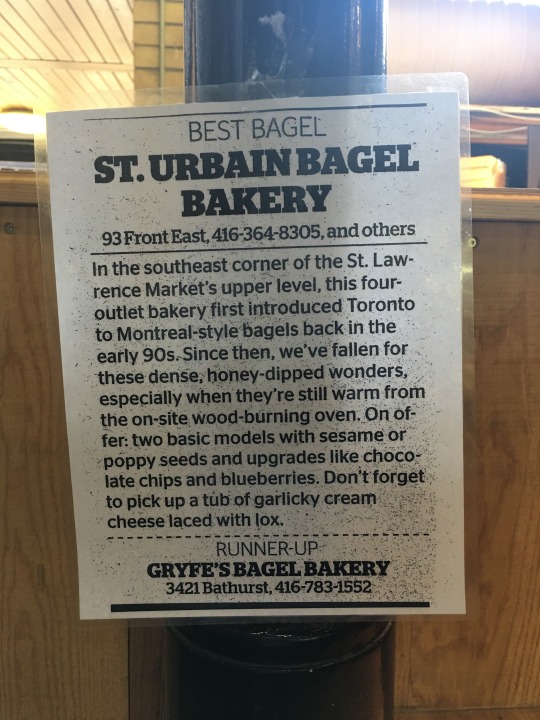
This morning I woke up and decided that I could go for a bagel with lox and cream cheese. I figured, it’s the weekend, I’m going to treat myself. So I walked across the street to St. Urbain Bagel Bakery (see above photo).
My Montreal friends reading this are probably thinking that this is no substitute for a Fairmount or St-Viateur bagel. But I enjoy St. Urbain. They are my go-to place for breakfast in the market.
What I really value, though, is the ability to walk across the street and grab a bagel for breakfast. It’s a pretty simple action. Nothing complicated about it.
But in our world of constant traffic jams, cars that should soon drive themselves, and near-instantaneous online delivery, it can be easy to forget that there’s still something really nice about just walking down the street in the morning and saying hello to a human.
I feel lucky that my neighborhood allows me do this. Not all do.
I was on CBC radio this morning talking about the revitalization of Dovercourt Village and Geary Avenue in Toronto.
The funny thing about this topic is that it’s one I actually held off writing about. I’ve been thinking about this street and area for probably about 5 years now. However, I do have to keep some secrets to myself 🙂
But then I started feeling like the cat was already out of the bag. Everyone in my circle was talking about it. So I wrote a post calling Dovercourt Village the next Ossington. I had no idea it would get the traction that it has gotten, but in hindsight it makes total sense. It makes a great headline: “Toronto’s ugliest street to become the next Ossington.” Boom.
The tough question that Matt Galloway asked me this morning was: What happens to all the blue collar businesses when/if Geary Avenue and the area really takes off? My response – given that it was only a 5 minute radio piece – was that it comes down to preservation vs. progress.
This is a topic that I’ve written about with respect to heritage buildings, but the same concept applies to communities as well. How do you allow neighborhoods to receive new investment while at the same time not erasing its past and the things that made it interesting in the first place?
It’s not easy, that’s for sure.
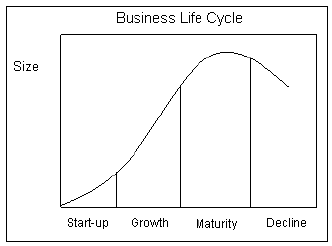
I absolutely believe that there are things that developers can do to respect the neighborhoods in which they build in. But at the same time there are economics at play. In business school, they teach you this:
It’s the lifecycle of businesses and industries.
The key takeaway here is that the rise and decline of businesses is actually quite healthy for markets. History is littered with examples. The word processor replaced the typewriter. The mobile phone replaced the landline. Air travel replaced rail travel. And the list goes on.
Today, I think we’re at a moment in time where our relationship to cars is changing dramatically. How we get around and how we own and operate them is being called into question.
So just because there’s auto shops on Geary Avenue today, doesn’t mean they’ll be there tomorrow regardless of whether the area takes off or not.
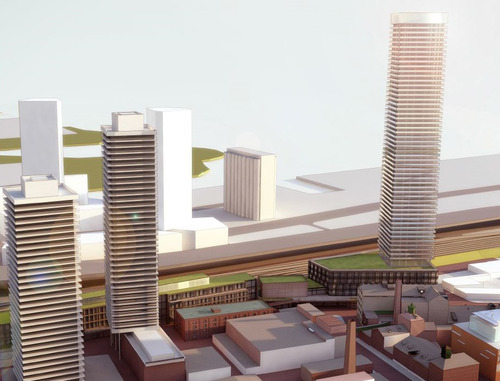
It’s the tower on the right hand side of the picture above. The 2 towers on the left are existing, although they’re quite recent. The development site is currently a parking lot and it abuts a railway corridor to the south.
The reason I bring up this project now is because I recently saw this notice go out from the Gooderham & Worts Neighbourhood Association. It’s an announcement for a public meeting that I believe just happened earlier this week (I think they meant to say 2015 instead of 2014).
After I saw the notice, I decided to share the rendering on social media to see what people thought of the proposal. The general consensus seemed to be that the tower looked a bit cookie cutter (though to be fair it’s hard to tell from renderings like this) and that 57 storeys was simply too tall for the area. I got comments back like “enough is enough.”
Now, I’m not here to say that 57 storeys is exactly the right height for this building and this location (though it might be), but I am saying that I don’t think it’s as important as most people think it is. I think we’ve become over-fixated on height, at the expense of other important design issues.
Part of this has to do with how we communicate projects and how we tell the story. If you look at the city’s website for this project, you’ll see that this is how it’s explained:
The City has received an Official Plan Amendment and Rezoning application for a 57-storey mixed use tower and a 5-storey commercial building containing 496 residential dwellings, 5,048 square metres of retail gross floor area, and 21,243 square metres of office gross floor area. The 5-storey commercial building is within the Distillery District, and the 57 storey tower is immediately south west of the Distillery District.
About the only thing that I think most people (outside of the industry) would understand are the heights of the buildings. Everything else – from the Official Plan Amendment to the number of square metres of gross retail area – is likely lost.
So it’s actually not surprising that most people just look at one or two renderings and the number of storeys, and then make a judgement call about whether or not it would be a positive thing for the city.
Now, I know why we communicate projects in such a clinical way. It’s to appear impartial. But there are so many other considerations when it comes to great city building.
How does the building meet the street? What are the first couple of floors like at eye-level? What’s the materiality? What would the experience be like for someone having a coffee on a patio outside of the building? What kind of commercial tenants will there be? Is there a unique leasing/programming strategy? What’s the overall vision for the project?
Again, I’m not saying that height is completely irrelevant. I simply fear that we might be losing sight of the bigger picture. The Distillery District is a magical place in Toronto. It’s hands down one of my favorite places to be. In fact, I’ll be there this weekend for a Winterlicious dinner. But I honestly couldn’t tell you how tall the existing towers are. Are they in the 40s?
I could, however, tell you exactly what it’s like to walk down the Distillery’s intimate cobblestone streets and sit on a patio with a beer in hand. It’s a beautiful thing.
I’ve written about the Tenderloin neighborhood in San Francisco before. It’s an infamous neighborhood in the center of the city that has for decades resisted gentrification (which was the topic of my post).
But as the technology sector continues to urbanize, many fear that it’s only a matter of time before it does eventually gentrify. A new nickname has even emerged for the neighborhood: the Twitterloin.
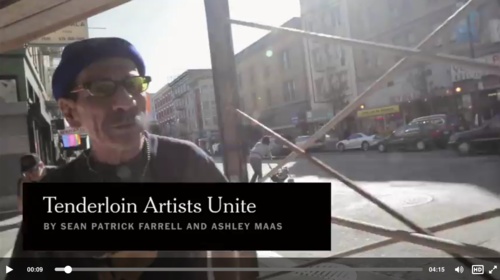
However, a local nonprofit called the Wildflowers Institute is trying to ensure that gentrification doesn’t erase the cultural assets currently housed in the neighborhood. Through a project called “Hidden Gems”, the group is literally knocking on doors to find active artists within the community (many of whom live in single rooms) and then supporting them through fellowship programs and other investments.
What’s fascinating about their approach is that they are actively seeking out the informal activities taking place within the community – activities that would otherwise be hidden and then potentially lost. Once discovered, they then do a number of mapping exercises to keep track of this data.
As somebody who believes city building will become a lot more data driven in the future, I think this is a really interesting initiative. And as gentrification pressures continue to increase in San Francisco, I’m sure this information will help guide the discussions. You can’t account for something you don’t know exists.
James Frank Dy Zarsadiaz (a Ph.D. candidate at Northwestern) published an article in Atlantic Cities a few days ago called, “Why gentrification is so hard to stop.”
In it, he essentially talks about how neo-liberalism has allowed private interest to trump public good and how it has dramatically changed cities and the expectations of its residents:
“…those who can afford to live in a city now expect a personalized, “just for you” urban lifestyle. For-profit companies chase these urbanites with upscale housing and creative marketing campaigns, transforming blighted and blue-collar neighborhoods into “livable” urban nooks.”
Now, as a developer I know I’m biased here, but is gentrification really as evil as he makes it out to be?
“I’ve always maintained that gentrification is what occurs when demand exceeds supply and blight is what occurs when supply exceeds demand.”
I like it because it’s a simple way of saying that what we are seeing is a natural market outcome. What’s wrong with somebody wanting to buy a house in a marginal area and fix it up? Can we reasonably expect to stop people from doing this so that wealth never increases within a neighborhood?
The bigger issue, in my view, is rising income inequality. We know that this is becoming more and more of an issue. The benefits to being smart and educated today are huge. So how do we ensure that we’re not creating a society of haves and have-nots?
Let’s figure this out and let people buy whatever homes they want.
One startup that’s been on my radar (which isn’t yet available in Canada) is Nextdoor. They describe themselves as a “private social network for your neighborhood” and are active in more than 22,500 American neighborhoods. To date they’ve raised $100M in venture funding.
From what I can tell, their primary focus (and big value proposition) has been around safety and security. Residents can use it to report incidents, such as a car break in. There are obviously other use cases, but I keep hearing this one come up. And I think it works because the community is so closely controlled. Every address is verified.
But a few things come to mind as I read about their success and growth (400% neighborhood growth over the past year). How many social networks can people handle? Why can’t this be done using an existing platform (and perhaps a closed group)? And is there an opportunity to create the same kind of closed social network for condo and apartment buildings?
There are lots of social networks out there. Whether you’re a wine snob or a pet owner, somebody has thought it. But if Path’s recent struggles are any indication, niche social networks can be tough. Which is why Nextdoor seems like a bit of an outlier to me.
But I think the success of Nextdoor stems from the fact that, even in our hyper connected world, a lot of us, paradoxically, still don’t know the people who live right beside us. And I think this is also the case in multi-family dwellings. It’s a problem I’ve thought about and discussed with an number of my condo-dwelling friends.
So I look forward to seeing how Nextdoor evolves and also seeing if they end up expanding to condos and apartments.