
Daily insights for city builders, delivered every morning at 6 AM ET. I’m Brandon Donnelly — a Toronto-based real estate developer and founder of Globizen. I’ve been writing here since 2013.

Tag: nashville

  • Nashville’s live music venues

    I’ve never been to Nashville, but I hear it’s a pretty good city for music. According to this new report from PennPraxis, titled the Nashville Independent Venues Study, the city has 252 venues that showcase live music. And more than 100 of them are solely dedicated to music.

    This gives Nashville one of the densest clusters of live music venues per capita, anywhere in the world. I also remember reading somewhere that the majority of venture funded startups in the city are in the music industry. So Nashville has a real music ecosystem going.

    Of course, when you’re really good at something it can create a dual-edged sword. In the case of Nashville, this success has led to growth, more bachelor/bachelorette parties being hosted in the city and, ultimately, developers wanting to build lots of new things.

    Right now, the city seems to be grappling with how best to balance this growth against the preservation of its live music scene. And that’s what this new report is focused on.
  • Adam Neumann has quietly acquired some 4,000 apartment units

    So it was announced today that Adam Neumann — the cofounder and former CEO of WeWork — has been quietly buying apartment buildings across the United States. According to the Wall Street Journal, he is involved in entities that have acquired more than 4,000 apartment suites valued at least $1 billion.

    The buildings, which seem to be fairly typical and have at least a few hundred doors, are located in cities like Miami, Ft. Lauderdale, Atlanta, Nashville, as well as in many other US cities. It’s not clear what the exact plan is for this real estate but people who claim to know things are saying that it will involve “redefining the future of living”, or something along these lines.

    Presumably this means catering to young professionals with cool design, fun amenities, and beer taps. Whatever ends up happening, it is interesting to see some of the cities that he/they are targeting. They are the cities that we’ve all been talking about for many years. You know, the ones that are growing quickly and have greater housing supply elasticities.

  • Airbnb is powering new purpose-built short-term rental buildings

    This past weekend I was in a condo building here in Toronto with large signs in the elevator saying, “No Short-Term Rentals Including Airbnb Are Permitted. Trespassers Will be Prosecuted.” It was the first time I had seen anything like this, but it immediately signaled to me that the building must be having a problem with short-term rentals. Why else would you deface the elevators? There are some buildings that allow short-term rentals, but most don’t.

    However, over the last few years we have started to see purpose-built short-term rental buildings. In some cases, existing apartments buildings were “converted”, as was the case with Niido’s two properties in Nashville and Orlando. Here tenants in the building can rent both unfurnished and furnished apartments and then rent them out on Airbnb up to a maximum of 180 days per year. To date, I think these are the only two properties to use the “Powered by Airbnb” moniker, but more are on the way.

    The developer behind Niido — Newgard Development Group — recently launched a new Powered by Airbnb brand called, Natiivo. This one looks to be focused on for sale product, with two upcoming projects in Austin and Miami. Both projects will have hotel licenses in order to avoid any regulatory risk going forward. But this makes me wonder how materially different this model is from the condo-hotels we’re already familiar with.

    For landlords and developers, the goal is obviously to maximize rents and prices. Allowing (or explicitly encouraging) residents to rent out their place and earn some extra cash, should help with that. And given the way I started this post, we also know there’s a desire to do this, particularly in places with strong tourist demand like in Nashville and Miami. But the reviews are mixed. Not everyone wants to live in a hotel. But then again, not everyone wants to co-live. To each their own.

  • Mapping the creative soul of US cities

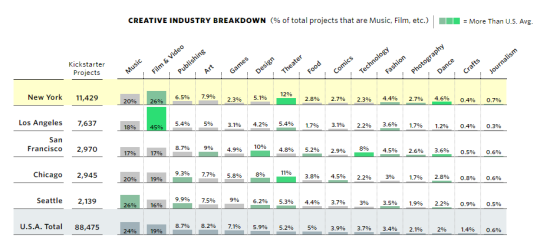
    Polygraph (visually-driven essays) has a great piece called, The Entire History of Kickstarter Projects, Broken Down by City. What they did was look at 88,475 Kickstarter projects to map the various creative communities across the US.

    Here’s a snapshot (you may need to zoom in):

    image

    In general, Kickstarter in the US sees a high concentration of music projects (24%) and film & video projects (19%). But where it gets interesting is to see which cities over-represent in certain categories.

    New York = film & video, theater, and dance

    Los Angeles = film & video (not surprisingly 45% of all projects)

    San Francisco = design and tech

    Chicago = theater

    Detroit = music

    Nashville = music (76% of all projects!)

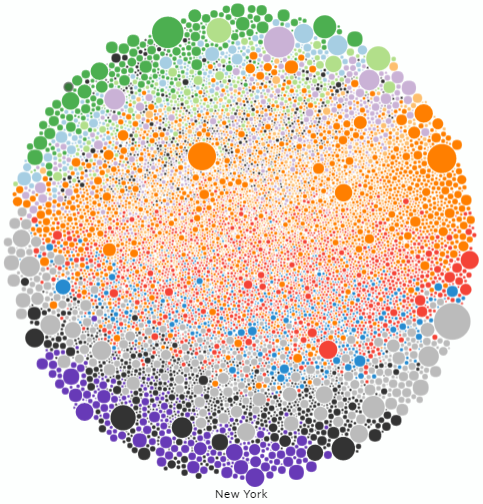
    They also measured the size of each project (number of backers) and created these neat bubble diagrams:

    image

    Above is New York. Red is music. Orange is film. And yellow is theater.

    I also like their explanation for why they did this project:

    Pretty much all existing attempts to map creative communities use census and jobs data. But creative efforts are often side-hustles. They’re garage/basement/cottage industries that will not appear in a census.

    It’s true. This data should be a much better capture of each city’s creative soul.