Daily insights for city builders, delivered every morning at 6 AM ET. I’m Brandon Donnelly — a Toronto-based real estate developer and founder of Globizen. I’ve been writing here since 2013.

Tag: munich

  • London super prime and the City Trifecta Index

    The latest (15th) edition of Knight Frank’s annual The Wealth Report was published last month. I find these interesting because they give you a global view of how and where capital is flowing into real estate (specifically prime real estate). London, for example, did rather well last year despite the pandemic. Buyers from the around the world spent nearly $4 billion on what is commonly referred to as “super-prime properties.” This is real estate with a sale price of US$10 million or more. London saw 201 super-prime properties trade hands last year, with an average price of $18.6 million and with 31 of these transactions being at or above $25 million. This is an increase compared to the year prior (2019), which I suppose is something given that the UK’s housing market was more or less frozen between March and May of last year. These figures put London at the top, ahead of New York and Hong Kong, when it comes to super-prime real estate sales in 2020. (London figures via the Financial Times.)

    Another interesting thing that you’ll find in the report is a city ranking that Knight Frank calls their City Trifecta. What this index does is take Knight Frank’s City Wealth Index (which considers where wealth is currently concentrated) and then adds in two other dimensions: innovation and wellbeing. The idea here is that innovation should drive future economic growth and wealth, and that wellbeing (quality of life) is pretty important when it comes to the future competitiveness of our global cities. When you look at the world’s top cities through this lens, the ranking starts to differ from what you may be used to seeing with cities like London, New York, and Hong Kong at the top (see above chart). Now you have Munich taking the number one spot; Boston and Toronto in 5th and 6th position, respectively; and cities like Zurich jumping up ahead of cities like Hong Kong. These kind of rankings always need to be looked at with a critical eye, but they can be interesting nonetheless.

    Image: Knight Frank

  • A visit to BMW World

    Today we visited BMW Welt (World) and the BMW Museum in Munich.

    BMW Welt was designed by COOP HIMMELB(L)AU out of Vienna. It is the result of a design competition that the BMW Group held in 2001. Construction of the ~73,000 square meter facility was completed in 2007.

    The project is centered around a great hall and an elevated vehicle delivery area known as Premiere. It was designed — and this includes the HVAC system — to handle 40 car deliveries per hour, or 250 per day. I guess they don’t work a full 8 hours.

    Below are two photos that I took of the delivery area. The circles you see on the floor in the second picture are rotating platforms. This is where you want to pick up your new car.

    And here is a plan of the entire Welt space via COOP HIMMELB(L)AU:

    I also really enjoyed the BMW Museum, which is housed in a separate building adjacent to the BMW Tower (the one that looks like engine cylinders).

    The “art cars” were a lot of fun. I’m sure that many of you will be able to guess the artist behind this one:

    But what I enjoyed most were the classics like this one here:

    The least interesting cars for me were the ones that weren’t old enough to be “classic”, but also weren’t new and shiny. This can happen with architectural styles as well. Designs sometime need time to settle in.

    For more photos of BMW Welt and the BMW Museum, follow me on Instagram.

    Drawings/Isometrics: COOP HIMMELB(L)AU

  • Homes built in the past year

    I’m on a flight right now reading the latest issue of Monocle Magazine in a seat that barely accommodates the length of my femur. This month’s issue has their annual ranking of the top 25 cities in the world.

    Munich is first, which is not unusual for their ranking methodology. It generally scores well. Quality of life is high. Crime is low. The economy is strong. Beer gardens are fun. And you’re close to the Alps for snowboarding.

    One stat that caught my attention — and it’s not included for all of the cities — is the number of homes built in the past year. Presumably this is all housing units in the metro area — for sale, for rent, subsidized and so on.

    Here are their (clearly rounded) numbers. The order is as they appeared in the ranking, but again, not ever city included this stat.

    • Munich: 8,300
    • Tokyo: 150,000
    • Copenhagen: 5,000
    • Berlin: 11,000
    • Madrid: 1,600
    • Hamburg: 7,000
    • Melbourne: 5,100
    • Helsinki 4,400
    • Stockholm: 7,000 (18,000 in Greater Stockholm)
    • Sydney: 39,000
    • Hong Kong 17,000
    • Vancouver 22,600
    • Amsterdam 5,100
    • Kyoto 8,900
    • Dusseldorf 2,600
    • Barcelona 1,000

    Some of these numbers appear to stand out, such as the counts for Tokyo, Sydney and maybe Vancouver. But it’s hard to draw any conclusions around housing supply and housing affordability.

    Melbourne and Amsterdam allegedly have the same number of homes built over the past year, but according to Monocle the metro areas of Melbourne and Amsterdam have populations of 4.85 million and 2.4 million, respectively. This also says nothing about their growth rates.

    So which one is doing a better job of addressing housing demand? I’m not sure.

    But it was still interesting to see that Tokyo delivers somewhere around 150,000 homes a year. Tokyo is somewhat unique globally in that it’s a big city — one of the biggest — that somehow manages to gracefully balance both scale and quality of life.

    Photo by Elias Keilhauer on Unsplash

  • Munich is planning an ambitious…Radschnellverbindungen

    On Monday of this past long weekend, I went for a quick bike ride over to the Beaches, up to Little India, and then back down to the St. Lawrence Market. 

    The ride along Lake Shore and through the Beaches is one of my favorites. Minus a few awkward twists and turns as you leave the East Bayfront, it’s generally smooth sailing. It feels a bit like a bike highway.

    It took me about 24 minutes to get to the beach, which means I was traveling on average just over 20 km/h. If you lived in the Beaches and worked downtown, that would be a perfectly reasonable commute in my mind.

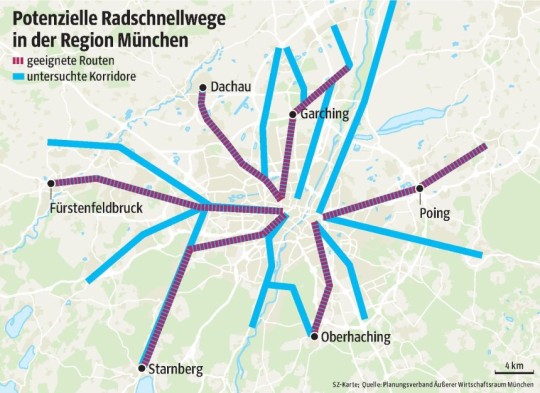
    And it’s for reasons like this that Munich is looking to invest in a huge network of bike highways. They’re calling it a Radschnellverbindungen – which I might start ambitiously calling some of the bike paths in Toronto – and the idea is to connect the city with all of the suburbs.

    Below is a map of the routes they’re looking at. The purple lines are “suitable routes” and the blue lines are corridors they’ve looked at it. If I’m wrong in my translation, blame Google.

    They are still in the feasibility stage, but the idea is for each bike path to be 4 meters wide and have no cross streets or traffic lights – essential a highway for bikes.

    And if you think this all sounds like a pipe dream, check out this video of the recently opened Cykelslangen (Cycle Snake) in Copenhagen.

    [youtube https://www.youtube.com/watch?v=iypvbe6J6Qs?rel=0]

    Would you commute to work on your bike if you had a highway, just like cars do?

  • I got 88 buildings

    The NH Deutscher Kaiser Hotel building in Munich looks like this:

    It’s a fairly conventional tower on top of a podium.

    However, photographer Victor Enrich decided to reimagine what this tower and podium could look like. In fact, he did it 88 times. Here’s the video. And here’s one example:

    The realism of each is incredible. It’s also a fascinating—albeit outlandish—study of what could be.

  • Toronto needs a consistent taxi brand

    For the sake of our global brand, Toronto taxis need to have a consistent brand – the same car, the same colour. I’ve thought about this before and written about it somewhere, but it’s worth repeating.

    I was driving around downtown on Saturday night and I started to compare the ratio of cabs to non-cabs on the road. As is typical for any weekend night, most of the cars were cabs. And yet they’re a complete hodgepodge of different car types and colours.

    The cab companies, of course, like it this way. They want to be differentiated. But from a practical standpoint, does this even matter? Sure, I might call a specific company to pick me up somewhere, but when I’m hailing a cab on the street I go for the first available car. I couldn’t care less what company it is. 

    The result of this heterogeneity though is that we’re missing out on a valuable opportunity to brand our city. New York has its yellow cabs, London has its black cabs and all of Germany has its beige Mercedes Benzes. In our psyche, those cars symbolize those cities.

    Just like companies, cities today compete with one another for talent and capital. It’s been said many times before that the vast majority of Millenials now choose where they want to live (which city) before they even start looking for a job. Toronto needs to be on the top of that last.

    Taxi branding may seem like a small detail, but it’s not. As a comparison, take for example the Shangri-La Hotel company. The first time I stayed at one of their hotels was in Vancouver. I remember asking one of the staff members about the fragrance that seemed to permeate the entire building.

    He told me that it was the “Essence of Shangri-La” and that it was actually diffused throughout the entire building, as well as around the perimeter. The purpose of this was to give global travels a familiar feeling – that feeling of being home – wherever they are in the world. Now that’s consistent branding.

    Similarly, being in Toronto should make you feel like you’re here and in no other city. Our lumbering streetcars certainly help with that, but our cabs don’t. In a time where globalization is making cities feel more and more alike, we need to be doing everything we can in order to differentiate.

    Hell, in addition to having the same car and colour, maybe we should even create an Essence of Toronto scent for our cabs.

  • Nothing stops Detroit

    When I told my friends that I had booked a weekend getaway to Detroit, I got responses like: “By accident?” and “Why on earth would you want to go there?” But that’s exactly what I did last weekend. I went to Detroit.

    I wanted to see first hand what was going on the city. I wanted to see if it really was the lost cause that the media makes it out to be or if it had the potential to come back. I had been following Dan Gilbert’s efforts to seemingly buy up every building in downtown Detroit and I wanted to see if those efforts were working. I’m an optimist, so I wanted to believe that they were.

    I also have friends who live in the city and a friend who’s working on a number of urban renewal initiatives in the midtown area. It was a great opportunity for me to get a local point of view and also learn about what’s coming in the development pipeline. So I met my friend Alex – pronounced Ay-lex in Michigan – and I got the run down on Detroit.

    Detroit is an absolutely fascinating city. As I mentioned before, it’s like visiting the ruins of a former empire, but one that’s recent enough to remind you of how ephemeral success can be. Whether it’s the death of Blackberry or the decline of Detroit, the mighty fall all the time. But it’s precisely this rich history that makes the city so interesting. When you walk inside some of the buildings built during the first half of the 20th century, you can’t help but be reminded of how important of a city Detroit was for America. Detroit was filthy rich.

    But even beyond the showpieces like the Guardian Building and Fisher Building, the Detroit landscape is littered with office and industrial buildings that would make any developer want to line up. One neighbourhood in particular that stood out for me was Rivertown. Running along the water just east of downtown, the area is filled with old brick buildings and the right street scale for a magnificent neighbourhood.

    However, I was told that this neighbourhood doesn’t really have a lot of momentum behind it. Most efforts are focused on the downtown and midtown areas. Still, I couldn’t help but imagine the area as a thriving mixed-use community. In the shorter term, I also thought the area could be really cool as an entertainment and nightlife district similar to Kuntspark in Munich, which was also a former industrial zone.

    Downtown and midtown are where it’s most evident that change is underway though. “Opportunity Detroit” is the slogan of Dan Gilbert’s real estate company, called Bedrock, and you see it plastered up in all of the windows downtown. Offices buildings are now leasing up and new retailers are moving in. I was told that five years ago none of this was happening. Woodward Ave was empty.

    As you move north towards midtown, you then discover a Michigan first: an urban depressed freeway. Detroit was the first city in America to build these and it’s certainly going to work in its favour as its city centre is reborn. I can only imagine how much more divided the city would be today had the freeways that wrap the core been built as elevated overpasses.

    But that’s not the case. Downtown and midtown are decently connected, albeit different in feel. In midtown, the buildings are more midrise in scale, the streets are broader, and the retail appears further along. There’s a Whole Foods that just opened up and fantastic new coffee shop called Great Lakes Coffee. It was busy when I was there on Sunday morning and I was told that it’s really the first place in Detroit where people could go to hang out and work.

    As you leave the core of the city things really fall off though. This is where Detroit becomes a prairie city and you see the one house on a block condition that the media likes to capture. It’s here where it becomes apparent that Detroit is simply too big, geographically, for its current population. You have infrastructure in place for 2 million people and yet a tax base of 700,000 people. No wonder it went bankrupt.

    So like many others have suggested before, I think Detroit needs to figure out a way to shrink in order to eventually grow. Just like a company going through restructuring, Detroit has to rid itself of some its liabilities. It’s going to have to take that write-down.

    At the same time, the population needs to be somehow consolidated and something needs to be done with all its excess land (urban agriculture is one idea). Jane Jacobs taught us that towers in a park don’t create urban vibrancy and the same can be said for houses in fields. Detroit is fragmented and divided. More so than dangerous, most of the city just feels eerily deserted.

    However, despite these challenges, two things really stood out for me during my visit.

    The first is that Detroit still very much has an ethos of production. It likes building and making things, and it’s visible in the emergence of brands like Shinola who are producing bikes, watches and leather goods right in the city.

    The second is that there’s a palatable sense of possibility. Detroit hasn’t lost that entrepreneurial spirit that made it a leader in manufacturing, music and sports. A great example of this is the Green Garage in midtown, which is a former Model T showroom turned sustainable coworking lab for Detroit entrepreneurs.

    But perhaps the best way to sum up this spirit is through a line I saw on a neon sign downtown on Woodward Ave. 

    It read: “Nothing stops Detroit.”