Daily insights for city builders, delivered every morning at 6 AM ET. I’m Brandon Donnelly — a Toronto-based real estate developer and founder of Globizen. I’ve been writing here since 2013.

Tag: multifamily

  • US expects to deliver more than 330,000 new rental units this year

    Here’s some recent data from RENTCafe looking at the supply of new multifamily rental apartments in the US. About 334,000 rental units are expected to be completed and occupied this year, which is a decline from the 2018 peak of 357,000 units, though still a relatively high number. This year is expected to be the fifth consecutive year where supply is greater than 330,000 units. Below you can also see how this breaks down across the largest MSAs (metropolitan statistical areas).

    For this study, RENTCafe looked at new apartment construction data for buildings with 50 or more units (so no smaller infill projects). It covers 109 US metro areas. To determine whether a building is likely to be completed in 2021, they looked at confirmed certificate of occupancies and also used some sort of fancy algorithm to predict the likelihood that an under construction project will get one before the year is out.

    For more on their study, click here.
  • Why are apartment rents in Seattle dropping?

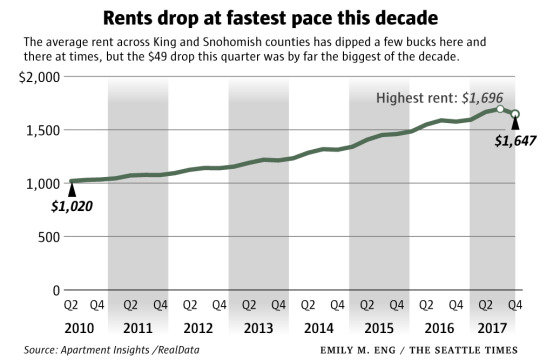
    This week I saw it reported that in this decade alone, the Seattle area is set to deliver more new rental apartments than it did in the prior 50 years combined. 

    And as a result, the sentiment is that new housing supply is finally starting to keep pace with demand and put downward pressure on rents. 

    Do you remember who was the crane capital of the US a year ago? They may still have that title.

    In some of the most desirable neighborhoods of Seattle – where much of the new supply is coming online – rents dropped 6% compared to the prior quarter. At the county level, this last quarter was by far the biggest drop of the decade according to the Seattle Times.

    Funny how that works.

    It’s also worth noting that the US as a whole is building far more rental apartments than condominiums. Here is a post I wrote in August 2015 which pegged condos as a percentage of overall multifamily construction at around 5.5%. That’s a tiny percentage.

  • A cohousing case study

    There’s a lot of interest right now in micro apartments. Here is a recent example from New York City. Generally speaking the model is driven by a need to increase housing affordability: shrink the apartments; lower the prices. 

    To compensate for these smaller units, the buildings are often equipped with larger shared spaces and a desire to create a sense of community.

    The below TED talk by architect Grace Kim is an interesting case study of a project that started, first, with a desire for cohabitation. Her thesis is that cohousing can make us happier, less lonely, and more socially connected.

    The cohousing community that she profiles is one that she both designed and developed and one that she now lives in and practices architecture out of.

    If you can’t see the video below, click here. It’s only 10 minutes. After you’ve watched it, let us know in the comment section below if this is a community you could see yourself being a part of.

  • CAPREIT announces first joint venture development

    Yesterday CAPREIT announced that we have entered into our first joint venture development agreement for a mixed-use project at 1100 King Street West in Toronto’s Liberty Village neighborhood. 

    The agreement is to acquire a 1/3 undivided interest in the residential component of the project for $60.3M. The residential component will consist of 3 towers and 506 apartment suites (sitting on top of a roughly 160,000 square foot commercial/retail podium that will not be owned by CAPREIT).

    Here’s what Thomas Schwartz, President and CEO of CAPREIT had to say:

    “We expect our interest in the property, combined with the property management fees we will receive, will be accretive to our cash flow and set the stage for similar partnerships, along with our own new rental developments in the future.”

    As a member of the development team at CAPREIT, it feels great to get this one out there.

    Click here for the full public press release.

  • Multifamily vs. single family

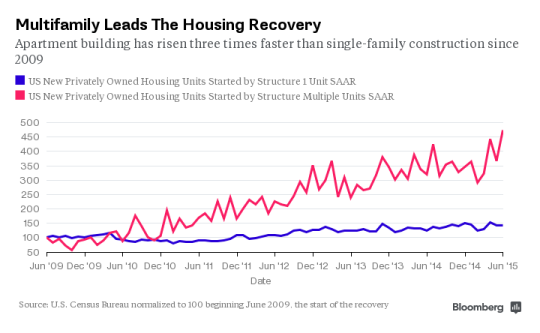
    Since 2009 when the U.S. economy started to recover, housing starts (i.e. new residential construction) have favored multifamily buildings over single family housing. Apartment/condominium construction has grown 3 times faster according to the U.S. Census Bureau (via Bloomberg).

    image

    A lot of this multifamily construction is assumed to be rental apartments, but this category also includes for sale condominiums. The classification has to do with building typology rather than housing tenure. (I would love to see how the above graph breaks down in terms of the latter.)

    The typical explanations for this trend often relate back to Millennials being poor and saddled with student debt. That’s why they’re delaying buying single family homes. But eventually the expectation is that they will resume doing

    (largely) what previous generations have done.

    Money and the economy, I’m sure, have something to do with the above trend. But I’m not convinced that it’s the whole story. 

    There are also shifts happening with respect to consumer preferences and with respect to how we plan and build our cities. That’s why I’m very interested in monitoring family formations and housing choices. 

    At the same time, I’m also a Millennial. And whenever I catch myself thinking a certain way, I assume that there are probably other Millennials out there who feel similarly.