Daily insights for city builders, delivered every morning at 6 AM ET. I’m Brandon Donnelly — a Toronto-based real estate developer and founder of Globizen. I’ve been writing here since 2013.

Tag: multifamily development

  • Two different multifamily markets

    I had lunch today with a friend (from school) who runs a multifamily development company in South Florida. His business is very similar to the apartment strategy that we are now working on in Toronto, in that he builds a repeatable apartment product (garden style apartments). In fact, he was telling me that he now has a dedicated design & QA/QC team within the company. Their job is to focus on continuous optimization and on reducing construction inefficiencies.

    This is the way!

    But each market is obviously unique. His rents are in the US$3 – 3.25 psf range (call it ~C$4.15 – 4.50 psf), whereas in Toronto you need something closer to C$5 psf to have a feasible project. Our yields are also lower on average. It’s hard work to get to an untrended yield-to-cost of 5% here. But for him, he can’t raise capital with anything less than 6.5%, which represents a development spread of at least 150 bps over where multifamily cap rates are today in his market (~5%).

    Juicy by comparison.

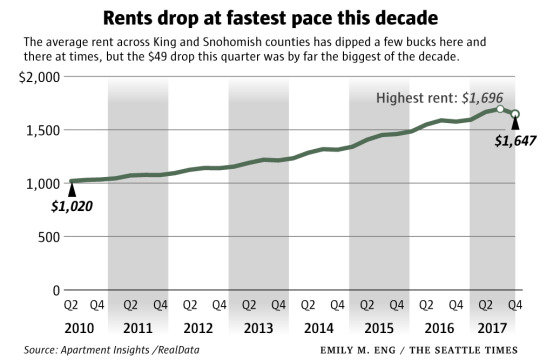
  • Why are apartment rents in Seattle dropping?

    This week I saw it reported that in this decade alone, the Seattle area is set to deliver more new rental apartments than it did in the prior 50 years combined. 

    And as a result, the sentiment is that new housing supply is finally starting to keep pace with demand and put downward pressure on rents. 

    Do you remember who was the crane capital of the US a year ago? They may still have that title.

    In some of the most desirable neighborhoods of Seattle – where much of the new supply is coming online – rents dropped 6% compared to the prior quarter. At the county level, this last quarter was by far the biggest drop of the decade according to the Seattle Times.

    Funny how that works.

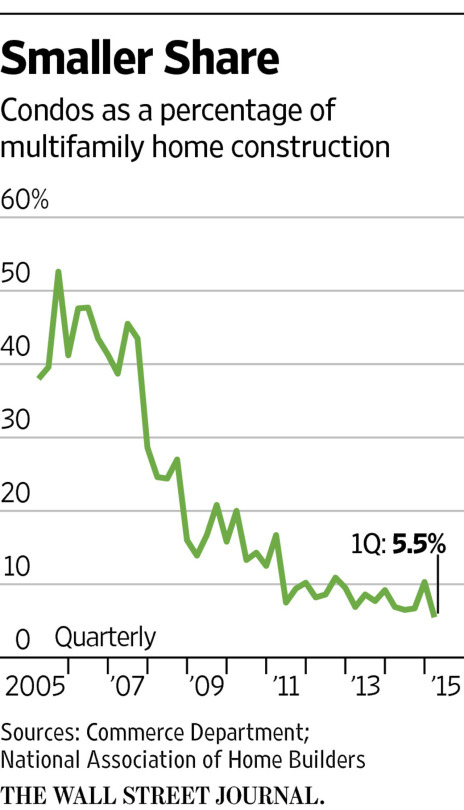
    It’s also worth noting that the US as a whole is building far more rental apartments than condominiums. Here is a post I wrote in August 2015 which pegged condos as a percentage of overall multifamily construction at around 5.5%. That’s a tiny percentage.

  • America really is building very few condominiums

    On my way back from Philadelphia
    this past weekend I wrote a post called, The
    Philadelphia (real estate) story
    . It was about how opposite the market is
    in Philly compared to Toronto.

    After writing that post and
    because of a discussion in the comment section, I started thinking about condo
    vs. rental apartment development across the US. Because unlike cities such as
    Toronto and Vancouver, it struck me that – outside of maybe New York and Miami
    – most U.S. cities are really not building a lot of for sale condos. And if
    you’re from Toronto or Vancouver, I bet that feels odd to you.

    But what exactly is that number?

    As of the first quarter of 2015, condos as a percentage of all new
    multifamily (apartment) construction in the US was only 5.5%. That’s a tiny number and is down from
    over 50% before the Great Recession, which means most
    cities in the US really are building mostly rental. Last year the US built 264,000
    multifamily units across 11,000 buildings
    .

    So why is that happening?

    There appears to be a number of
    factors, according to a
    recent article in the Wall Street Journal
    .

    There’s a supply side
    constraint:

    Another obstacle cited by developers: construction loans. Matt
    Allen, chief
    operating officer of the Related Group, a developer based in Miami, said he can
    get a construction loan for roughly 75% of the cost of building an apartment
    complex. But lenders will cover only 50%, on average, of a condo complex’s cost
    because of the greater risk, he said.

    There’s a demand side
    constraint:

    As a result, the Federal Housing Administration, which
    backs mortgages made to low-wealth buyers, tightened its lending standards in a
    series of moves from 2008 to 2012. Under the new rules, in order for the FHA to
    insure mortgages in a given condo complex, at least half of the units must be
    owner-occupied and no more than half can be FHA-insured, among other
    requirements. For condo projects under development, at least 30% of units must
    be under contract for sale before the FHA will start backing mortgages there.
    Mortgage giants Fannie Mae and Freddie Mac tightened
    their standards as well.

    And there are macroeconomic
    factors:

    On the entry-level end, tepid job growth early in the
    recovery and the younger generation’s affinity for flexibility have fueled
    demand for rentals. Apartment rents are up nearly 16% since 2010, according to Reis Inc.

    Notwithstanding
    the above, could this be a post-recession policy pendulum that has swung
    too far in one direction?