Daily insights for city builders, delivered every morning at 6 AM ET. I’m Brandon Donnelly — a Toronto-based real estate developer and founder of Globizen. I’ve been writing here since 2013.
There’s something powerful about seeing/hearing cities being depicted in film, TV, and other kinds of pop culture. It creates familiarity and does a lot to drive the brand of that place.
But how often are you just seeing one city disguised to look like another? Actually quite often.
Here’s an interesting video that talks about how the 3rd largest film production city in North America never actually plays itself.
I know that there are real economic benefits to being a cheap place to film movies, but I would love to see Canadian cities play themselves. There are also big benefits to that.
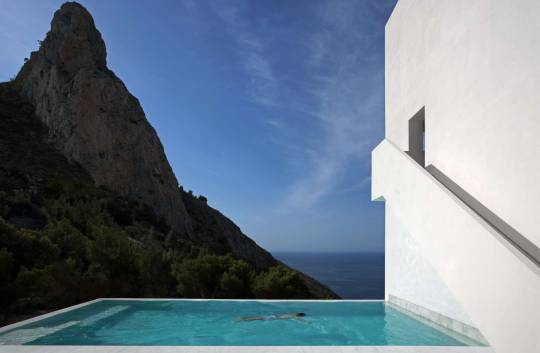
There has always been a strong relationship between architecture and film. Next to actually being there, video is one of the best ways to experience architecture.
And that’s because space is not static. A big part of how we experience space has to do with what it feels like as you move through it.
For example, American architect Frank Lloyd Wright was notorious for his sprawling horizontal houses and low ceiling heights. In his Fallingwater House (which is stunning), I swear that my head was rubbing on the ceiling in certain rooms (I’m 6’3").
But he did this to purposefully create a feeling of compression. Because then as you exited the room (in this case to go outside onto a terrace) the feeling of openness and expansion is all that more powerful. The contrast creates awareness.
On Monday I watched the movie Moneyball for the first time. I really enjoy movies, but I unfortunately don’t watch a lot of them, which is why I am only now watching Moneyball. It was released in 2011.
The movie is based on a 2003 book of the same name that many people believe changed the game of baseball. It emphasizes rigorous statistical analysis (known as sabermetrics) over gut feeling, instinct, and traditional metrics when it comes to assembling winning baseball teams.
I don’t know a lot about sabermetrics, but I am now excited to read the book. Still, the dichotomy between the New York Yankees and the Oakland Athletics is incredibly interesting to me. And it reminded me of a post I wrote a few months ago ago called: When everyone thinks you’re wrong.
In the movie, Billy Beane, the GM of the Athletics, realizes that he cannot compete with the Yankees dollar for dollar. The Athletics are a small market team and the Yankees, with their large payroll, will always be able to pay more for players. So he decides that he will need to think about the problem differently to win.
What’s interesting about this is that it’s exactly the framework I talk about in my post when it comes to buying (real estate) development sites:
“…you can really only win development sites in one of two ways. Either you’re willing to spend the most money or you see something and have a vision that nobody else sees.”
Of course, lots of baseball teams today are now employing sabermetrics. But at the time, everyone thought Billy Beane was nuts. It’s hard to try something new and be different. Many of us just want to do what is least likely to fail.
But there’s so much value in having conviction and being right about something that everyone else thinks is wrong. You won’t always get it right. And that’s okay. But when you do get it right, it’ll be magic.
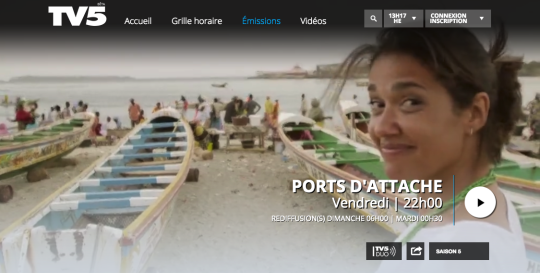
This morning I was interviewed for a Montreal-produced TV show called Ports D’Attache. The English version of the show is called “Waterfront Cities of the World” and it airs on Discovery.
Rather than a travel show, it’s a look at the “spirit and soul” of each waterfront city through the lens of “local personalities.” There’s definitely a lot of fodder for city geeks and so I thought you all might find the series interesting.
Toronto was the last stop of season 5. The other cities from this season include Philadelphia, Budapest, Rome, Taipei and Kuala Lumpur, to name only a few of them.
I’m glad that they decided to come to Toronto and I’m delighted that they invited me to be on the show. The team was great and, if you haven’t already noticed, I love supporting this city.
The show will first be released in French (with my comments dubbed over), but an English version will follow. Once that version is released, I’ll circulate a link.
I was out for a bike ride last night and, on my way home, I decided to try out the new dedicated bike lane on Adelaide Street. Usually I would take King Street, but it was completely full because of Caribana parties.
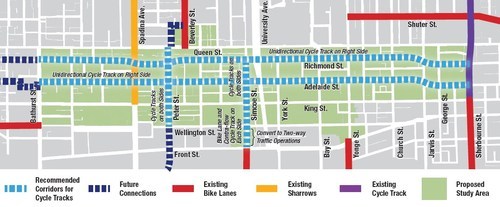
For those of you who may not be aware, the city of Toronto is currently piloting two dedicated bike lanes on Adelaide Street and Richmond Street in the downtown core. Both streets are one-way and because the lanes were so big to begin with (highway-like spacing), I’m told that these new bike lanes didn’t even eat up a driving lane.
Here’s a map of the pilot area:
Given that dedicated bike lanes are a scarce resource here in Toronto, I have to say that it was rather luxurious having my own piece of road. And because there’s no longer any fear of parked car doors swinging open, I was able to ride a lot faster than I normally would.
But as my friend Evgeny pointed out earlier this week, there’s a big difference between dedicated and grade separated bike lanes. Indeed, on my trip from Bathurst Street to Church Street last night, I encountered 3 cars parked in my lane.
So, I hope that these bike lanes become a permanent fixture downtown, but that the city makes them grade-separated. I’m sure people will use them. At the same time, I think they could also act as a catalyst for more pedestrian life along both of these streets.
If you haven’t yet tried them out, I would encourage you to do so. The city is tracking usage and so you would be supporting the cause. And if there’s anybody parked in your lane, below is one way to handle it. It’s a video by Casey Neistat out of New York. If you can’t see it below, click here.
Earlier today I stumbled upon a documentary called “The Human Scale.” I haven’t watched it yet, but I’m planning to rent it from iTunes later this weekend. Here’s the trailer. Click here if you can’t see it below.
One of the things that’s so fascinating about studying cities right now, is that it feels as if we’re at a major turning point with respect to how we think about them. We’re coming off a long period (decades) of infatuation with the car, where planners and engineers predominately cared about one thing and one thing only: efficiently moving cars in and around cities.
But having now fully built out cities around the car, we’ve come to realize two important things. First, that it’s virtually impossible to keep up with the demands of the car. No matter how many highways and roads you build, there always seems to be gridlock. And second, by focusing so closely on the car, we’ve built cities that aren’t great places for people.
If you take a look at this short clip from The Human Scale (featuring Siena, Italy), I think you’ll immediately see how differently we used to build our cities and how disruptive the car has been to them.