Daily insights for city builders, delivered every morning at 6 AM ET. I’m Brandon Donnelly — a Toronto-based real estate developer and founder of Globizen. I’ve been writing here since 2013.

Tag: monocle magazine

  • The history of humankind’s greatest invention

    A number of people emailed me this past weekend saying that they appreciated the recent book recommendation — something to read over the holidays. So here’s another one: Metropolis — A History of the City, Humankind’s Greatest Invention.

    Right now is probably the ideal time to read a book about the history of cities because it’s a reminder of just how resilient cities are in the face of adversity. Even ones that have been utterly wiped out because of war or some other catastrophe have managed to successfully rebuild.

    If you’d like to buy a copy, you can do that over here. This book was also featured in part two of a “book club” that The Urbanist is running on its radio show right now. So if you’d like to take it for a 30-minute spin instead, click here.

  • My life as a tram

    Love them or hate them (I happen to love them), Toronto’s streetcars are part of this city’s identity. Most North American cities got rid of their streetcars around the middle of the 20th century. But Toronto didn’t. And that has left us with the largest first generation streetcar network in the Americas in terms of total track length, number of cars, and ridership. That’s something. If you’re also a fan of streetcars (or just like geeking out about cities), you may enjoy this little ode to Zürich’s tram network by Monocle. It’s called, “My life as a tram.”

  • New Monocle City Series to launch in Chengdu

    Today, Monocle announced a new “City Series,” which will take the form of a focused half-day summit. The objective is to explore the urban issues facing mayors, developers, investors, and citizens. The first summit will take place this November 4 (2019) in Chengdu — the capital of the Sichuan province in China.

    For those of you who aren’t familiar with Chengdu, it’s a modest Chinese city with over 14 million people in the administrative area and over 10 million people in the urban boundary (2014 figures). It is the 5th most populous agglomeration in China.

    I can’t vouch for the quality of this new series, since this will be the first one, but Monocle has been running a longer, multi-day, quality of life conference for a few years now. Mostly, I am intrigued by the selection of Chengdu as the inaugural city for this new series. I take it as evidence that interesting things are happening there.

    Image: Monocle

  • Tokyo’s kitchen cars (or food trucks)

    Click here for a short video (by Monocle) about Tokyo’s nascent “kitchen car”, or food truck, scene. (The soundtrack is fun.) Historically, street food stands, or “yatai,” have had a questionable reputation in Japan. They proliferated across the country following World War II when times were tough and food was being rationed. But as Tokyo prepared to host the 1964 Olympics, local governments began to clamp down on yatai. They were seen as unhygienic and a place for drunks to hang out. There may have also been a sense of shame around the country’s post-war struggles. Whatever the case may be, these new food trucks have — aided by technology — changed the way people eat on the street.

  • Building a better São Paulo

    São Paulo, and Brazil more broadly, are near the top of my list of places that I want to visit. 

    Starting in the 1930s, Brazil became an early adopter of modern architecture with projects like the Ministry of Education and Health Building. It was one of the first countries outside of Europe to push modernism.

    So I am overdue for a tour of Oscar Niemeyer and Lucio Costa’s work.

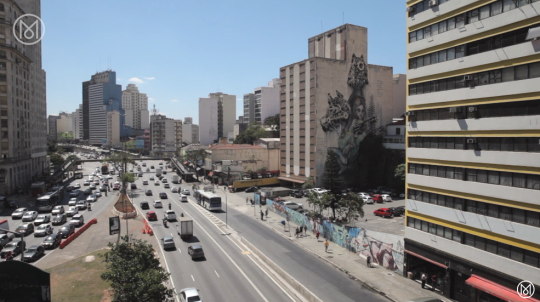
    Here is a short 7 minute video from Monocle about some of the ways in which São Paulo is reinventing its city center.

    It is for the launch of their new book, The Monocle Guide to Building Better Cities, and it got me excited about visiting the city (and country) sometime soon.

  • Homes built in the past year

    I’m on a flight right now reading the latest issue of Monocle Magazine in a seat that barely accommodates the length of my femur. This month’s issue has their annual ranking of the top 25 cities in the world.

    Munich is first, which is not unusual for their ranking methodology. It generally scores well. Quality of life is high. Crime is low. The economy is strong. Beer gardens are fun. And you’re close to the Alps for snowboarding.

    One stat that caught my attention — and it’s not included for all of the cities — is the number of homes built in the past year. Presumably this is all housing units in the metro area — for sale, for rent, subsidized and so on.

    Here are their (clearly rounded) numbers. The order is as they appeared in the ranking, but again, not ever city included this stat.

    • Munich: 8,300
    • Tokyo: 150,000
    • Copenhagen: 5,000
    • Berlin: 11,000
    • Madrid: 1,600
    • Hamburg: 7,000
    • Melbourne: 5,100
    • Helsinki 4,400
    • Stockholm: 7,000 (18,000 in Greater Stockholm)
    • Sydney: 39,000
    • Hong Kong 17,000
    • Vancouver 22,600
    • Amsterdam 5,100
    • Kyoto 8,900
    • Dusseldorf 2,600
    • Barcelona 1,000

    Some of these numbers appear to stand out, such as the counts for Tokyo, Sydney and maybe Vancouver. But it’s hard to draw any conclusions around housing supply and housing affordability.

    Melbourne and Amsterdam allegedly have the same number of homes built over the past year, but according to Monocle the metro areas of Melbourne and Amsterdam have populations of 4.85 million and 2.4 million, respectively. This also says nothing about their growth rates.

    So which one is doing a better job of addressing housing demand? I’m not sure.

    But it was still interesting to see that Tokyo delivers somewhere around 150,000 homes a year. Tokyo is somewhat unique globally in that it’s a big city — one of the biggest — that somehow manages to gracefully balance both scale and quality of life.

    Photo by Elias Keilhauer on Unsplash

  • Guide to hotels, inns, and hideaways

    Monocle has a new guidebook out that is dedicated to hotels, inns, and hideaways. It also has a particular emphasis on the “honest, charming, quirky and independent.” So forget the conventional 5-star hotels. Hotels are fascinating places, even in today’s world of Airbnb. If you’re planning a trip or planning to start a hotel, this may be a useful handbook for you. Pick one up, here.

  • The Korean Peninsula

    I just spent the last 7 minutes listening to this brief historical overview of Seoul by The Urbanist, while I bounced around the city on Google Street View, admiring the coverage of their transit network and the density of their low-rise neighborhoods. 

    I love Street View and I love using it to explore cities.

    One of the things I liked about The Urbanist episode –  beyond it being a good soundtrack while I explored – is that it talks, albeit briefly, about why Seoul is located where it is today. 

    I am always curious about this when it comes to cities. I mean, who was it that decided, yup, this is going to be the spot. Because it’s generally a pretty sticky decision once it is made.

    You may also find this 2014 NASA photograph of the Korean Peninsula interesting. The nighttime sky renders up a pretty stark contrast between North Korea and South Korea.

    According to NASA, per capita power consumption in North Korea and South Korea is 739 kilowatt hours and 10,161 kilowatt hours, respectively. That’s why the satellite photo looks the way it does.

  • Living on water

    Phaidon has a new architectural book out that surveys 55 homes, all of which have some sort of connection to water, whether that be an ocean, lake, river, or pool. It’s called Living on Water. I don’t (yet) have a copy, but it looks like the perfect coffee table book for a cottage, summer home, or studio apartment with zero connection to water. Monocle on Design recently interviewed the editor of the book (podcast episode here). So if beautiful homes on the water are your thing, maybe check it, and the book, out.

  • Thickets of haphazardly planned condo towers

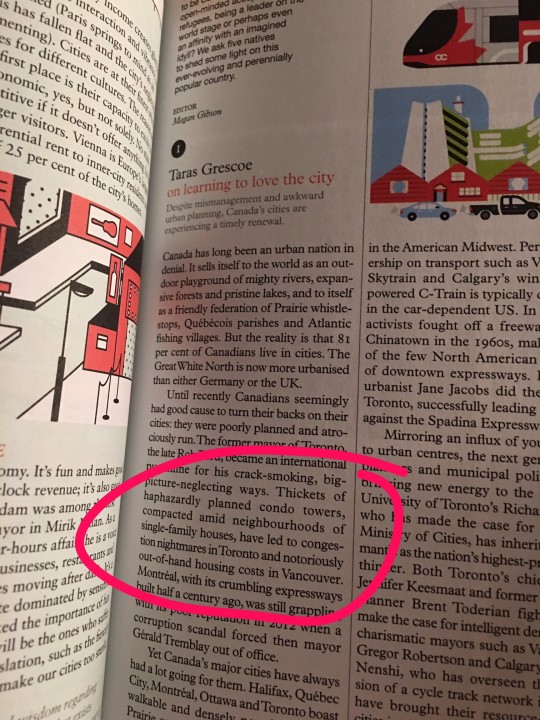
    I couldn’t sleep last night, so I got up and pulled out an old issue of Monocle magazine from my nightstand. I then stumbled upon the following article by Taras Grescoe.

    What really stood out for me was this line:

    “Thickets of haphazardly planned condo towers, compacted amid neighbourhoods of single-family houses, have led to congestion nightmares in Toronto and notoriously out-of-hand housing costs in Vancouver.”

    It bothered me for a few reasons:

    – The frame of reference is the single-family house. It perpetuates the cultural bias that what matters most in cities, like Toronto and Vancouver, is low-rise housing.

    – I don’t get the “haphazardly planned” comment. New tower development has been heavily concentrated in the downtown core, growth centers, along the Yonge subway corridor, and so on. Their built form is also significantly influenced by their relationship to these low-rise “Neighbourhoods.”

    – I believe that building up, as opposed to out, is the way to address congestion nightmares. Though I will concede that our ability to plan and execute on transit in this city is positively deplorable. 

    – How did thickets of condos create an affordability problem in Vancouver? Many factors at play in this city, including a powerful geographic supply constraint.

    Those are just a few of my thoughts from early this morning. What are yours?