
Daily insights for city builders, delivered every morning at 6 AM ET. I’m Brandon Donnelly — a Toronto-based real estate developer and founder of Globizen. I’ve been writing here since 2013.

Tag: modular

  • The recurring promise and resistance of prefab housing

    It’s important to always remember that the idea of prefabricated housing has been around for a very long time, and yet its history is perhaps best described as a recurring cycle of revolutionary promise versus structural resistance.

    Some markets, such as Sweden and Japan, have managed to find success, with the majority of their low-rise housing now industrialized or at least involving factory-made components. But in many, or most, other markets, the prefab landscape remains checkered with bankruptcies.

    I was reminded of this when I watched this video about the 22 Parkside house in London by Richard and Su Rogers. Originally designed in 1967 for Richard’s parents, the house used prefabricated elements, such as simple steel frames and bus windows, with the hope that it might serve as a solution to Britain’s housing crisis.

    Richard jokes in the video that it never happened, but it remains a seminal modernist house nonetheless. (I love the yellow frames.) This problem is not as easy to solve as it may seem, because it’s not just a design and engineering problem.
  • Does off-site construction equal more compromises?

    We have been talking about prefabricated and modular buildings for so long that it’s easy to think it might never happen. (Here’s a related post that I wrote back in 2015.) There are also lots of groups that have tried and failed. Perhaps the most high profile is the bankruptcy of off-site construction company Katerra, which had raised some $2 billion in funding, but for whatever reason(s) couldn’t figure things out.

    That said, I’m starting to get the feeling that change might actually be underway in our industry. Over the last few months we’ve been talking about startups like Nabr. But there are many others, including Factory OS, which has been quietly building affordable housing in California (presumably far away from here). To date, they have completed 10 buildings and over 1,200 units, and they have another 24 or so buildings in the pipeline.

    This feels promising to me. And I think it’s being aided by our current environment — costs are way up and people are desperately searching for efficiencies. But if this is really going to transform our industry, I think we’re going to need to be willing to make some sacrifices. Standardization and efficiency likely means making some concessions around design and overall specificity. Not every project can be custom, as is generally the case today.

    That likely means that cities and communities will also need to become more forgiving when it comes to urban design guidelines. Could you please step your building back right here and follow this oblique angle that lines up with this important historic datum line? Nope, sorry, can’t. Our production line can’t accommodate that sort of change. Would you like the most affordable housing possible with today’s means or would you like a custom design?

  • Muuto stacked shelf system

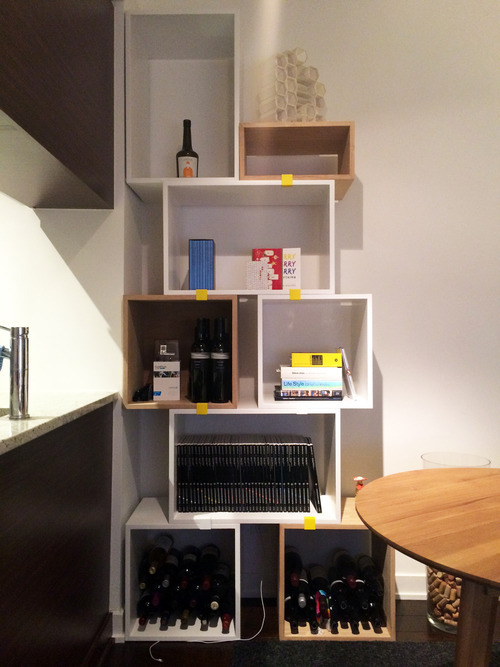
    I don’t have a lot to say today. I had a busy day and then this evening I set up some new shelving in my apartment. Here’s what it looks like:

    There’s a bulkhead directly above it (that you can’t see in this picture) and so I’ve been wanting to put shelving in this corner ever since I moved in almost 2 years ago. I haven’t really organized the contents yet, but I did get some wine into the bottom of it. First things first.

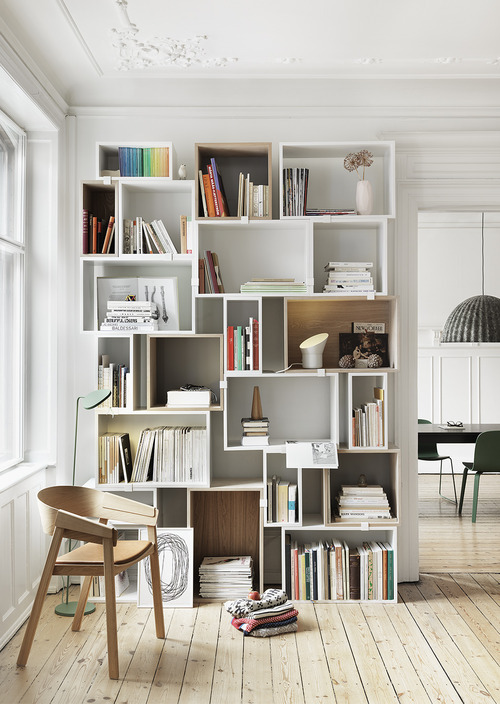
    Initially I thought about getting built-in shelves. But custom millwork is expensive and, to do something even remotely interesting, the pricing got stupid. So I searched and searched and eventually stumbled upon the Muuto stacked shelf system designed by JDS Architects.

    This is the picture that sold me:

    My setup doesn’t look nearly as impressive, but I’m still thrilled with it.

    The way it works is really simple. You stack up the boxes however you would like and then, once you’re satisfied, you just clip them together. That’s what those yellow things are in my picture. You can hide them at the back if you want, but I purposely ordered yellow ones in order to highlight how the system actually goes together.

    It wasn’t the cheapest option out there, but I’d rather have fewer things of higher quality. I already have too many things.