Daily insights for city builders, delivered every morning at 6 AM ET. I’m Brandon Donnelly — a Toronto-based real estate developer and founder of Globizen. I’ve been writing here since 2013.

Tag: modern

  • 50th year anniversary of Playtime

    This month is the 50th year anniversary of the Jacques Tati film, Playtime. Initially released in December 1967, Playtime is a French comedy that is often considered to be director Tati’s most notable work. Apparently it was commercially unsuccessful at the time of its release. But it has since become recognized, at least by some, as one of the greatest films ever made.

    The film is a satire of modern society. And so it’s also a funny critique on modern architecture and the prevailing ideologies at the time. Watch the trailer below and you’ll very clearly see this relationship: a Frenchman lost in a new, modern Paris. I remember watching one of his earlier movies – Mon Oncle – in one of my undergraduate architecture classes.

    If you can’t see the trailer below, click here:

    [youtube https://www.youtube.com/watch?v=zrYB8hgyq4s&w=560&h=315]

  • Introducing Junction House

    image

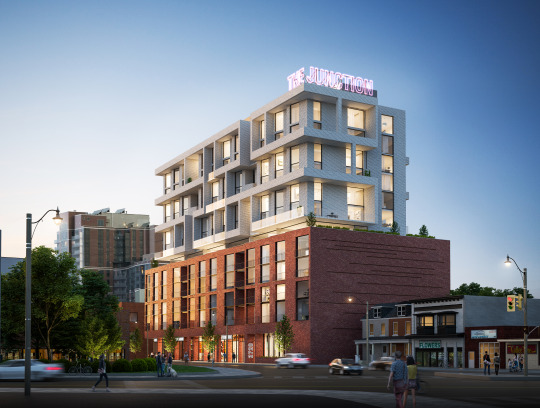
    Earlier this week I posted this teaser photo on social (full photo above) and said to stay tuned for a big announcement. Well, that announcement is here and you can read all about it over on the Globizen blog. Please let me know what you think in the comment section below.

  • For Sale: Breuer House II

    image

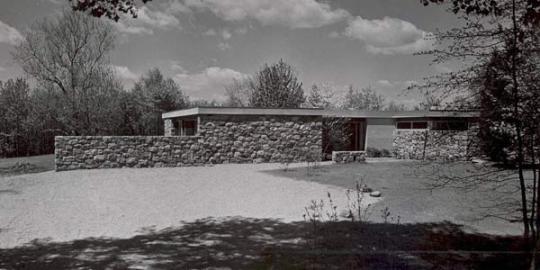
    Breuer House II is currently on the market in New Canaan, Connecticut for $5.85 million. The house has 4 bedrooms, 4 full bathrooms, and 2 half bathrooms. It is 4,777 square feet and sits on 3.11 acres of land.

    Originally built in 1951, the house was designed by the Hungarian-born, Bauhaus-trained, and Harvard-teaching modernist architect, Marcel Breuer. It served as their family home until 1975, after which time it was sold and almost demolished. Thankfully it was instead purchased, restored, and expanded (by another Harvard architect).

    Marcel Breuer was a member of what is known as the Harvard Five. They were a group of five architects who either taught at or went to the Harvard Graduate School of Design and who had moved out to New Canaan to build experimental modern homes starting in the 1940s. Homes like Philip Johnson’s Glass House.

    Seeing the Breuer House II listed for sale this morning reminded me of how cool it must have been at the time for a bunch of radical architects to move out to a sleepy New England town and start building modernist boxes. I’m sure it pissed off more than a few people.

    Does anyone know of anything similar to this happening today? 🙂

    Image from Modern Homes Survey

  • A truly modern ski and snowboard resort

    Today my friends and I spent the day at Snowbird.

    In terms of the skiing and snowboarding, it’s way up there for me alongside Jackson Hole.

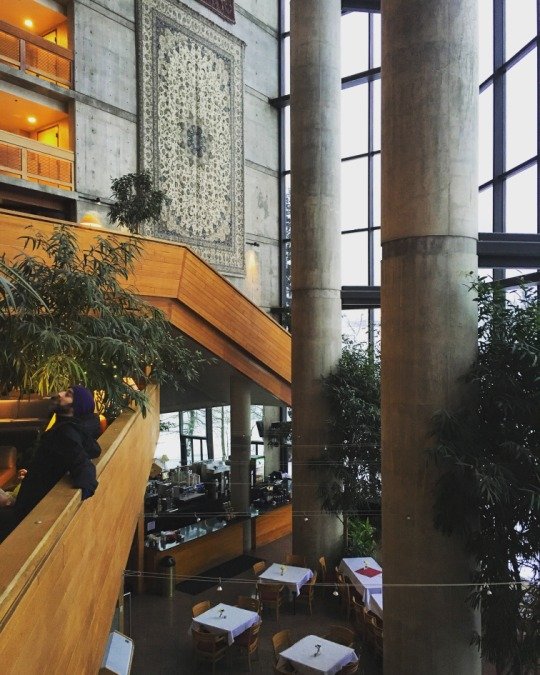
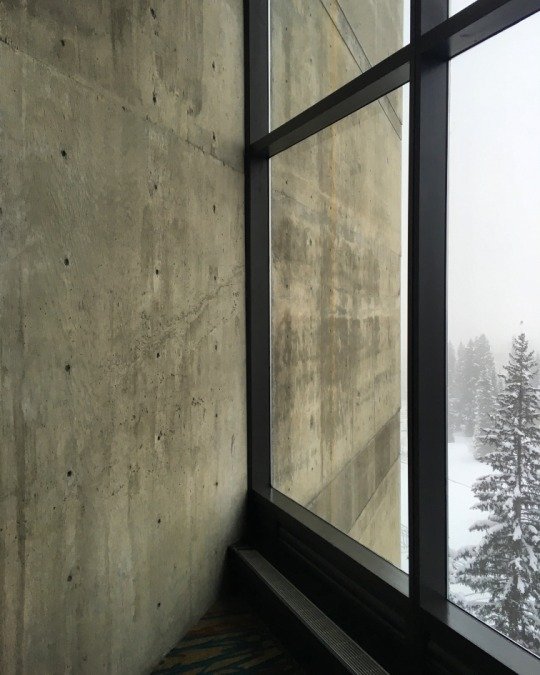
    But beyond the mountain, two things really stood out for me. Firstly, I really liked the overall brand and identity of the resort. Everything from the napkins in the cafeteria to the ski run signs were decidedly modern. Secondly, I loved the Brutalist architecture. And both of these elements combined to create what felt to me like a truly modern ski resort.

    Here are two photos that I took today:

    imageimage

    Developed in the mid-1960s by a man named Ted Johnson, the vision had always been to create a new kind of resort. In fact, Ted was insistent that they eschew the typical faux-alpine architecture that had come to characterize ski towns. 

    Here’s a brief summary of the parties involved and Ted’s design direction, via Salt Lake Modern:

    In 1965, the Snowbird Design Group was founded to create the first master plan. The original group was composed of Robert Bliss, Dean of the School of Architecture at the University of Utah, Jim Christopher, principal at Brixen & Christopher Architects, Dan Kiley, renowned landscape architect and site planning consultant based in Vermont, and architect Jack Smith. Johnson was adamant that the new resort not look “alpine lodgey” and based on the steep terrain and available land, the only choice for design would be to make it compact and dense. An aesthetic very unlike Alta, located just above Snowbird.

    For me, it’s the contrast between the rugged exposed concrete and the warm wood that I love. I left today thinking to myself that Snowbird is the most architecturally interesting ski resort I’ve ever visited.

    But as luck would have it and immediately after we left the resort, I discovered a community group called, “Save our Canyons.” And they don’t appear to be as smitten as I am with the Brutalist architecture. Here’s an excerpt from one of their articles talking about a new construction project at Snowbird:

    “Alas, more Snowbird droppings are fouling our Wasatch nest. Snowbird, already renowned for the hideous concrete bunkers at its base, has plopped another wad of architectural guano on top of Hidden Peak.”

    Of course, it is well known that Brutalist architecture isn’t often a crowd favorite. But when done well, it can be quite beautiful. Hopefully there are others who see what my friends and I saw today.

  • That hustle and bustle

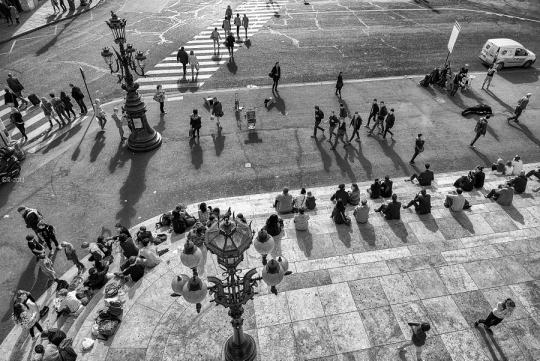
    Street Scene(s) by Olivier Rentsch on 500px.com

    https://500px.com/embed.js

    One of things I love about cities is the hustle and bustle of people. 

    I would rather eat at a busy restaurant than a quiet or dead one. I would rather workout at a busy gym than one with nobody there. And I would rather work in an office or at a coffee shop than work at home by myself. Working at home actually drains me if I do too much of it.

    The reason for that is because I derive a lot of my energy from the outside world. Urban life energizes me. To Swiss psychiatrist Carl Jung, that is the defining characteristic of an extrovert. I am focused on the “outside world of objects.”

    But because of this, I can’t help but slowdown during the holidays. Once the city dials down and the streets become emptier, my mood actually changes. I don’t feel as energized.

    It’s fascinating to think about the connection that many of us have with urban life. Since the first cities were established there has always been some kind of centralized place, market, or agora (in the case of ancient Greek cities) where people came together to exchange goods and ideas.

    But one of the most interesting turning points for modern urban life, as we know it today, came in 19th century France with poets and writers such as Charles Baudelaire.

    At the time that Baudelaire was active, Paris was undergoing Hussmannization. It was being transformed from a medieval city with cramped narrow streets into a modern metropolis of broad avenues.

    And essential to these new streets and urban spaces was the flâneur. At the time, the flâneur was an important literary and artistic figure. He was a man about town. A man of leisure. An urban explorer in the new modern metropolis.

    Here is how Baudelaire defined the flâneur in his Painter of Modern Life:

    The crowd is his element, as the air is that of birds and water of fishes. His passion and his profession are to become one flesh with the crowd. For the perfect flâneur, for the passionate spectator, it is an immense joy to set up house in the heart of the multitude, amid the ebb and flow of movement, in the midst of the fugitive and the infinite. To be away from home and yet to feel oneself everywhere at home; to see the world, to be at the centre of the world, and yet to remain hidden from the world—impartial natures which the tongue can but clumsily define. The spectator is a prince who everywhere rejoices in his incognito.

    One of the central themes at the time was that of anonymity. The modern city had grown to such a scale that a paradox had emerged. Despite all its density and physical proximity, urban life had an isolating effect. It had become easy to just be a number in an ephemeral crowd.

    But fascinating to me is this idea that urban life – with all its ebbs and flows – could bring “immense joy” to the flâneur. In fact, the very definition of a flâneur was someone who did nothing. They weren’t capitalists on the pursuit of new material possessions. Their sole focus was urban life and nothing else.

    And while most of us probably don’t routinely wander around our own cities as tourists without purpose, I suspect that many of us can appreciate the impact that urban life has on us. I know I do. It gives me energy.