Daily insights for city builders, delivered every morning at 6 AM ET. I’m Brandon Donnelly — a Toronto-based real estate developer and founder of Globizen. I’ve been writing here since 2013.

Tag: mobile

  • Market power in tech

    Benedict Evan’s latest post on Microsoft, IBM, and anti-trust is excellent. In it he argues (reminds us) that market power during one generation of tech, doesn’t necessarily guarantee market power in the next. And that anti-trust intervention isn’t actually responsible for Microsoft missing out on, among other things, mobile. The rules of engagement simply changed. The PC is now a smartphone accessory.

    Here is an excerpt:

    The tech industry loves to talk about ‘moats’ around a business – some mechanic of the product or market that forms a fundamental structural barrier to competition, so that just having a better product isn‘t enough to break in. But there are several ways that a moat can stop working. Sometimes the King orders you to fill in the moat and knock down the walls. This is the deus ex machina of state intervention – of anti-trust investigations and trials. But sometimes the river changes course, or the harbour silts up, or someone opens a new pass over the mountains, or the trade routes move, and the castle is still there and still impregnable but slowly stops being important. This is what happened to IBM and Microsoft. The competition isn’t another mainframe company or another PC operating system – it’s something that solves the same underlying user needs in very different ways, or creates new ones that matter more. The web didn’t bridge Microsoft’s moat – it went around, and made it irrelevant. Of course, this isn’t limited to tech – railway and ocean liner companies didn’t make the jump into airlines either. But those companies had a run of a century – IBM and Microsoft each only got 20 years.

    For the full post, click here.
  • 10x the scale

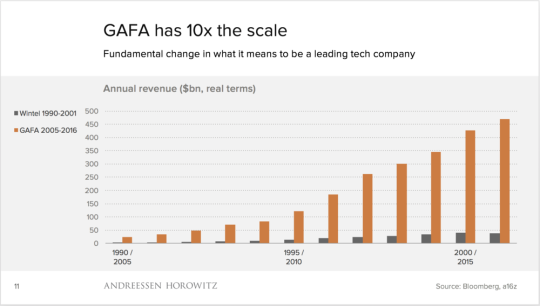
    Below is a chart from Benedict Evans comparing annual revenue from the Wintel era (Microsoft + Intel) to the current GAFA era (Google, Apple, Facebook, and Amazon). 

    His argument is that, today, “the scale of tech winners” is about 10x what it was during the previous cycle.

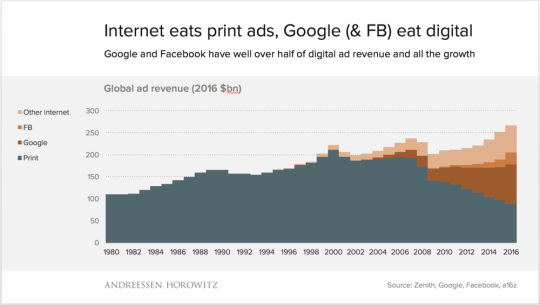
    And here is a chart, from that same post, showing how the internet ate print ads when it comes to global revenue:

    A lot of this has to do with the unprecedented growth of smartphones and the sheer number of people who came and are coming online. Mobile is 10x the PC market.

    But the other interesting narrative from the post is the argument that these companies (GAFA) have learned from previous generations just how aggressive you need to be to survive.

    The shift to mobile posed a structural threat to Facebook. At the time of its IPO, there were serious doubts as to whether the company would be able to pull off this transition.

    Which is why the founder went out and spent 10% of the company to acquire companies that would help with this transition and ensure its survival. That seems to have worked.

    In the words of Andrew Grove: “Only the paranoid survive.“ And in today’s tech world, the rewards for surviving are that much bigger.

  • More than just a coffee shop

    image

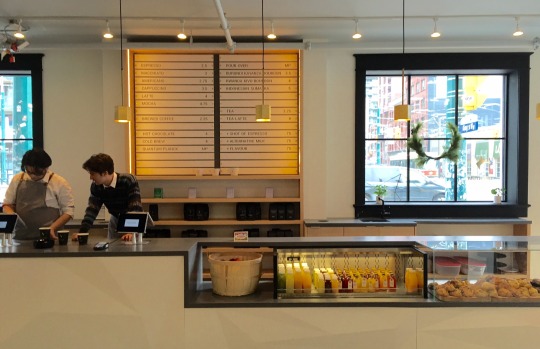
    Today’s blog post is coming to you live from Quantum Coffee at the corner of King and Spadina in Toronto.

    I’m sitting by the window (where I keep running into friends) in a beautiful space that used to be an ugly youth hostel. Nice work Reflect Architecture and MAAST

    It’s my first time at Quantum, but I am so intrigued by all that is happening here that I feel compelled to share.

    So Quantum is a coffee shop. The americano I had this morning was quite good. I hope to have another one sometime in the future. But there’s more to this story. 

    Quantum is actually just one leg of something bigger. Attached to it – literally upstairs – is something called BrainStation. And across the street from it is something called The Konrad Group.

    The Konrad Group is a digital agency that does everything from brand strategy to mobile development. BrainStation teaches those same skills to other people via in-person courses in this recently renewed heritage space. And Quantum is the stimulant that helps fuel it all.

    The connective tissue between these 3 businesses, which are all basically owned by the same poeple, is something that I find super fascinating.

    It also feels like the intersection of design, technology, and space (real estate). And as many of you know, that’s what I’m all about.

  • 16 mobile theses and how tech might change the built environment

    Caucasian woman standing near passing subway in train station by Gable Denims on 500px.com

    https://500px.com/embed.js

    One of the things that I try and do here on this blog is examine the intersection of design, real estate, and technology. I didn’t explicitly set out to do that, but more and more I find myself thinking that way when I’m writing and when I’m giving talks.

    Part of that is because of my passions, but part of it is because there is a big and important overlap. One example of that is autonomous, self-driving cars. The tech community is enamoured with driverless cars, but everyone involved in the built environment should also be thinking about their impacts. Because it’ll be significant.

    Benedict Evans – who is a venture capitalist with Andreessen Horowitz in the Valley – recently published a post called, 16 mobile theses. It’s a look at 16 topics, trends, and shifts that are happening in the tech space. (There’s also a related podcast discussion.)

    If you’re involved in internet products, you absolutely need to give it a read. But I also think it’s interesting to read it through the lens of a designer or real estate person. Productivity is changing. Notions around the living room are changing. And yes, autonomous vehicles are going to have a profound impact on the urban landscape of our cities – just as cars did initially.

    Below are 3 excerpts from Benedict’s post that I really enjoyed.

    The first is about mobile and just how massive it is:

    “The mobile ecosystem, now, is heading towards perhaps 10x the scale of the PC industry, and mobile is not just a new thing or a big thing, but that new generation, whose scale makes it the new centre of gravity of the tech industry. Almost everything else will orbit around it.”

    The second is about how “networked” is quickly becoming a given:

    “Our grandparents could have told you how many electric motors they owned – there was one in the car, one in the fridge and so on, and they owned maybe a dozen. In the same way, we know roughly how many devices we own with a network connection, and, again, our children won’t. Many of those uses cases will seem silly to us, just as our grandparents would laugh at the idea of a button to lower a car window, but the sheer range and cheapness of sensors and components, mostly coming out of the smartphone supply chain, will make them ubiquitous and invisible – we’ll forget about them just as we’ve forgotten about electric motors.”

    And the third is about those self-driving cars:

    “The move to electric and the move (if and when) to autonomous, self-driving cars fundamentally change what a car is, but also what the whole automotive system might look like. Electricity changes the mechanical complexity of cars and hence changes who might build them and what they might look like. Autonomy and on-demand services change who buys them, meaning the buying criteria will be different. But they could also change the urban landscape just as much as cars themselves did – what do mass-market retail or restaurants look like if no-one needs to park?”

    Can you think of other ways in which tech will impact cities and the spaces we occupy?

  • Foursquare uses their global foot traffic data to accurately predict iPhone sales

    I am a fan and long time user of Foursquare – now known as both Foursquare and Swarm.

    Foursquare has struggled against competitors such as Yelp.com when it comes to local business recommendations. And I have less than 100 friends on my Swarm. It doesn’t seem to be that popular here in Toronto.

    But I’ve always loved the data collection aspect of Foursquare / Swarm. Even though most people don’t seem to care about that. When I check-in somewhere, such as the gym, it’ll tell me how many weeks in a row I’ve been there, whether it’s a new personal record, who else is nearby, and a host of other things.

    I’ve always felt like there was so much potential in all of the data it was collecting.

    Well the company is starting to make better use of that data. Recently they used their foot traffic data at Apple stores (I am assuming this goes beyond just check-in data) to predict the number of iPhones that Apple was going to sell globally following the launch of the 6s and 6s Plus.

    They predicted between 13 to 15 million handsets and it turns out they were right:

    This validates the accuracy of our prediction and while we’re proud of the result, we certainly aren’t surprised. Foursquare’s data is essentially the world’s biggest panel of foot traffic data — we have the best sense of the trends and patterns of the movement of people and their phones around the world.

    This is powerful stuff. If there were a way for me to be bullish on Foursquare beyond just writing this post, I would be.

  • Speed, price, and quality

    Project-triangle.svg

    Project-triangle” by Cosmocatalano – Own work. Licensed under CC0 via Wikimedia Commons.

    When I was in business school, one of my friends – who runs his own agency – explained to me the Project Triangle and the “pick any two” philosophy. 

    Whether you’re building a building or building a mobile app, projects can be typically broken down in terms of 3 constraints: speed, price, and quality. The “pick any two” philosophy is that – because these dimensions are interrelated – you can only really get 2 of these dimensions at any one time.

    So for example:

    • If you want a project done really quickly and you want it to be high quality, then it’s not going to be cheap. It’s going to be expensive.
    • If you want something done really quickly and you want it at the lowest price possible, then it’s not going to be high quality. It’s going to be low quality.
    • Finally, if you want something high quality and you want it done cheaply, then it’s not going to be done quickly. You might get it done, but it will be deprioritized by whoever is doing it.

    Few things in life are truly black and white, but I really like this framework. It acknowledges the fact that something has to give. It’s unsustainable to think you can always get super fast, high quality work at rock bottom prices.

  • Marginal cost = 0

    Earlier this week I wrote a post called: The pull from services to products. And in it I made mention of the fact that part of what’s driving this pull towards products is that the marginal cost of servicing additional users or customers is almost nothing in a world of internet services and products.

    Well the reality is that this phenomenon is driving a hell of a lot more. It could – and probably will – fundamentally change almost all aspects of the economy.

    I know that sounds like a pretty audacious statement, but if you watch the following 10 minute talk by Albert Wenger (Union Square Ventures) you might start to feel the same way. He outlines 5 changes being driven by the fact that in the digital world, marginal cost = 0. The impacts go well beyond tech, capturing sectors such as transportation and industrial real estate.

    [youtube https://www.youtube.com/watch?v=sVEtTzlqsoE?rel=0]

    If you can’t see the video, click here.

  • Location-based social network Foursquare is unbundling

    I’ve been a Foursquare user for a number of years now. I like seeing which friends are nearby and where I’ve been. I love the data aspect of it. It’s a kind of urban “spidey sense.”

    Sometimes when you “check-in”, the app will tell you the last time you were there (if it’s been awhile), how many consecutive weeks you’ve been there (which I like seeing when I check-in at the gym), and also give you any tips that others may have left about the place you’re at–such as, try the sea urchin ceviche.

    But Foursquare has been struggling. Check-ins proved to be a bit of a fad and Yelp solved the what-do-you-want-to-do-tonight problem better. However I’ve always felt that, on a fundamental level, Foursquare had the potential to be so much more powerful than Yelp. 

    Well, today the big news in the tech world is that Foursquare is unbundling its app. There will be Foursquare and there will be Swarm. Foursquare will be a recommendation engine that helps people find places to eat, drink, shop and so on (just like Yelp), and Swarm will be all about social–seeing where your friends are and which ones are nearby. And along with this unbundling, there will be no more check-ins:

    But how can Foursquare personalize its users’ results if they are no longer collecting check-ins, the foundation of Foursquare’s recommendation engine? Crowley smiles and says something a bit shocking. He no longer needs check-ins, the meat and potatoes of Foursquare’s entire business and data collection engine for the last five years.

    Not only has Foursquare collected 6 billion check-ins, he says, but it has collected five billion signals to help it map out over 60 million places around the world. Each place is a shape that looks like a hot zone of check-ins — of times when people have said “I’m here.” Foursquare’s “Pilgrim” location-guessing engine factors in everything from your GPS signal, to cell tower triangulation, to the number of bars you have, to the Wi-Fi networks, in order to create these virtual shapes.

    Now that it has this data, Foursquare can make a very accurate guess at where you are when you stop moving, even without a check-in, it’s a technology it hopes will allow it to keep its database of places fresh and accurate. Foursquare calls these implicit check-ins “p-check-ins,” or Neighborhood Sharing. Take your phone into four or five different Japanese restaurants over the course of six months and without a single check-in Foursquare will learn that you like Japanese food and start making recommendations for you based on that data.

    There will obviously be a number of people who have anxiety about an app that’s passively tracking everywhere they go and then trying to feed them recommendations (come eat here!), but I do think they’re on to something.

    The opportunity with Foursquare (and its data) is that the recommendations can be tailored. If I’m looking for a place to eat, Foursquare will already know that I love Mexican and that I just worked out (meaning I’m probably extra hungry). Personally, I’m okay with that.

    But then I start to wonder how this might impact cities. If the process of discovery becomes this automated and this tailored, how might it change the way we organize and design our cities?

  • Shopping: offline vs. online

    According to Sequoia Capital, Americans spent $4 trillion on retail shopping last year – 95% of which was still done in traditional brick-and-mortar stores. I’m actually a bit surprised by how high this number is. I would have thought that a larger percentage of people would be shopping online.

    For me personally, I’d say that my split might be close to 50/50. From furniture to clothes, to even a new bicycle, I buy a lot online, come to think of it. Part of the reason is convenience, but the other reason is that I like having easy access to a broader selection.

    About the only thing I really prefer buying in person is groceries. However even there I’ve been exploring ways to regularize shipments of the items I typically buy. I can’t recall where I read it, but I remember seeing something about less than 1% of groceries in America being bought online.

    Intuitively, the percentage of online sales is only going to rise, particularly given the shift to mobile. Consumers can now shop anytime, anywhere. Real estate companies and retailers certainly need to pay attention.

    But just like the internet didn’t make cities irrelevant, I don’t think it’ll make shopping in person completely extinct. As Sequoia Capital points out in its article, mobile phones are creating new opportunities at the intersection of online and real world shopping.

    So while I don’t know what the future online/offline split might be, I suspect that the two worlds will continue to blur together. I might buy a bicycle online, but when it comes time to service it, I’d like to be able to bring it into a store.