Daily insights for city builders, delivered every morning at 6 AM ET. I’m Brandon Donnelly — a Toronto-based real estate developer and founder of Globizen. I’ve been writing here since 2013.

Tag: mobile app

  • How many people are actually using a COVID exposure alert app?

    One of the things that I don’t think we are doing a good job of here in Canada is promoting our COVID Alert app. Most of the people I talk to don’t seem to have it installed on their phones. And most of the people I talk to seem to be nervous about sharing personal information with it, including their location. (That’s not actually how the app works.)

    The thing with exposure alert apps is that they’re only really useful if most people are using them. And they’re only really useful if people who test positive for the virus enter the code that they are given into the app. So it relies on us trusting that other people will do the right thing. I get that. But those same shortcomings apply when we just ask someone if they’ve been exposed to anyone with COVID-19.

    I could be wrong, but my view on this is pretty simple.

    If everyone who had COVID-19 got immediately sick and showed highly discernible symptoms, then this virus would likely be a lot easier to control. Part of the problem, as I understand it, is that some people get really sick and some people don’t get sick at all. But these latter people can still unknowingly spread it around — perhaps to other people who might get really sick.

    Given this variability, it’s critical for us to know who has been potentially exposed and who has not been exposed. Otherwise, we’re running around mostly blind. From what I can tell, exposure alert apps are one of the best ways for us to track transmission. But, of course, it only works if you’ve got the app. For those of you who don’t already have it, you can download it for both iOS and Android by going here.

    P.S. I’m writing this post because it came up with my barber today while I was getting a haircut. He wasn’t all that aware of the app, but he ultimately concluded that we have a problem of education and that he was going to download it. Maybe some of you will do the same after reading this.

  • Canada’s COVID Alert app

    I installed and setup Health Canada’s COVID Alert app this morning.

    It’s really simple to do that. You don’t enter any personal information. You just select which province you’re in, agree to let it use your Bluetooth, and give it permission to share the random codes that you collect with its servers (more on this below). The app is then active and working. But to be clear, it doesn’t collect your location (it doesn’t use GPS or location services). It doesn’t collect the places or times that you are next to someone who also has the COVID Alert app. And it doesn’t know if you’re with someone who was previously diagnosed with COVID-19.

    Built on top of the private exposure framework that was collectively developed by Apple and Google, the app works by using Bluetooth to exchange “random codes” between nearby phones that have the app. These are anonymous and random codes that are used to track which phones have been next to which phones for any meaningful period of time. The app also uses Bluetooth signal strength to estimate proximity. So it knows how long your phone has been proximate to someone else’s (with the app) and how close they got to each other.

    That’s pretty much all that happens with the app unless you test positive for COVID-19. At that point, you will be given a one-time key along with your diagnosis. The onus is then on you to anonymously self-report on the app. Once you do that, anyone who was exposed — i.e. next to your phone in the last 14 days — will receive an alert on their phone via the app. And since the app doesn’t know any names or who anybody is, it’s of course all completely anonymous.

    It’s great to see all of this coming together. The private sector worked to build the underlying framework and now you have government building on top of it to deliver public health tools. I know that some or many of you will be concerned about privacy, but that appears to have been very well thought out. If you haven’t already downloaded the app, I would encourage you to check it out. It’s available for iOS and Android and can be downloaded over here.

  • Exposure tracing APIs to be released May 1

    The “contact tracing” API that Apple and Google are working on and that I wrote about earlier this month is set to be released on May 1. Given all the concerns around privacy, it’s now being referred to as “exposure tracing.” The idea, here, is to emphasize that it is being designed to trace the coronavirus and not individuals.

    To be clear, we’re talking about APIs, and so third party apps will need to be built on top of this tech before we can start downloading anything to our phones. But I am sure that will happen very soon and I will gladly opt in.

    It’s also worth mentioning that this entire concept of smartphone exposure tracing only works when Apple and Google cooperate. Whatever apps ultimately get built need to work across both platforms, otherwise there would be far too many gaps in the network. So this — along with the focus on privacy — has become a bit of good PR for “big tech.”

    The smart people working on exposure tracing over at Oxford University seem to think that (alongside other interventions) we could stop this virus with only about 60% of the population using an exposure tracing app. (They ran models with a pretend city of 1 million people.) But even at 50% penetration, they believe it could make a meaningful contribution.

    These are numbers I think we could easily get to in major cities. Overall, I suspect it could also make people feel a lot more comfortable about going out. And going out is what’s going to be required as we gradually reopen the global economy. How many of you think you will opt in to something like this once it becomes available?

  • Apple and Google are building a voluntary contact-tracing network for COVID-19

    Venture capitalist Albert Wenger wrote on his blog today that the road back from COVID-19 could start — as early as May — provided we’re able to get our act together around three essential things: masks, tests, and tracing for everyone. We have all been talking about the importance of these things over the last few weeks, but I think it’s worth mentioning just how quickly some of this is starting to happen.

    Both Apple and Google have announced that they are building a voluntary contact-tracing network. By May, they hope to release a set of APIs that other software developers will be able to build on top of. Bluetooth will be what is used to detect when humans are in close proximity to each other. Eventually, both companies plan to integrate contact tracing right into their operating systems.

    Here’s how it might work:

    Of course, we are also seeing new startups emerge, like this one here called Coronatrace.

    Similar to what Apple and Google have in mind, the app will be a voluntary contact-tracing network. By using it, your phone will begin to log how you move about, something that is already happening today with many of the apps we already use. Should someone test positive for COVID-19 (they would need to update their health status within the app), it would then immediately notify the network and anyone who might have crossed paths with them.

    Obviously it would be far better to simply have a vaccine. But the experts are saying that will take some time — 12 to 18 months? And in the interim, we’re going to need to get the global economy back up and running. Seeing solutions like these being developed makes me hopeful we’ll be able to do that sooner rather than later.

  • Lifelogging

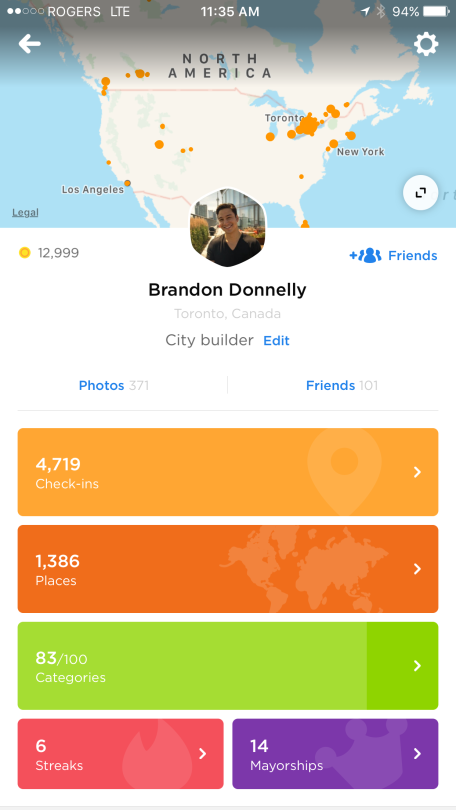
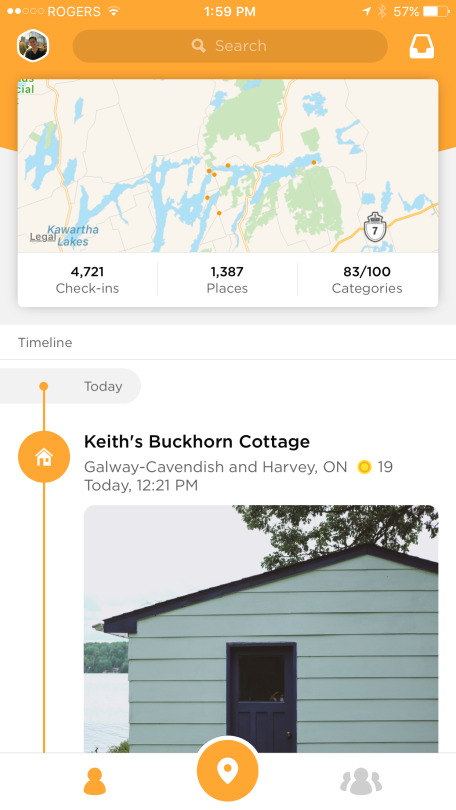
    Swarm recently released version 5.0 of its mobile app. Blog post here. Instead of gamification (leaderboards and so on), the emphasis is now on lifelogging – a more personal collection of all the places you’ve been.

    Here’s what that looks like:

    The most notable change is a front and center map that shows you all of your check-ins. You can also zoom in and really explore where you’ve been, geographically. Swarm refers to it as a “virtual memory book.”

    Lifelogging is absolutely the main reason why I use Swarm and why it still finds itself on my home screen. One of the reasons I enjoy blogging is that it’s a public diary. Swarm is a modified version of that for me. So this change feels right.

    My other Swarm use cases are being able to share check-ins to Twitter and serendipitous encounters with friends.

    But the more I use Swarm the more I think that divorcing this use case from Foursquare (this happened in 2014) was a mistake. If Swarm is now about lifelogging (instead of just playful check-ins) and if Foursquare is about finding the perfect place to go out, then why not merge these experiences? 

    Tell me where I should be going, let me make lists of places I want to go, and then let me log it to my diary along with tips for other people.

    At the time of the divorce, the data seemed to suggest that very few people did both of these things within the consolidated app. People either checked-in or they looked for a place to go. Rarely did they do both.

    Perhaps that would be different with lifelogging.

  • What could a connected lockbox mean for the residential real estate business?

    image

    I just discovered an interesting Dallas-based startup this morning called TOOR. They were on Shark Tank and haven’t yet launched their product, but it’s essentially a connected lockbox. Lockboxes are a mainstay of the residential real estate industry (they hold the keys so that co-operating agents can show a property) and they are becoming even more common nowadays because of Airbnb rentals.

    What caught my attention about TOOR is the app that goes along with the lockbox that also allows people to search for homes. Once you’ve found a home you can even find an agent for an escorted tour. I’m not clear on the exact workflow, but I am thinking that if you buy this connected lockbox you then have the opportunity to put your home up for sale on their platform.

    This is interesting because the app will also verify user identities and scan people’s IDs, so it helps to solve the security problem that agents today now solve. I could imagine the app storing my credit card so that if I go into a home unescorted and I do something mischievous, it then charges me. It also makes it really easy to just drive around and pop into homes by instantly scheduling appointments.

    In any event, I may have the exact user flows a bit wrong, but it’s fascinating to think about how something as simple as a connected lockbox could start to chip away at the status quo.

  • Trust & attention

    Over the weekend I received a marketing email from a real estate company advertising their new mobile app. I didn’t download it.

    Nowadays, every company and brand seems to have a mobile app. If you don’t already have one for your organization, I bet many of you have thought about creating one. This is natural given how profound the shift to mobile has been.

    But I can’t help but feel like we are overestimating the kind of attention that many of these apps will receive. App usage is highly concentrated. We’ll spend hours on Instagram, but almost every other app in existence gets ignored.

    I love how marketer Seth Godin puts it: “the two scarce elements of our economy are trust and attention.” Attention is not scalable. Each of us have a finite amount of attention to give. And there’s lots of competition for it.

    At the same time – to borrow Godin’s thought process – a lot of people will sacrifice trust for the sake of attention. We overpromise because we become desperate. I mean, if you think about it, every company or organization is trying to figure out how to get you to pay attention to them.

    But I’d like to think that trust can also help you garner attention. Once I trust someone or some organization, I’m more likely to give them the time of day. They’ve earned it. And I feel like that’s where things are headed in today’s information economy.

    Trust and attention. Think about it. They’re pretty powerful things, no matter how you spend your days.

  • Find the best local construction professionals at the lowest prices

    One of my closest friends, who also happens to be in the same industry, is currently testing out a new construction marketplace idea. It’s called Tenderlet and it’s an online platform that helps your average house or condo owner “find the best local construction professionals at the lowest prices.”

    Right now it’s just a basic website, but he is obviously thinking that it could grow into a far more robust online marketplace.

    The way it works is real simple:

    1. You tell Tenderlet about your construction job – everything from a water damaged ceiling repair to new hardwood flooring. 
    2. Tenderlet goes out and gets multiple quotes on your behalf (just like how the professionals do it). 
    3. Then Tenderlet comes back to you with at least 3 quotes and a recommendation. It’ll even handle scheduling and payments.

    Eventually he’s imagining that there will be a mobile app, reviews for the construction professionals, and a location dimension, which can make all the difference, particularly for smaller jobs. But you have to start somewhere.

    I think he’s on to something here. I know I want to use it. So I would encourage you to check out tenderlet.com and give it a try. If you have any feedback about the idea, I am sure he would love to hear from you in the comment section below.

  • How I moved over the last 3 weeks

    At the beginning of this year I wrote a post about a mobile tracking app called Moves that I had heard about through my friend Sachin Monga. He had just published a beautiful set maps showing where he physically spent his time in both Toronto and San Francisco.

    His post spurred me to download the app and at the end of my post I promised to share my own set of maps once I had collected enough data points. It’s only been about 3 weeks, but already my maps are starting to fill out, so I thought I would do a release.

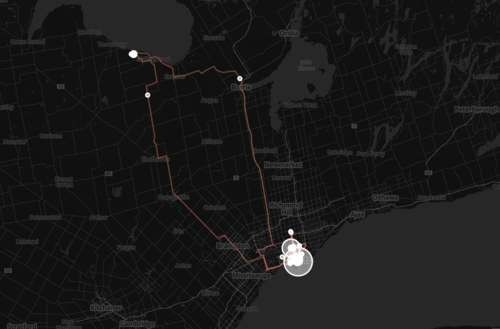
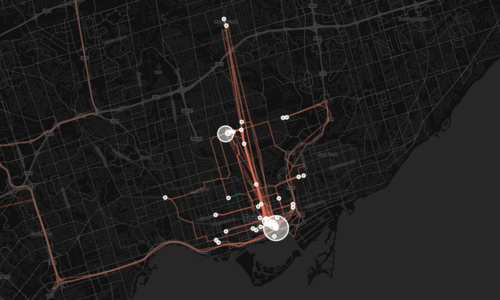
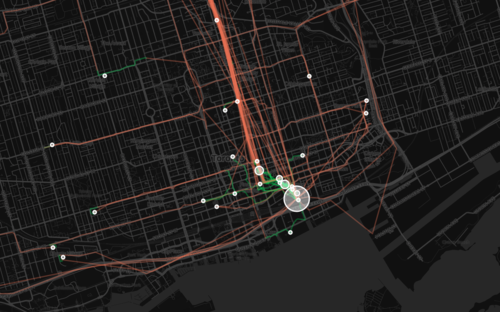
    The orange lines represent transport of some sort (car, subway, streetcar, and so on) and the green lines represent walking. I don’t cycle very often in the winter (I know, I’m a fair-weather cyclist), so you won’t see any of those lines just yet. However if I posted a map from the summer, I know it would look completely different.

    Here’s a first one showing a regional scale:

    image

    Here’s a second one showing the city of Toronto:

    image

    And here’s a third one showing mostly downtown:

    image

    What’s interesting about these maps is how much you can tell about me and the way I move around the city.

    For one, there’s a good chance I ski or snowboard given that I’m driving up to Collingwood, Ontario in the winter. You can also see how heavily dependent I am on the Yonge subway line, which is the thickest orange line in the middle of downtown. It’s also interesting to see how localized I am within my neighborhood (St. Lawrence Market). I walk to get groceries. I walk to the gym. I walk to coffee. And the list goes on.

    This is fairly typical for people living in urban neighborhoods, but it would be interesting to see where it applies in the city and where it begins to fall apart. I would also imagine that there’s a correlation to the area’s Walk Score, although this (Moves) might actually be a better measure since it’s usage data.

    Either way, imagine what cities could do if they had this sort of data for every resident. They would be able to see precise resident flows and then determine exactly where transit and infrastructure investments should be made instead of politicking to determine where they should be made.

    That time is coming.

  • Why buy a car when you’ve got mobile apps

    One of the things that many city planners, transportation experts, and municipalities are trying to figure out is how to successfully shift people away from driving towards alternative modes of transportation, such as biking and transit. Now, this is no easy task. There are a myriad of factors that influence a person’s decision to drive or not drive–or if they should even own a car in the first place. Though, land use and density are, in my opinion, probably the biggest.

    But of all the solutions thrown around, mobile apps are typically not within the playbook. However a recent New York Times article is making the argument that it should be, because car-sharing services and apps like Uber seem to be indeed having an affect on people’s decision to own a car. And that’s because in some cities it’s actually cheaper to use Uber every day (than to own a car) and because taxi use has been shown to correlate with other (non-driving) forms of mobility.

    Paradoxically, some experts say, the increased use of ride-sharing services could also spawn renewed interest in and funding for public transportation, because people generally use taxis in conjunction with many other forms of transportation.

    In other words, if Uber and its ride-sharing competitors succeed, it wouldn’t be a stretch to see many small and midsize cities become transportation nirvanas on the order of Manhattan — places where forgoing car ownership isn’t just an outré lifestyle choice, but the preferred way to live.

    And to be honest, I don’t think this is all that far stretched. More and more I find myself wondering why I even own a car. It’s not appreciating sitting downstairs in my garage and, given the frequency in which I use it, I would definitely be better off financially if I simply used an app like Uber or Hailo more often. About the only thing those apps aren’t great for are trips to Home Depot and snowboard trips to the mountain.