Daily insights for city builders, delivered every morning at 6 AM ET. I’m Brandon Donnelly — a Toronto-based real estate developer and founder of Globizen. I’ve been writing here since 2013.

Tag: mid rise

  • The most unremarkable streets in Toronto

    Within Toronto’s urban structure you have regular streets and you have things known as “Avenues.” (This is among a bunch of other stuff such as Centres and Employment Areas.) What this Avenue designation does is tell you that it may be a suitable location for a new mid-rise building, which is something that I have written a lot about on this blog. Here in Toronto, this means that you would then need to consult the “Mid-Rise Building Performance Standards.” Indeed, if you dust off these standards and turn to the introduction, you’ll find the following: “The Performance Standards are intended to provide simple, straightforward guidance for those seeking to develop midrise projects on the Avenues.”

    But if you want to find some of the most truly unremarkable streets in this city, you need to look at the arterial roads that didn’t quite make the cut to be an Avenue. I don’t want to generalize, but they are generally exceedingly ugly. You can’t help but feel like Toronto has simply outgrown the low-rise building typologies that, in most cases, still remain on these streets. In some cases, they’re also directly adjacent to a subway station, which is kind of like running a great big movie theater with only a handful of seats inside. Maybe one day they’ll grow up to be Avenues. But don’t hold your breath. So what’s another possible solution? Toronto-based PHAEDRUS Studio has an idea. It’s called the Hi-Lo Hybrid.

    Initially designed for a specific client and a specific site, it also happens to be something that could be deployed all across the city. What they have shown here is a 5 storey infill building on your typical long and narrow Toronto lot. As designed, it could house 4-8 units, as well as some non-residential uses, on a lot that previously only had 1-3 units. It would make a lot of sense for some of the ugly streets that I’m talking about. But let’s be honest: it would be almost impossible to get approved. One of the biggest issues would probably be the adjacency/overlook issue that it generates with the neighboring backyards. It’s probably also too tall.

    One of the main reasons why, I think, laneway suites work and are now permissible as-of-right in Toronto is that they replace existing garages. (ADU’s for the Americans.) They reallocate space that was previously used for cars to humans. And so the incremental height / density is not all that great. They, for the most part, preserve precious neighborhood character. What the Hi-Lo Hybrid proposes is not so incremental. It’s bold. It would be a massive fight. I know that and you know that. But bold is generally what you need when you’re trying to do great things and when you’re trying to shape the future. And so with that, I’ll leave you all with some words from the late American architect, Daniel Burnham.

    “Make no little plans; they have no magic to stir men’s blood and probably themselves will not be realized. Make big plans; aim high in hope and work, remembering that a noble, logical diagram once recorded will never die, but long after we are gone will be a living thing, asserting itself with ever-growing insistency. Remember that our sons and grandsons are going to do things that would stagger us. Let your watchword be order and your beacon beauty.”
  • Building great mid-rise buildings

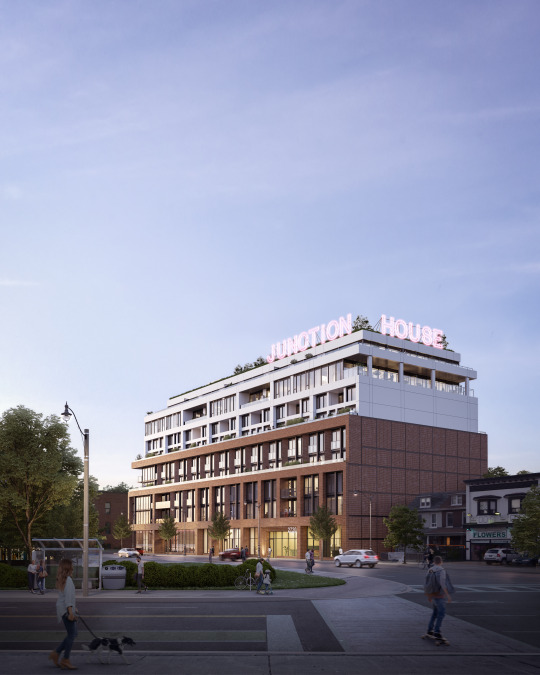
    Alex Bozikovic is right to praise Gairloch’s upcoming development in the Junction. It’s a beautiful project and it’s exciting to see so many architecturally significant projects in one neighborhood — either completed or to be completed. I’m thinking specifically of DUKE Condos (TAS and Quadrangle), our Junction House project (currently under construction), and now Gairloch’s.

    But Alex (as well as Jeremiah Shamess) is also right to point out some of the tensions and contradictions that are inherent to building at this scale. We want European-type mid-rise buildings all along our avenues, but we also want our housing to be more affordable. Problem is, mid-rise buildings are the most expensive way to build.

    The approvals process also tends to privilege urban design considerations over things like livability and construction costs. We talk about the shadow impacts that the project might have on the surrounding community, but not about how well the suites will layout when it’s all said and done — not to mention how expensive they will be to build.

    The cynics will tell you that it doesn’t matter what it costs to build because developers will always profit maximize (as is the case with every other for-profit business). But that’s an oversimplification that ignores a bunch of factors.

    One, it’s not as simple as just price. You also have to consider sales velocity. Price and sales velocity tend to be inversely correlated. In other words, as prices increase, sales velocity tends to naturally slow. You then begin to trade-off higher prices for increased time (which has a cost) and more market risk.

    As I’ve said many times before on the blog, development happens on the margin. Usually the way this plays out is that you create a development pro forma, you look at all of your project costs, and then you say, “oh shit.” You’re then stretching to figure out how you’re going to make the math work.

    Two, there are usually always parts of a city where development isn’t feasible (in some unfortunate cases, it might be the entire city). The potential revenues simply don’t support the costs. And as costs continue the rise, any areas that have not seen a corresponding increase in prices and/or rents will also become undevelopable.

    So there’s price, and there’s also a question of where great buildings are even possible. As many have already pointed out, it’s certainly not everywhere.

  • Two-up, two-down

    Feargus O’Sullivan is doing a series in CityLab right now on the “home designs” that define four European cities: London, Berlin, Amsterdam, and Paris. The first one is on London’s classic “two-up, two-down” design, which refers to a two storey home with a living room and kitchen on the ground floor and two bedrooms on the second. It’s a simple design, but one that has supposedly endured.

    O’Sullivan argues that for many, or perhaps most in Britain, this is what a “home” feels like. It’s grade-related and there are two floors. Indeed, only 14% of British people live in an apartment, compared to 57% in Germany (a majority). This percentage is much higher in London, with about 43% of people living in an apartment. But about 25% of the population still lives in some sort of attached house.

    Home equals house. And for us North Americans, this is of course relatable. But the Germany example is a reminder that this is not necessarily universal. Attitudes toward housing are cultural. And cultures can and do change. I am seeing that happen right now in Toronto. Some of us are becoming less like the British and more like the Germans.

  • Paris and Vancouver population densities compared

    In this January 2018 report from the Fraser Institute, they pegged the average population density of Paris to be about 21,067 inhabitants per square kilometer (2014 population year). It is the second densest city in their report after Hong Kong, but the densest in Europe. By comparison, Vancouver sits at around 5,493 inhabitants per square kilometer (2016 population year).

    Now, these are of course city averages. Some neighborhoods will be higher and some will be lower. According to a January 2018 study by Alasdair Rae — who is a works in the Department of Urban Studies and Planning at the University of Sheffield — these are the most densely populated square kilometers across Europe (or at least within the 39 countries that he looked at).

    Paris, once again, comes in near the top with a peak density somewhere around 52,218 inhabitants per 1km square. The square in question is in the neighborhood of Goutte D’Or. And the only square within the study to come in denser is one from the L’Hospitalet de Llobegrat in Greater Barcelona (53,119 inhabitants per square kilometer).

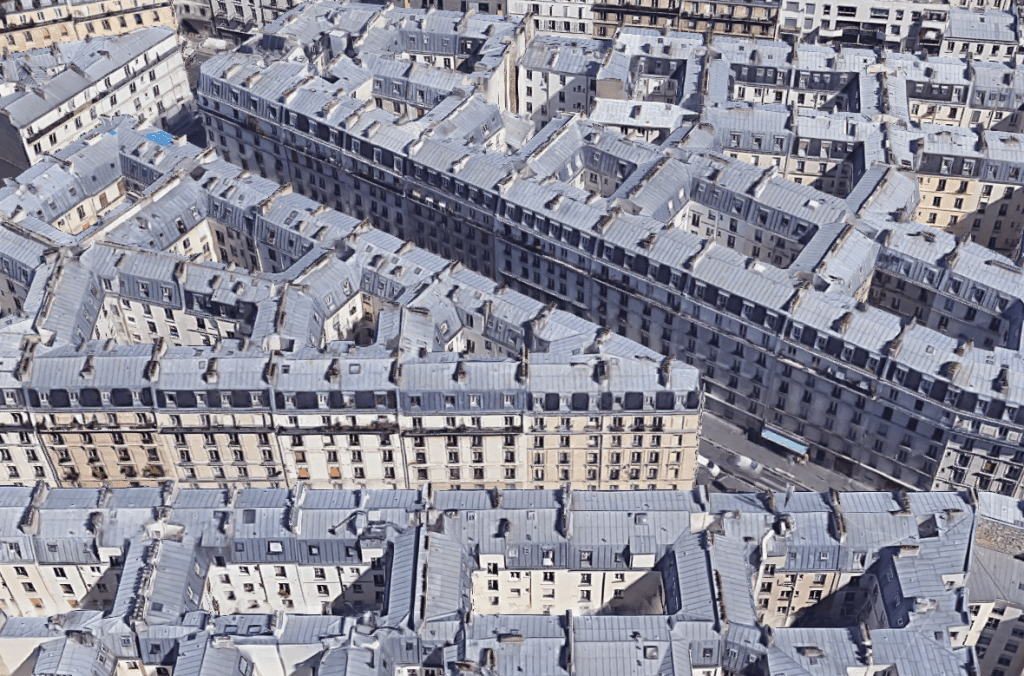
    Now let’s take a look at how these sorts of densities actually manifest themselves. Below is an aerial capture from Google Maps showing a section of Goutte D’Or in Paris. The buildings are all pretty much 7 storeys (mid-rise), but the blocks are mostly filled in. Lots of interior courtyard apartments. This is one way to get to over 50,000 people per square kilometer.

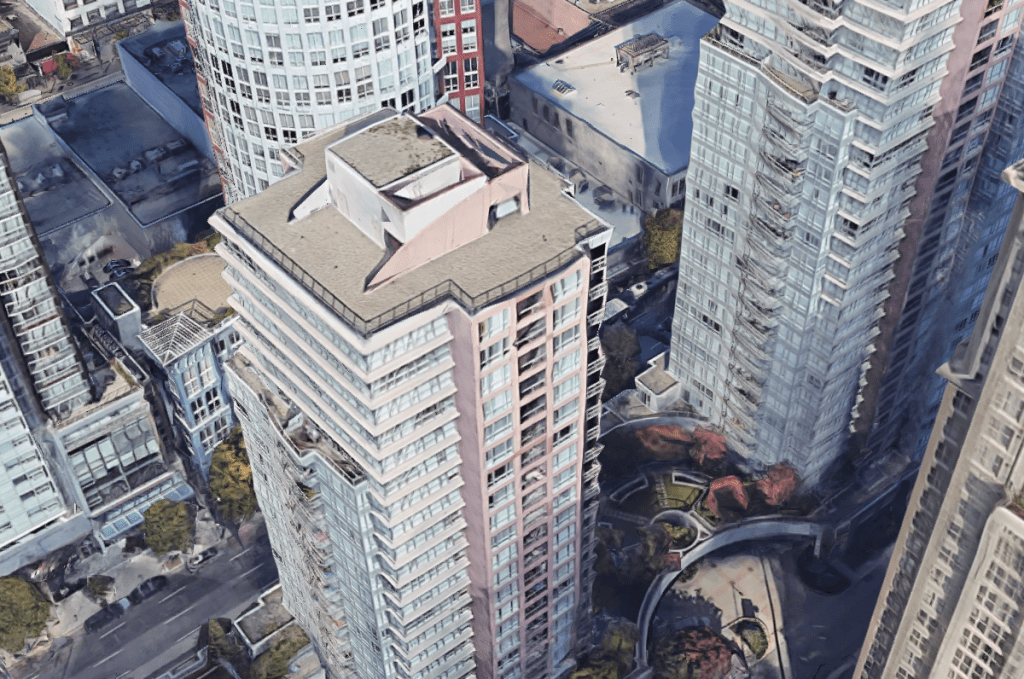
    Returning to Vancouver as a point of comparison, below is an aerial capture from downtown Vancouver at exactly the same scale as the Paris capture. I couldn’t find a density map of downtown, but it’s probably safe to assume that it’s greater than 5,493 and a lot less than 52,218 residents per square kilometer.

    What you see here is typical Vancouverism. Lots of slender point towers, careful tower positioning and spacing, and generally low podiums. It is a perfect demonstration that height and density do not necessarily correlate. It is possible to have low buildings and high density, which is something that Europe obviously does very well.

    But here’s the important question: In which of these two examples would you rather live? Please leave a comment below.

  • Junction House ground breaking

    The Junction House team is excited to announce that construction will start this fall and that our ground breaking ceremony will be held at 11AM on Saturday, October, 19th. Mark your calendars.

    It will take place at our Sales Gallery — 2720 Dundas St W. This will be one of the last opportunities to see the award-winning Junction House Sales Gallery before it is demolished in preparation for construction.

    There will be photo opportunities for everyone in attendance, and so we encourage you to bring your phones/cameras. You’re welcome to extend this invitation to family and friends, but kindly RSVP by sending an email to info@junctionhouse.ca.

    We look forward to seeing you there.

  • OMA’s first ground-up project in Manhattan finishes construction

    121 East 22nd — which is OMA’s first ground-up project in Manhattan — recently finished up construction at the corner of E 23rd St and Lexington Ave (the site continues through to E 22nd St, where there is basically a 2nd building). I wrote about the project over two years ago, here.

    Below is a photo by Laurian Ghinitoiu, via Dezeen, of it completed:

    The defining feature is its “prismatic corner”, which, I understand from this interview with David Von Spreckelsen (President of Toll Brothers City Living), was largely an outcome of the site’s restrictive zoning. There was a requirement to have constant street walls. That minimized what could be done architecturally on the project’s main elevations.

    The solution is two contextual street walls — the punched windows are designed to match the rhythm of their adjoining buildings — coming together and creating dramatic visual interest only at the point where they intersect. Below is a rolled out elevation from OMA. Note the gradient created by the windows as they converge toward the corner (center in the drawing below).

    The other interesting thing about this project is that it reminded me just how different the built form of Manhattan can be compared to Toronto. In the case of 121 East 22nd, the streetwalls rise 150 feet without any stepbacks. There is then a 10 foot stepback before the building rises another 60 feet — similarly without any additional breaks.

    I love the grandeur.

  • The investment case for mid-rise condos

    Shane Dingman’s recent Globe and Mail article about “the investment case for mid-rise condos” is a good summary of why this housing type has become so popular in Toronto.

    Mid-rise buildings tend to attract more end-users because of their boutique scale. That is, they attract people who plan to move into the building once it is built, as opposed to buyers who plan to rent out their unit. We are certainly seeing this with purchasers at Junction House.

    Because of their generally smaller scale and because they are often built in mature neighborhoods with few opportunities for new construction, supply of new mid-rise housing also tends to be limited. That bodes well for future price appreciation.

    Here’s a quote from Shaun Hildebrand (President of Urbanation), taken from the above Globe article. (Sorry, it’s behind a paywall.)

    “Price growth between the two building types [mid-rise and high-rise] began to converge in 2018, and in Q1-2019, buildings under 12 storeys saw average resale prices per square foot grow 10 per cent year-over-year, compared to 6.5 per cent for buildings of 12 or more storeys,” Mr. Hildebrand said. “We may be now entering back into a period of outperformance of mid-rise buildings as the market is shifting.”

  • A video and some art

    We made a video for our Junction House project. If you can’t see it embedded below, click here. You may have already seen some of the cut-downs on my socials, but this is the full version.

    [vimeo 293178524 w=640 h=300]

    The stickers under our projecting Junction House sign box irk me, but otherwise we’re all really happy with the way the video turned out. We wanted it to feel real and authentic.

    I am also thrilled to announce that we have partnered with a few local artists for this project. 

    The first is Leeay Aikawa. She is a multidisciplinary artist who moved to Toronto from Japan in 2003 and now works and resides in the Junction. We’re excited to have the opportunity to exhibit her work. You’ll find it in our “sales gallery” when that space opens.

    The next artist will remain a secret for now (though that’s a hint). Stay tuned to the blog and the socials.

  • Reintroducing Junction House

    Today we released the above rendering for Junction House and announced that sales will begin this fall.

    144 condominium homes. A mix of 1, 2 and 3 bedroom suites, including our Two-Storey House Collection and our Laneway House Collection. Prices starting in the $400s.

    One of our partners also happened to serendipitously send me this Globe & Mail article today talking about the increasing demand for and shortage of mid-rise housing:

    “The market is substantially undersupplied in mid-rise,” said Mr. Hildebrand, who notes that mid-rise projects in the GTA [Greater Toronto Area] were just 31 of 2017’s new launches, accounting for 3,833 units (12 per cent of the total).

    Stephen Price, CEO of Graywood Developments, went on to say this in the article:

    “There’s a huge appetite for medium density in Toronto. Many don’t want to live in the downtown core, this buyer is more interested in being in a community and there is a greater propensity to buy larger more livable units.”

    Given the huge influx of inquiries we received today after the above announcement was made, I would say that feels right. And our focus at Junction House is very much on “larger and more livable.”

    If you’re at all interested in a new home at Junction House, I would encourage you to get on our priority list, here.

  • Unpacking the family condo

    John Lorinc has a piece in the Autumn 2018 issue of University of Toronto Magazine that is worth a read. It covers families in Toronto being priced out of the low-rise housing market and/or making the conscious decision to live in an apartment or condo.

    He raises an important question:

    The big question hovering over this generational transition is all about city-building, and whether increasingly dense metropolitan regions such as Toronto and Vancouver can figure out how to turn all those newly sprouted forests of highrises into true communities that are both affordable and appealing to the wide range of people who call these cities home.

    The reality seems to be that more people in this city – out of economic necessity and/or because of a lifestyle preference – are choosing to raise a family in multi-dwelling housing. I live in a condo and my neighbors are raising a child two doors down from me.

    I am sure that we will continue to see more of this and I am sure that we will get better at designing for families. We are trying to do our part with the 2-storey homes that we have incorporated into our Junction House project. 

    I would, however, like to respond to the underlying tone in the article that but for developers being stubbornly resistant to larger 3-bedroom apartments in this city, we would have a myriad of new condominiums filled with families.

    The reality is that there are market and structural forces (including cultural biases) that steer what gets built.

    There are affordability considerations. Larger condos cost more money than smaller condos. And that prices out many families, particularly if there are cheaper alternatives available in the form of low-rise housing. 

    The reason we appear to be at an inflection point today is because the cheaper alternatives are disappearing. (This of course returns us to the broader question of overall housing affordability.)

    There are also timing and financing considerations that likely create a supply-side bias. Most lenders require that a certain number of condo units be pre-sold before construction starts. 

    This means that, as a developer, you need people that can both afford what you’re selling and that are willing to buy three to five years out, and perhaps even longer. That can be difficult for many families.

    Lastly for this post, there’s the GST/HST New Housing Rebate in Ontario, which I have argued before on the blog could be incentivizing smaller suite sizes and could use a refresh for today’s home prices.

    All of this is not to say that we shouldn’t be designing for urban families and that we shouldn’t be focused on delivering more affordable housing to this and other cities. Those are two very important things.

    It is simply to say: there’s a lot going on here that needs to be unpacked.