
I just finished watching this TED talk with Bill Gates. For those of you who are up on their TED talks, this is not the one from five years ago where Bill predicted a pandemic and told us all that we were nowhere near ready. (We, of course, didn’t listen.) This is one that was published a few days ago and talks about how we should be responding to the outbreak that we are currently living through. The Bill & Melinda Gates Foundation has been committing significant resources toward solving problems exactly like this one. So it’s interesting to hear his thoughts. In case you’re wondering, herd immunity isn’t the answer. We need (1) widespread testing and (2) to be extremely disciplined about our social distancing. In his words: “But money, you know bringing the economy back and doing money, that’s more of a reversible thing than bringing people back to life.”
Tag: microsoft
-
Market power in tech
Benedict Evan’s latest post on Microsoft, IBM, and anti-trust is excellent. In it he argues (reminds us) that market power during one generation of tech, doesn’t necessarily guarantee market power in the next. And that anti-trust intervention isn’t actually responsible for Microsoft missing out on, among other things, mobile. The rules of engagement simply changed. The PC is now a smartphone accessory.
Here is an excerpt:
The tech industry loves to talk about ‘moats’ around a business – some mechanic of the product or market that forms a fundamental structural barrier to competition, so that just having a better product isn‘t enough to break in. But there are several ways that a moat can stop working. Sometimes the King orders you to fill in the moat and knock down the walls. This is the deus ex machina of state intervention – of anti-trust investigations and trials. But sometimes the river changes course, or the harbour silts up, or someone opens a new pass over the mountains, or the trade routes move, and the castle is still there and still impregnable but slowly stops being important. This is what happened to IBM and Microsoft. The competition isn’t another mainframe company or another PC operating system – it’s something that solves the same underlying user needs in very different ways, or creates new ones that matter more. The web didn’t bridge Microsoft’s moat – it went around, and made it irrelevant. Of course, this isn’t limited to tech – railway and ocean liner companies didn’t make the jump into airlines either. But those companies had a run of a century – IBM and Microsoft each only got 20 years.
For the full post, click here.
-
A non-zero probability of copycats
Software businesses are generally high margin businesses. But along with this feature comes some risks. Here’s an excerpt from a recent post by Scott Galloway (which is actually about FedEx):
With any software start-up, there is a non-zero probability that you wake up the next day and find that a better-resourced firm (Microsoft, Oracle, Salesforce, Adobe) has deployed 200 engineers to copy your product, bundle it with their stack for free, or near free, and … welcome to zero. I believe this is happening to Slack, but more slowly than Netscape, as Microsoft’s General Counsel has likely coached Satya to charge a nominal fee for Teams and let Slack bleed out, instead of putting a bullet in its head and stirring the DOJ from a 3-Ambien slumber.
Real estate, by comparison, doesn’t get disrupted in quite the same way. A location/city can lose its economic purpose (Great Grimsby is just one example), but as long as there are growth tailwinds the real estate should do well.
Venture capitalist Fred Wilson has on many occasions written about how he (and his firm) made a fortune in the dot-com era, only to lose it all and have to remake it again over the subsequent decades.
One the lessons learned from that experience (according to his blog), was to take some of that second tech fortune and invest it into hard assets — namely real estate. That feels right to me.
-
Google announces $1 billion investment in housing
This week, Google announced a $1 billion investment in housing across the San Francisco Bay Area. Here is the blog post announcement by CEO, Sundar Pichai. And here are a couple of paragraphs from the post explaining how this is expected to work:
First, over the next 10 years, we’ll repurpose at least $750 million of Google’s land, most of which is currently zoned for office or commercial space, as residential housing. This will enable us to support the development of at least 15,000 new homes at all income levels in the Bay Area, including housing options for middle and low-income families. (By way of comparison, 3,000 total homes were built in the South Bay in 2018). We hope this plays a role in addressing the chronic shortage of affordable housing options for long-time middle and low income residents.
Second, we’ll establish a $250 million investment fund so that we can provide incentives to enable developers to build at least 5,000 affordable housing units across the market.
In addition to the increased supply of affordable housing these investments will help create, we will give $50 million in grants through Google.org to nonprofits focused on the issues of homelessness and displacement. This builds on the $18 million in grants we’ve given to help address homelessness over the last five years, including $3 million we gave to the newly opened SF Navigation Center and $1.5 million to affordable housing for low income veterans and households in Mountain View.
Google is not alone in its efforts to improve housing supply in the Bay Area but, according to CityLab, this is “the single largest commitment by a private employer.”
There’s a lot of debate about the value of housing supply, alone. But in 2017, the Bay Area added 3.5x as many jobs as it did housing. I think most people would agree that’s a suboptimal, and potentially unsustainable, mismatch.
Also, if large companies such as Google and Microsoft are making these sorts of investments, it is likely that they’re worried about housing unaffordability impacting their ability to attract and retain top talent going forward.
Perhaps this is a signal for just how unsustainable this mismatch has gotten.
-
Microsoft Canada moving to CIBC Square

Today, Microsoft announced that it will be moving its Canadian headquarters from Mississauga to the new CIBC Square development that is currently under construction in downtown Toronto (and rendered above).
According to RENX, Microsoft will occupy 132,000 square feet across 4 floors in the first tower. Occupancy is scheduled for September 2020.
I love this project. The design architect is WilkinsonEyre. And there’s going to be an elevated one-acre park spanning the rail corridor between the project’s two towers.
But it’s also noteworthy because it is an example of a major suburban tenant deciding to relocate to a transit-oriented urban environment. (I have a post on this somewhere.)
Image: WilkinsonEyre
-
10x the scale
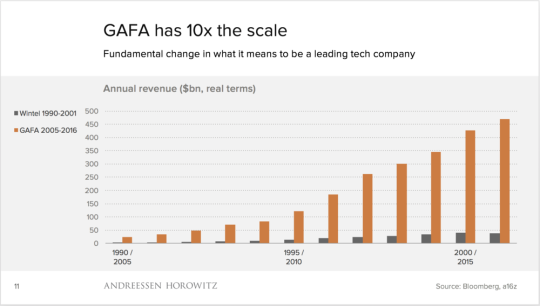
Below is a chart from Benedict Evans comparing annual revenue from the Wintel era (Microsoft + Intel) to the current GAFA era (Google, Apple, Facebook, and Amazon).
His argument is that, today, “the scale of tech winners” is about 10x what it was during the previous cycle.
And here is a chart, from that same post, showing how the internet ate print ads when it comes to global revenue:
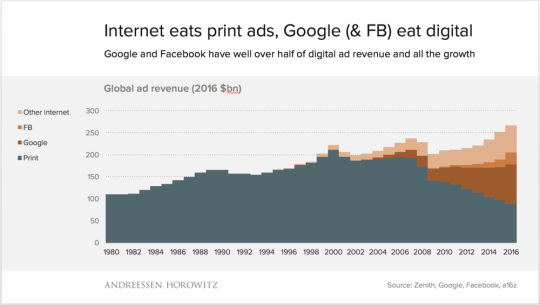
A lot of this has to do with the unprecedented growth of smartphones and the sheer number of people who came and are coming online. Mobile is 10x the PC market.
But the other interesting narrative from the post is the argument that these companies (GAFA) have learned from previous generations just how aggressive you need to be to survive.
The shift to mobile posed a structural threat to Facebook. At the time of its IPO, there were serious doubts as to whether the company would be able to pull off this transition.
Which is why the founder went out and spent 10% of the company to acquire companies that would help with this transition and ensure its survival. That seems to have worked.
In the words of Andrew Grove: “Only the paranoid survive.“ And in today’s tech world, the rewards for surviving are that much bigger.