Daily insights for city builders, delivered every morning at 6 AM ET. I’m Brandon Donnelly — a Toronto-based real estate developer and founder of Globizen. I’ve been writing here since 2013.
Today’s post is perhaps a good follow-up to yesterday’s post about housing supply in Ontario. Below are a few charts taken from a recent article by Wendell Cox looking at net domestic migration across the US. The takeaway here is that the shift from larger cities to smaller cities seems to be accelerating, following a trend that started before COVID.
The data in these charts is organized according to population and by Core Based Statistical Areas (CBSAs). At the bottom are America’s two megacities: New York and Los Angeles. Both have metro areas that exceed 10 million people. As you can, these two city regions have been losing the most people, both in terms of total humans and on a percentage basis. The goldilocks sweet spot seems to be cities in the 500k to 1 million range.
But the most telling figure is probably this one here:
This chart adds up all major metropolitan areas with a population greater than 1 million, and then shows net migration over the last decade. Here you can see when this trend started (around 2016) and how it has been accelerating. In this case, it does appear that COVID added some fuel to the fire. But the question remains: Why is this longer-term trend even happening?
Is it a short-term phenomenon? Is it because once a city reaches a certain size it simply becomes more annoying to live in it and people would prefer to live elsewhere? Or is it more about overall affordability? That is, if we could figure out how to deliver more affordable housing in our cities, could we stymie the bleeding toward smaller and more affordable ones?
I don’t know the answers to the questions. But they have been widely debated and I still think they’re interesting ones. If all things were equal (or closer to equal), how and where would most people choose to live? Put differently, how much of this is some sort of natural market outcome and how much of it is a direct result of our actions (or inactions)?
The media tends to describe agglomeration economies — one of the benefits of big urban areas — as being entirely serendipitous. Minimize travel. Maximize chance encounters at the local coffee shop. And then all of a sudden patents will go up and new startups will emerge. That does that happen, I’m sure, but there’s a bit more structure to a lot of these encounters. Economies of agglomeration is not just about serendipity. It is about the benefits of and the decision to concentrate economic activity.
Last week, a think tank in the North of England (IPPR North) published a report outlining, among other things, job creation and productivity across England. Based on these metrics, London and the South East dominate, with “productivity” in London being by far the highest. Almost half of England’s new jobs over the last decade were in these two regions. Above is a chart from the Financial Times. The trade-off is wealth and income inequality. And the report does look to how the government could address this centralization of power and wealth.
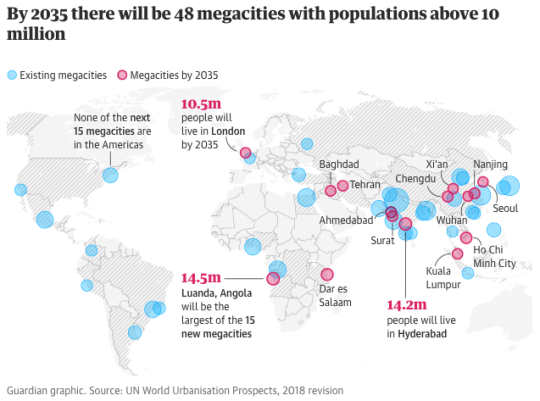
The Guardian is running a series right now called: The next 15 megacities. A megacity is typically (but loosely) defined as a city (or metropolitan area) with a population of at least 10 million people.
By 2035, another 15 cities are expected to become megacities according to the United Nations. Hence the above series. None of these new entrants will be in the Americas. And only one – London – is anticipated to be in the West.
The first city in their series is Baghdad. The second is Dar es Salaam. And the third, and latest, is Tehran. They are such interesting reads.
I have said this before on the blog, but the pace of growth in many of these cities is astounding. Dar es Salaam – one of the fastest growing cities in the world – is adding about half a million people ever year.
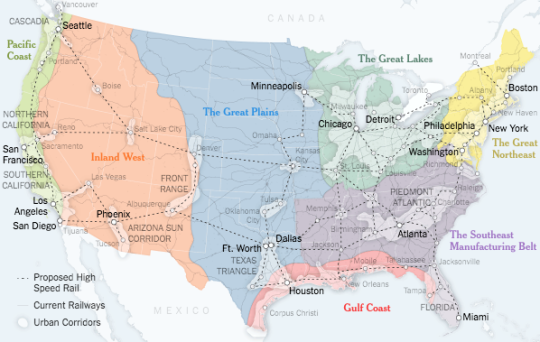
Parag Khanna recently published an article in the New York Times calling for a new map for America.
Here’s why:
“The problem is that while the economic reality goes one way, the 50-state model means that federal and state resources are concentrated in a state capital — often a small, isolated city itself — and allocated with little sense of the larger whole. Not only does this keep back our largest cities, but smaller American cities are increasingly cut off from the national agenda, destined to become low-cost immigrant and retirement colonies, or simply to be abandoned.”
This is something that I’ve been writing about for awhile on this blog. As we continue to transition to an urban-based information economy, it strikes me that, here in North America, we’re going to need to refocus our governance structures around cities. We’re going to need to place our metropolitan regions at the fore if we want to continue competing with rising powers like China – which, by the way, seem to be adopting a megacity model.
Here’s another snippet from the article:
“While Detroit’s population has fallen below a million, the Detroit-Windsor region is the largest United States-Canada cross-border area, with nearly six million people (and one of the largest border populations in the world).
Detroit’s destiny seems almost obvious if we are brave enough to build it: a midpoint of the Chicago-Toronto corridor in an emerging North American Union.”
I’ve argued for this before and I continue to believe that it makes a lot of sense.
A lot of what is covered won’t be new to this audience, but I like how he talks about the importance of urban connectivity, the shift from political to functional geography, and the idea that, in a megacity world, countries can actually be the suburbs of some cities.
One thing you might notice about the talk is how he glosses over both Canada and Europe. This is a reminder to me that if Canadian cities are going to continue to compete against the emerging megacities of the world, we are going to need to think at the scale of the megalopolis. And a big part of that means a focus on extra-urban connectivity.
Click here if you can’t see the embedded talk below.
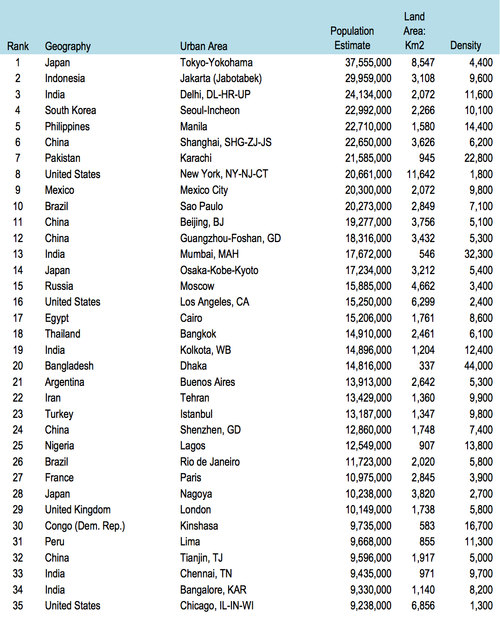
Without a question, we are living in an urban era. More people now live in cities than anywhere else on the planet and I’ve repeatedly argued that cities are our most important economic engine. As a result of these demographic and economic shifts, we’re seeing megacities at a scale the world has never seen before. Below is a list of the top 35 largest urban areas in the world.
The top urban area is Tokyo-Yokohama, with a population of roughly 37.5 million people. That’s almost the same as the state of California and is more than the entire population of Canada, which sits at just over 35 million people. London, which, during the 2nd half of the 19th century, would have been the largest urban area in the world is now the 29th largest.
But at the same time, London arguably remains the most important global city–a title that can only really be rivalled by New York. Which raises an important distinction. One that Aaron Renn clearly identifies in this recent article for New Geography: Just because a city is a megacity, doesn’t mean it is or will ever be a global city. In fact, Renn argues that many of the world’s largest megacities will never “turn the corner” and become leaders of the global economy.
For that to happen, he believes that the city needs to belong to a country on the rise:
Moscow was the capital of the Soviet Empire. New York and Los Angeles came of age when America was the rising, and ultimately dominant, economic colossus. It’s the same for Paris and London, two borderline megacities, which rose as imperial capitals.
But how much of this is driven by the country and how much of it can be driven by the city itself, upwards? Could it be the city that ultimately empowers the country to rise? I ask these questions because Renn frames his argument as if “national hyper growth” is the only prerequisite that will allow the struggling and underdeveloped megacities to pull themselves up and into the developed world.
But the problem is that there’s no clear path to prosperous maturity for these megacities. They are so huge, and their problems so immense that they are difficult to even conceptualize, much less do something about. The amount of needed infrastructure provision alone – water, sanitation, drainage, transport, telecom, electricity, parks, schools, etc. – is staggering. And that doesn’t even touch arguably more difficult problems like corruption and good governance. Absent national hyper growth – a la Japan or Korea – of a level that creates a plausible claim to being the world’s rising economic power, or the proceeds of empire, it seems unlikely any of these cities will ever succeed. By contrast, smaller cities have a much more addressable problem space.
Now, I don’t disagree that the problems in these cities seem almost insurmountable. I’ve been to places like Dhaka, Bangladesh. I’ve witnessed first hand the challenges facing megacities in the developing world.
But to assume that these cities are lost causes without the nation itself lifting it up, seems almost self defeating and overly pessimistic. It also strikes me as a bit of a chicken and egg scenario. Because if cities are our economic engine, then “national hyper growth” seems difficult without also getting our cities right.
What comes first?
Yes, there are and will be reforms that need to happen at the federal level but, at the same time, I think there’s a lot that can and should happen from the ground up. Perhaps that’s part of the reason Singapore has been so successful. As a city-state, its reforms were both top down and bottom up.
I want to believe that with the right reforms, policies, and leadership, any country can create a framework in which its cities are able to thrive. And that it’s not just the result of imperial rule or some other circumstance. From good and transparent governance to developed financial markets, there are many things that cities need to truly prosper. But when you get it right, the results can be remarkable.