
Daily insights for city builders, delivered every morning at 6 AM ET. I’m Brandon Donnelly — a Toronto-based real estate developer and founder of Globizen. I’ve been writing here since 2013.

Tag: medium

  • Attention = money; why the attention economy is broken

    “…the path to profit is to manufacture attention more cheaply than what you get paid for it.” Ev Williams

    A big part of our economy is centered around attention. Some would argue we are living in a de facto attention economy. That is now our scarce resource. There are only so many waking hours in a day and every company and social media platform is fighting for their sliver of your attention.

    However, the irony of the attention economy is that, while it has gotten easier to make and share “content” with the world, the quality of that content matters less than the attention it garners. Because that’s what the system rewards. Whatever you may think about Trump, he has mastered the art of attracting attention.

    Ev Williams – co-founder of Twitter and CEO of Medium – recently wrote a piece on this topic called: Words still matter. It is very much about the mission driving his publishing platform, Medium. Here is an excerpt:

    It’s not that there aren’t journalists, publishers, and thinkers doing great work and putting it out there. But the realities of the attention economy are very tough for those who create things designed for anything but the widest possible (i.e., lowest-common-denominator) audience. For ad-driven sites, the revenue per reader has been dropping for years (while the experience worsens and privacy disintegrates), leaving little room for research, fact checking, or polish… let alone nuance or complexity. The system demands quantity. It demands speed. And it demands little else — except our clicks.

    Their solution is the Medium Partner Program. It is an “open paywall” that allows publishers of great content to lock some of their best content behind a paywall. Their view is that to fix the attention economy, we need to move beyond ad-supported lowest-common-denominator content. 

    This not entirely novel, but they are calling themselves the first “open paywall” platform. I would be curious to hear your thoughts about this in the comment section below. I’ve had a few people suggest to me that I employ a similar approach for this blog. I’m not convinced.

  • 4 years

    Today is the 4 year anniversary of this daily blog.

    Sure, I’ve missed a few days over the years (my estimate is 4-5 days), but for the most part I have shown up here every day and written something. 

    Sometimes that something is very short and/or bad. I’ve had a few people say to me: “I can tell when you’re super busy. Your posts are shorter.” I’m okay with that. Part of this exercise for me is simply about the discipline. 80% of success is showing up, right?

    In some ways, what I do here is an anachronism. Here is a good vintage article (2011) that talks about two different schools of thought when it comes to blogging.

    The reality is that it’s painfully slow and difficult to build an online audience via a personal blog using your own domain. It takes years, unless you’re a celebrity, which I am most certainly not. That’s why many people give up.

    Instead, many people/influencers choose to build their audience on top of an existing network, such as YouTube, Instagram, or Medium. Medium is pretty tempting and I’ve seen lots of bloggers port over their personal blogs.

    The idea here is that you simply bring your content to where your/an audience already lives, instead of trying to get them to come to you. 

    Of course, one of the risks of this approach is that you don’t own/control the platform. What if people one day decided to stop using MySpace? I like the idea of owning (at least part of) my online presence.

    So here’s to another year on the blog. Thanks for reading! I really do appreciate it. Regular scheduled programming will resume tomorrow.

  • Dashilar Platform

    I am reading about the Dashilar Platform this evening. I am sure that some of you are already familiar with what’s happening in this Beijing neighborhood since the platform was founded in 2011. But I am just turning my attention to it.

    The Dashilar Platform is an approach to urban regeneration that grew out of a perceived failure, namely the redevelopment of Beijing’s historic Qianmen neighborhood in the lead up to the 2008 Summer Olympics.

    In this latter case, a top-down tabula rasa approach was adopted and the entire precinct was demolished to make way for what – I am told – is now a kitschy tourist area that has lost most, if not all, of its urban authenticity.

    The Dashilar approach runs counter to this and is trying to work bottom-up. Below is a description of their strategy from the Dashilar Platform website. (It feels like it was written using Google Translate.)

    Dashilar Platform is an open platform founded by Beijing Dashilar Investment Limited. As opposed to the conventional concept of blanket development, Dashilar Platform will utilize key nodes which act as catalysts for change in the area. Through research and design investigation, Dashilar Platform will promote certain archetypes, modules, and best-practice examples for both residents and outside investors. The aim is to encourage the community to move independently yet coherently towards the strong yet flexible goal of creating a sustainable community with increasing depth and diversity. All parties are welcome to join Dashilar Platform and participate in our [progressive] Dashilar Project.

    Some view this “urban acupuncture” strategy as simply a way to promote gentrification through small injections of culture and design. But gentrification, without displacement, strikes me as being the point given that the area was in decline. It was also probably one of the only sensible approaches given the fragmented ownership and illegal structures in the area.

    What stands out for me as I read up on the Dashilar Platform, is the acknowledgement that the market alone will not preserve all of which is thought to be currently desirable in the neighborhood.

    Here is an excerpt from a Medium article written by Masha Borak – a journalist and translator based in Beijing:

    Collaboration is not the only interesting thing about the [Dashilar] project. In the words of their representative, the platform wants to take on the role of a “urban curator" that would decide which kind of businesses could get cheaper rent so they wouldn’t be left to the market.

    Given the discussion that is going on in Toronto right now about 401 Richmond Street West – a non-profit and cultural hub in an area of the city seeing significant development pressures – this struck me as being particularly timely and relevant.

    Markets are not perfect.

    If any of you have any familiarity with the Dashilar Platform and what has been happening in this neighborhood, I would love to hear your thoughts in the comment section below.

  • I love work

    I spent this morning drafting the third post in my BARED blog series. First one, here. Second one, here. If any of you would like to be featured next, or know of someone who you think should be featured next, please send me an email or tweet.

    At this point, I need to move onto other things today. But I did want to mention a post that Ev Williams (Blogger, Twitter, Medium…) recently penned where he talks about keeping technology in check and the drain of being always connected.

    Here are two interesting excerpts:

    “I’ve spent the last 20 years breathing and building the internet. So I have a good sense for the benefits of always-available instant access and all it entails. I also have a strong appreciation for the drain being constantly connected can cause on your health and sense of well-being.”

    “Building companies requires a ton of work — and I love work. But I’ve also found that working 24/7 no longer produces the best work product or the best life experience (not that it ever did).”

    This really resonates with me, as I am sure it does for many of you. I like being always connected. I like waking up every morning and writing a blog post. I like saying yes to things. And I, like Ev, love work. 

    But it can be draining when your ambition seems to exceed your body’s ability to keep on going. And when that happens, you no longer produce your best work, which is the whole point. 

    So in the end, I think we all need these little checks and balances. Exercise is number one for me. It is well worth the time it takes. What do you do for balance?

  • Local rail-driven agglomeration economies

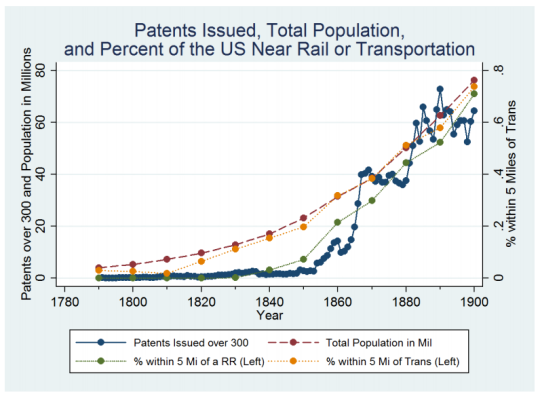
    This morning I came across the below graph in a Medium article by Eric Jaffe of Sidewalk Labs. It is taken from a research paper by Elisabeth Ruth Perlman called, Dense Enough To Be Brilliant: Patents, Urbanization, and Transportation in Nineteenth Century America.

    What this chart shows is patents issued – a proxy for innovation – in all U.S. counties between 1790 and 1900. This data is then compared against access to transport, such as rail. The discovery is a statistically significant relationship between innovation (patents issued) and rail (transport) access.

    The spike in the 1850s (shown above) is as a result of increased rail access.

    But Perlman takes it a step further and asks: what is causing this spike in innovation? Is it because inventors and creators started responding to the larger market now accessible to them because of rail connectivity? Or did transportation somehow improve productivity and the flow of information?

    To answer this question, she dug into the patents themselves (over 700,000 of them) to try and identify how ideas and key words were spreading. What she found is that rail access alone doesn’t encourage innovation. References to new technologies did not increase.

    What mattered was what happened locally. Transportation improvements promoted urbanization and density during her study period, and that’s what drove innovation. Connectivity created agglomeration economies at the local level.

    Obviously a lot has changed since the 19th century. But whether it’s rail connectivity or internet connectivity, have the rules really changed? Place still matters. What happens locally still matters. Perhaps even more. 

    This is an important lesson to consider as we build our cities and invest in transportation. Rail alone isn’t enough. What matters more is what we build around it. Are we dense enough to be brilliant?

  • Formula for life

    https://500px.com/embed.js

    Earlier this week I somehow stumbled on an old (2012) Medium story by Ev Williams, called, Formula for Entrepreneurial Success. (Ev is the cofounder of Medium, Twitter, and Blogger. He basically invented blogging.)

    His post includes 5 short recommendations, and is obviously aimed at entrepreneurs, but I think the lessons also apply more broadly to life in general. They resonated with me, so I thought they might also resonate with you.

    So whether you’re starting a company, developing a new building, or just living life, here are Ev’s 5 points:

    1. Work with amazing people. Don’t compromise on who you choose to found your company with and hire. Do not put up with ego-centric personalities or downer attitudes.

    2. Take on big challenges. It’s pretty simple: Hard things are valuable; easy things are not so valuable. Reaching the mountaintop is rewarding because it is hard. If it was easy, everybody would do it.

    3. Focus. Say no to most things: Features. People. Partnerships. “Coffees.” Projects. Only a few of them really matter. (Yes, it’s hard to know which.) Don’t get distracted.

    4. Take care of yourself. When you don’t sleep, eat crap, don’t exercise, and are living off adrenaline for too long, your performance suffers. Your decisions suffer. Your company suffers.

    5. Love those close to you. Failure of your company is not failure in life. Failure in your relationships is.

    If I had to pick one of the items from this list, I’d say I struggle the most with focus. It’s not that I can’t focus and complete tasks, it’s that I’m the kind of person who wants to fill every second of the day with something meaningful. And when people email me wanting to go for coffee or help with something, I want to do it.

    But unfortunately, time is a hugely valuable commodity and you have to be selective.

    So surround yourself with amazing people. Don’t be afraid of big challenges and risks. Focus. Eat well and lift weights (my preference). And love the important people in your life.