
Daily insights for city builders, delivered every morning at 6 AM ET. I’m Brandon Donnelly — a Toronto-based real estate developer and founder of Globizen. I’ve been writing here since 2013.

Tag: mcgill

  • Canada keeps exporting its best builders, but the fix is right in front of us

    Canada has a smart, highly educated, and entrepreneurial population base. The problem is that too many are leaving to build elsewhere. Here are some alarming stats from Barn Ventures, using data from Dominion List.
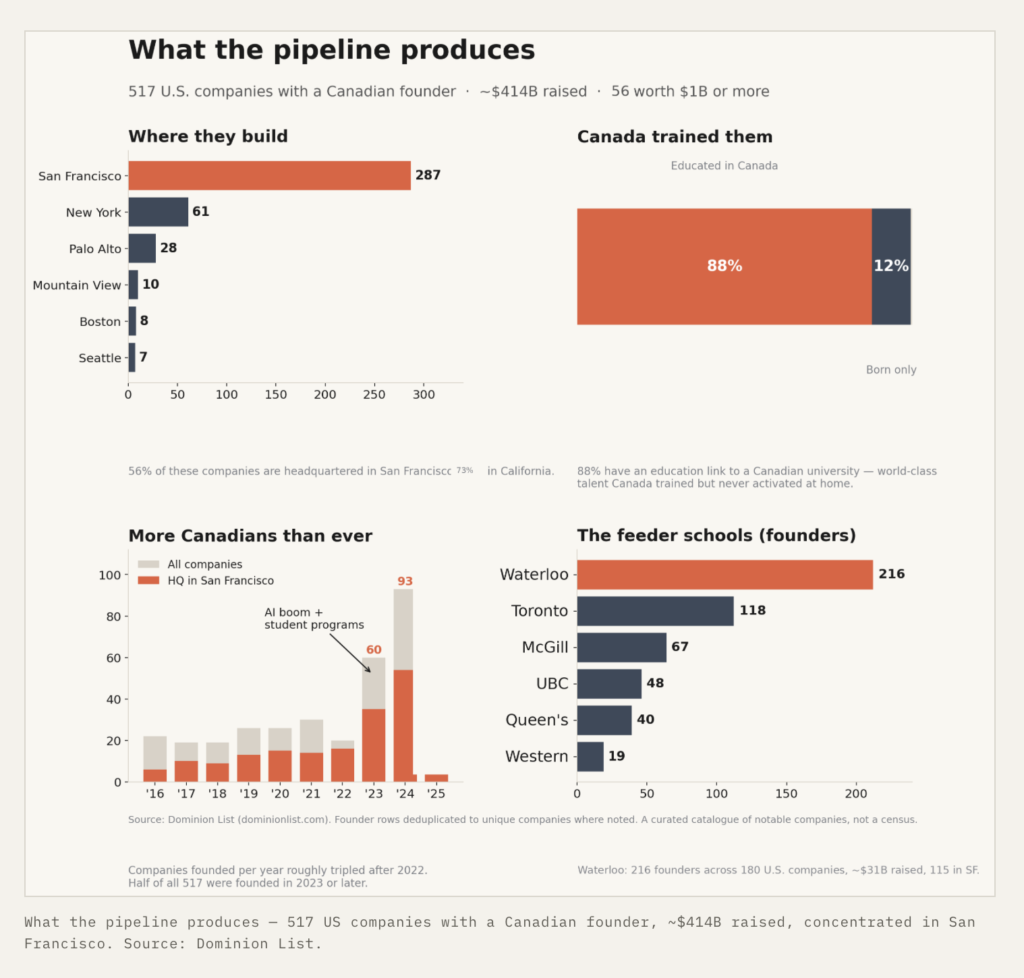
    The list shows 517 US-based companies with a Canadian founder. Of these founders, 88% were educated in Canada (12% were only born here), and the top feeder schools are the exact ones you’d expect: University of Waterloo, University of Toronto, and McGill University (in that order).

    Collectively, these companies have raised something like $414 billion of capital and 56 of these founders are now worth at least $1 billion. This is wealth being generated outside Canada, and then being reinvested into things, people and opportunities outside the country.

    The good news is we already have the raw ingredients. Excerpt from Jesse Rodgers at Barn Ventures:

    The thing Canada has is the one input none of these programs can manufacture: the builders. The Dominion data proves it — 88% of those founders are our graduates. Waterloo produces them on a schedule. The missing piece isn’t talent, or even capital — it’s the infrastructure to recognize and back people before someone in San Francisco does, and now “before” means before they’ve finished a degree.

    If we wait until a smart young person has graduated, started a company, and proven out their idea (which is often what Canadian capital wants), it’s too late! That founder is gone, living in the US, and raising capital for audacious, stupid-sounding ideas that have a small chance of 100x payoffs.

    As they should.

    This is one of the reasons why I think our current real estate downturn will be a net positive for the country in the medium and long term. Too much capital was getting allocated to real estate, starving other economic development opportunities (and I say this as a real estate developer).

    We need to be taking more bets on young Canadians with crazy ideas and accepting that failure is a normal part of the process. Because if we don’t, another country clearly will.
  • Les escaliers de Montréal

    Montreal is one of my favorite places on the planet. In fact, if I have one regret in life it’s that I didn’t do my undergrad at McGill University. Living in Montreal as a poor student would have been the best. Though I shouldn’t complain because I did spend quite a bit of time there when I was a poor student.

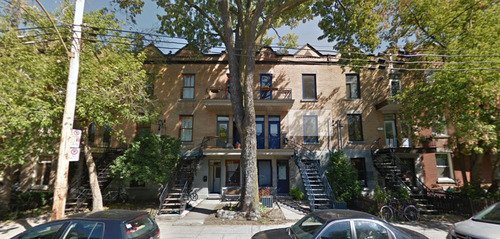
    If you’ve ever been to Montreal, the image at the top of this post will look familiar. The urban landscape of Montreal–at least in the residential areas–is filled with exterior staircases. They’re all over the place. And this always strikes everybody as a bit odd given that it’s a pretty cold and snowy place a lot of the time. Nonetheless, those staircases are quintessentially Montreal.

    Some people think it was done to minimize the amount of interior space that needed to be heated, but I’ve never really gotten a definitive answer. Either way, all those stairs are an interesting byproduct of Montreal’s commitment to one predominant building type: the multiplex. A multiplex is essentially a small apartment building containing a handful of units. They’re usually only around 3 storeys high. And they’re all over the Ville de Montréal.

    To be honest though, I don’t think I’ve ever really explicitly thought about this defining Montreal quality. But then last night I stumbled upon an interesting blog post called “Les escaliers de Montréal vs towers of Toronto." (escaliers = stairs) In it the author talks about how Montreal is essentially this city of multiplexes (with stairs everywhere) and Toronto is this, more modern, city of towers surrounded by single family homes.

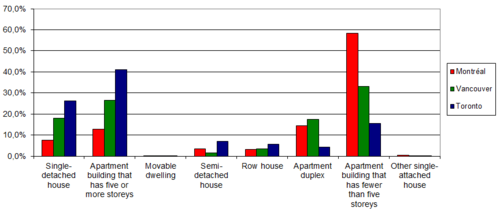
    And here’s the data to back it up:

    When it comes to single-detached houses and apartment buildings taller than 5 storeys, Toronto dominates. But when it comes to apartment buildings less 5 storeys, it’s all Montreal. And if you add in apartment duplexes, you’ve accounted for almost 75% of Montreal’s housing stock. Note: These figures are for the city proper and don’t include any amalgamated suburbs.

    The author’s explanation for this comes down to zoning and timing. Since Montreal is an older city, the belief is that Montreal was simply further along in its evolution when formal land-use planning came into effect and started to order the city. I generally agree with this hypothesis, but I think it’s also worth keeping in mind that, just because a Toronto house might be zoned as single family, doesn’t mean it’s actually begin used as such.

    A lot of the older houses in Toronto have been subdivided into what are effectively illegal multiplexes. Since this is all happening under the radar, nobody really knows what the actual stock of multiplexes might be. Nonetheless, there’s no denying that there are some real differences between the urban fabric of Montreal and Toronto.