Daily insights for city builders, delivered every morning at 6 AM ET. I’m Brandon Donnelly — a Toronto-based real estate developer and founder of Globizen. I’ve been writing here since 2013.

Tag: mayor john tory

  • AusterityTO

    I don’t know who is behind the guerrilla art project AusterityTO, but it is exceedingly clever. Whoever it is, they are going around Toronto and tagging various objects and moments with museum labels — all of which cite mayor John Tory as the artist. Here is one called “Urinal.”

    And here is the installation description from the website:

    A clever subversion of the seminal work “Fountain” by Marcel Duchamp. Water does not flow from this fountain due to neglected maintenance and lack of attention. It is a sculpture which asks the viewer to imagine what it could be, and to ponder why it isn’t. However, the artist’s title also challenges the viewer, much as Toronto challenges the citizen to find ways to make the most out of what we have: the washrooms are frequently locked, and perhaps this fountain can be repurposed for something else.

    There is growing frustration in Toronto around the quality of our public services and spaces. I can’t open Twitter these days without coming across at least one photo of a busted and/or overflowing garbage bin. And now these sorts of posts are all being tagged with #AusterityTO.

    Images: AusterityTO

  • Toronto mayor proposes road tolls, finally

    When I wrote yesterday’s post about road tolls, it hadn’t been announced that Toronto Mayor John Tory was going to call for road tolls on both of the highways coming into downtown. That didn’t leak until late in the evening. So I was just writing another post on a topic that I care about.

    Today, however, that announcement was made and the proposal is a flat $2 toll on both the Gardiner Expressway and the Don Valley Parkway. It is expected that this could bring in close to $200 million a year in new revenue for the city – all of which would be dedicated towards transit and roads. Good.

    First, I want to applaud the mayor for coming out in support of road pricing. I didn’t agree with him on the Gardiner East, but I agree with him on this – mostly. It is a bold move.

    The reason I say mostly is because I hope that we don’t simply default to a fixed and blunt road toll. There are more sophisticated options out there, such as variable pricing models that change based on demand/congestion levels.

    Here’s a post that explains how that works and why I think it’s a good model.

    With this approach, it becomes more of a congestion charge rather than a toll. It also gives commuters the option of driving during off-peak times to save money. And if we implemented something like this, I am sure that we would see employers and office hours adapt. More on this in the above post.

    Still, I absolutely believe that it’s a step in the right direction for this great city. So thank you Mayor Tory.

  • The most fascinatingly boring city in the world

    The Guardian Cities UK is currently focusing on all things Canada for a special week-long series. The first post is up and it’s about why Toronto is “the most fascinatingly boring city in the world.” The piece is by Stephen Marche.

    I don’t agree with everything in the essay – or maybe I just despise being called boring, steady, and predictable – but there are a number of great gems that I would like to reblog today. Here are the 5 that stood out for me.

    1. Chicago vs. Toronto:

    “What Chicago was to the 20th century, Toronto will be to the 21st. Chicago was the great city of industry; Toronto will be the great city of post-industry. Chicago is grit, top-quality butchers, glorious modernist buildings and government blight; Toronto is clean jobs and artisanal ice-creameries, identical condos, excellent public schools and free healthcare for all. Chicago is a decaying factory where Americans used to make stuff. Toronto is a new bank where the tellers can speak two dozen languages.”

    2. London vs. New York vs. Toronto Bankers:

    “In London and New York, the worst stereotype of a banker is somebody who enjoys cocaine, Claret and vast megalomaniac schemes. In Toronto, a banker handles teachers’ pension portfolios and spends weekends at the cottage.”

    3. Montreal vs. Toronto:

    “I was 19 when he said that, and I knew even then that for the rest of my life, Canada’s future would be built on money and immigrants. I wasn’t wrong. Most Canadian business headquarters had already taken the five-hour drive west. After 95, the rest followed. Montreal decided to become a French-Canadian city. Toronto decided to become a global city.”

    4. The last time Toronto built a white elephant subway line:

    “On any given morning on the Sheppard subway line in the north of the city, you can sit down in perfect peace and order, although you will find little evidence of good government. As the latest addition to Toronto’s fraying infrastructure, the Sheppard subway is largely untroubled by urban bustle. The stations possess the discreet majesty of abandoned cathedrals, designed for vastly more people than currently use them, like ruins that have never been inhabited. Meanwhile, in the overcrowded downtown lines, passengers are stacked up the stairs. The streetcars along a single main street, Spadina, carry more people on a daily basis than the whole of the Sheppard line, whose expenses run to roughly $10 a passenger, according to one estimate. A critic has suggested that sending cabs for everybody would be cheaper.”

    5. On Mayor Tory:

    “The current mayor, John Tory, is not an idiot, although he is hardly a figure of the “new Toronto”. He represents, more than any other conceivable human being, the antique white anglo-saxon protestant (Wasp) elite of Toronto, his father being one of the most important lawyers in the city’s history. The old Wasps had their virtues, it has to be said – it wasn’t all inedible cucumber sandwiches and not crying at funerals.”

  • #WeTheOther

    We may not all agree on things like bike lanes and transit, but if there’s one thing that can generally unite a city it’s playoff sports. 

    I love the solidarity that it creates. You may have nothing else in common with the person sitting next to you at the bar, but suddenly you’re best friends because your team is winning.

    As I write this post, #WeTheOther is currently breaking the internet after CBS Sports ran a cheeky online poll asking: Who will win the NBA title? The four options were:

    1. Warriors
    2. Thunder
    3. Cavaliers
    4. Other

    For those of you who don’t follow basketball, there are only 4 teams left in the NBA playoffs right now! So in what was likely a deliberate snub to the Toronto Raptors, CBS conveniently obfuscated them in their poll.

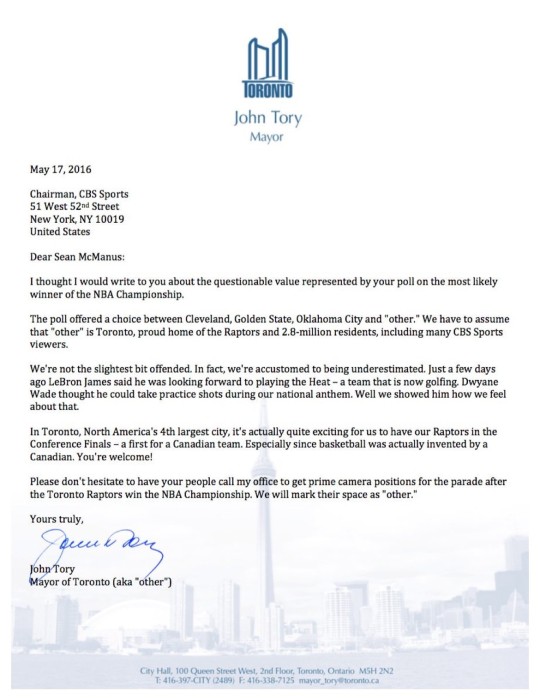
    Here’s how Mayor John Tory quickly responded:

    What would sports be without the trash talking?

  • Those troublemakers

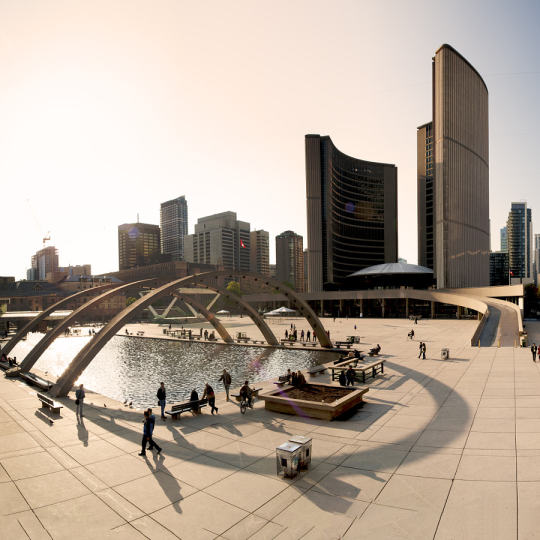
    Toronto City Hall by Sébastien Pacaud on 500px.com

    https://500px.com/embed.js

    Jennifer Keesmaat is the Chief Planner of Toronto. She was hired for this job in 2012.

    She has a Masters in Environmental Studies (Politics and Planning). She is a Registered Professional Planner with the Canadian Institute of Planners. And she was also the founder of 2 (city) planning firms prior to taking the position of Chief Planner for Toronto.

    So presumably, she was hired for this job because she possesses some sort of expertise in the realm of planning. I also presume that she is expected to make her opinions known to other people so that informed planning discussions can occur and decisions can be made.

    So I find it curious that in some circles, and in the media, Jennifer Keesmaat is being branded as a “troublemaker.”

    A lot of the recent chatter stems from the fact that Keesmaat was at odds with Mayor Tory during the Gardiner Expressway East debate (quote via Toronto Life):

    Eventually Tory had enough and pulled Keesmaat into a meeting where he basically told her to zip it. “The mayor has said it is perfectly appropriate for staff to make their opinions public, as Ms. Keesmaat has done,” wrote his communications chief, Amanda Galbraith, in a statement. “It is not appropriate for city staff to campaign against councillors or the mayor on social media or through other public platforms.” Keesmaat counters that she never campaigned. “I stated an opinion,” she says simply.

    But the “troublemaking” didn’t just start with the Gardiner East. Pretty much since the moment she took the position of Chief Planner and launched her own blog (ownyourcity.ca), she was dubbed a shit disturber. (Those bloggers!)

    But if you ask me, these criticisms stem from an old and outdated way of thinking.

    The last thing we need from government is less transparency and more politicking. We should be working towards more, not less, information. Even if that information doesn’t butter our metaphorical bread.

    What do you think?

    I think this will make for a great discussion in the comment section below.

  • Teaming up to fix Toronto’s traffic troubles

    image

    “This will be a game changer and will establish Toronto as a leader in running a truly smart city.”
    – John Tory, Mayor of the City of Toronto

    Yesterday I registered for a hackathon called TrafficJam that’s taking place this October 2 – 4, 2015 here in Toronto. It’s being organized by Evergreen CityWorks and the City of Toronto, with the goal of fixing Toronto’s traffic troubles.

    Tickets are free, but going fast. If you’re interested in this sort of thing, I would encourage you to sign up today. And if you do register or are already registered, drop me on a line so we can connect. I’m excited to see what kind of solutions we’re all able to come up with over the course of a weekend.

    But as I was registering and reading through the website, I couldn’t help but think about some of the traffic problems that we won’t be solving over the hackathon weekend, namely the politicization of transportation planning in this city.

    As an example of that check out a post by transit blogger Steve Munro called, The Vanishing Relevance of SmartTrack

    SmartTrack is the transit platform that Mayor John Tory ran on last year. And this post explains why it is unlikely to achieve its pitch promises.

  • Gardiner East vote shows that Toronto is not yet ready to be an urban leader

    image

    Today is very sad day for Toronto. 

    After 2 days of debate, City Council voted this afternoon, 24-21, in favor of rebuilding the elevated Gardiner Expressway East (”hybrid” option) that runs along the city’s eastern waterfront.

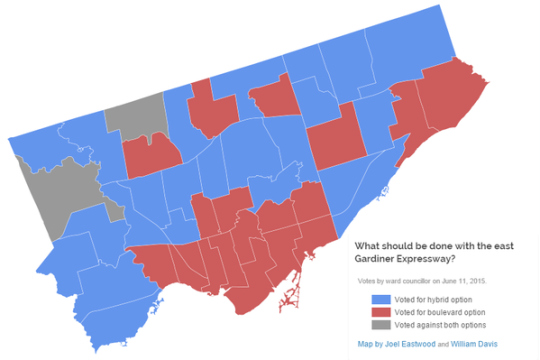
    And once again, Toronto is largely divided. See above image prepared by Joel Eastwood and William Davis.

    It’s the old city of Toronto (who uniformly wanted the elevated highway replaced with a boulevard) versus the rest of the city (who for the most part voted for the hybrid).

    I can’t begin to tell you how deeply disappointed I am by not only the outcome, but also by how it happened and why it may have happened. For all of our talk about being a progressive global city, today we are clearly not that. 

    Because more than a vote on what to do with the Gardiner East, today was a vote on how we believe we should be building this city for the future. 

    When the Gardiner East was first built, the vision was one of fluid private mobility, where it would be possible to quickly circle around and across the city on an endless sea of highways. Detroit was doing it. Baltimore was doing it. Everybody was doing it.

    In other words, we were building our environment around the car. And our primary – some would say singular – focus was to ensure that the car could move unencumbered around the city. That’s why Toronto is now home to the busiest and one of the widest highways in the world.

    But despite all this, Toronto remains crippled by gridlock. And so does every other big city city in the world that has bet on cars as the solution. Why is that?

    Because that model doesn’t work.

    The I-10 Katy Freeway in Houston is 26 lanes at its widest point. It is the largest highway in the world by number of lanes. But from 2011 to 2014, commute times in some sections increased by as much as 51%. Is that because they haven’t built enough highway? How much is enough?

    By comparison let’s look at a city that has bet on transit as the solution: Tokyo. 

    The metropolitan area of Tokyo is approximately 37.8 million people. That’s more than the entire population of Canada and by most accounts is the largest urban region in the world. But despite its size, Tokyo is consistently ranked as one of the most livable cities in the world and also one of the most efficiently run.

    Interesting.

    So when I heard Councillors going on today about how a vote for the “hybrid” is a vote not to increase congestion and gridlock, it became abundantly clear that many – apparently most – people in this city still do not appreciate what it is going to take to get us efficiently moving as this region approaches 10 million people by 2041.

    This should not have been a debate about 3 minutes. That, as I’ve said before, is a red herring.

    Of course, there was lots of lip service to transit. Many seemed to agree that transit is the future. And some even went so far as to say that removing the Gardiner East and replacing it with a boulevard is the right thing to do, but that we simply can’t do it now because we haven’t made the requisite investments in transit. 

    If transit is truly what we want, then we why don’t we take the boulevard savings and put it directly into transit?

    To me it’s like saying: I really want to be homeowner, but I can’t afford it right now. So instead, I’m going spend more on rent so that I can burn through more money and make it even more difficult for myself to eventually become a homeowner.

    Because that is what happened today. 

    We voted to overspend on a stretch of elevated highway that is used by a small sliver of downtown commuters (~3%), instead of replacing it with a cost-effective surface boulevard (with similar road capacities) and then prioritizing the proven solution to urban congestion: transit.

    At the same time, we also made a number of other things clear in today’s vote. 

    We made it clear that cars matter more than our city’s public realm; that cars matter more than our waterfront revitalization plans; that cars matter more than our environment and our “efforts” to reduce GHG emissions; and, frankly, that cars matter more than our overall quality of urban life.

    I believe that cars will always be a part of our cities, but I don’t believe in putting them ahead of you and I. I guess old habits die hard. That my friends, really sucks.

  • Guest Post: Three minutes that rule the world – Will demolishing the Gardiner East actually make traffic worse?

    Today on Architect This City, we have a guest post by Darren Davis, who is a transport planner in Auckland, New Zealand. He’s a regular commenter on this blog, and I know he’s been following the Gardiner East debate quite closely – as many urbanists around the world are. I appreciate him offering and taking the time to write this piece. Thank you.

    ——————————–

    The decision this month on whether to demolish the Gardiner East Expressway and replace it with a surface boulevard or to rebuild it with a similar elevated structure will be a watershed moment for Toronto, akin to the decision not to have freeways in the urban core of Vancouver in the late 1970s.

    There are numerous good reasons why removing the Gardiner East elevated structure is the right move for Toronto, covered previously by The Globe and Mail and in the Council for Canadian Urbanism’s open letter to Toronto City Council. If you aren’t aware of these, I strongly recommend reading them. 

    Also of note are two things:

    1. Just 3% of Downtown commuters drive on the Gardiner Expressway East, a tiny fraction of the 68% who arrive Downtown on public transit.
    2. The “remove” option does not reduce traffic capacity over the “hybrid” option but could reduce travel speeds in uncongested conditions (read on for why I don’t think that this will happen in real life).

    However, one element of this debate that has not got much airtime is the transportation modelling that claims an additional two to three minutes travel time with the “remove” option over the “hybrid” option which retains the elevated expressway in a slightly modified form. 

    Toronto Mayor John Tory has stated that "I didn’t get elected to make traffic worse. And let’s be clear, removing that piece of the Gardiner will almost certainly make traffic worse.” But is it in fact true that demolishing the Gardiner Expressway East will make traffic worse as the transportation modelling claims?

    The key thing to understand is that transportation modelling, which tries to predict future travel times, is the product of a bunch of assumptions which may not in fact be borne out in real life. 

    For example, the effect of induced traffic, where additional traffic capacity leads to additional traffic being attracted to the route, is reasonably well known but generally not factored into transportation modelling. Induced traffic happens because increased travel speeds attracts traffic that would have otherwise avoided the route at congested times; attracts people to drive where they previously used other modes and encourages trips that would not otherwise have taken place. The effect of induced traffic is to quickly nullify the benefits of adding traffic capacity.

    However, what is less well known is that the reverse happens where there is either a reduction in traffic capacity (not the case in Toronto as the “remove” option retains the same traffic capacity) or speed.

    This is because in this situation, four things happen:

    1. Some travel re-routes. The “remove” option with a widened Lakeshore Boulevard as part of the street grid simply gives more ability for traffic to re-route away from congestion over an elevated expressway structure where drivers are literally trapped until they reach their exit.
    2. Some travel re-times. Some people will retime trips to avoid congested travel times, such as starting and/or finishing work at less congested times.
    3. Some travel changes mode. Some people will be encouraged to change mode by the perceived worsening in traffic conditions.
    4. Some travel is avoided entirely. Some people will choose not to travel at all in the peak of the peak. For example, this could take the form of working from home or shopping on the internet instead of by car.

    Transportation models only take into account the first item but not the others. The modelling is also sensitive to traffic growth assumptions and assumed mode split and trip distribution. Often transportation models assume continued growth in car travel even though per capita kilometres travelled peaked about a decade ago.

    While this may all sound well and good theory, does this actually happen in practice?

    In Auckland city centre, we have extensive experience with the reallocation of road space away from general traffic. Many busy key city centre approach routes have had general vehicle lanes reduced to make way for bus lanes (which generally carry around 65-70% of the people moving capacity of the street). 

    This has involved up to a 50% reduction in private vehicle capacity (whereas in Toronto, the “remove” option retains the same traffic capacity but may slow throughput). Auckland has done two of these in the past twelve months – both involved converting a general traffic lane to a bus lane. 

    Don’t get me wrong: There is sometimes pain at implementation with about a three week period of congestion as car drivers adapt to the new reality – and most likely negative media coverage will accompany this. But after about a month, equilibrium will be restored and life will continue much as it did prior to the change. 

    Part of this is that there will be various “optimisations” during this introductory period where signal timings are adjusted and other tweaks made – the sort of tweaks that can only be fine-tuned in a real world situation. But a bigger part of this is that the four factors above – re–routing, re-timing, mode change and avoided travel – come into play.

    I cannot overemphasise enough that life will return to normal surprisingly soon if the Gardiner East Expressway is demolished and replaced by a widened Lakeshore Boulevard.

    My advice

    When people talk about two to three minutes of extra travel time, take the foregoing into account and take those claims with the very big grains of salt that they deserve. If Toronto makes the right choice and chooses the “remove” option, my bet is that the biggest surprise of all will be how little difference it makes to peak travel times for the 3% of Downtown commuters who used to use the Gardiner Expressway East.

    Disclaimer

    The author of the above post is an employee of Auckland Transport, however, the views, or opinions expressed in this post are personal to the author and do not necessarily represent the views of Auckland Transport, its management or employees. Auckland Transport is not responsible for, and disclaims any and all liability for the content of the article.

  • A petition to Toronto City Council to remove the Gardiner Expressway East

    image

    “If the decision ultimately of the council is to support the hybrid I think frankly it’ll be a major step backwards and you’re going to miss a once in a lifetime opportunity, and I’ll be very frank, we’ll be the laughingstock of the world.” 

    -Paul Bedford, former chief planner of Toronto

    As many of you I’m sure know, I have been a vocal and passionate supporter of removing the eastern portion of the elevated Gardiner Expressway in downtown Toronto. I have written about it so many times that a lot of you are probably sick of hearing about it.

    I’m sorry if that’s the case. But it’s a hot and important topic in Toronto right now. We’re just over 3 weeks away from City Council finally making a decision. That is scheduled to happen on June 9th and/or 10th. 

    For the most part though, I was pretty confident that we would ultimately make what many of us believe is the right decision. But then this past week Mayor John Tory went public in his support for the “hybrid” option, which is basically to rebuild the elevated expressway in a slightly different configuration. And that really upset me.

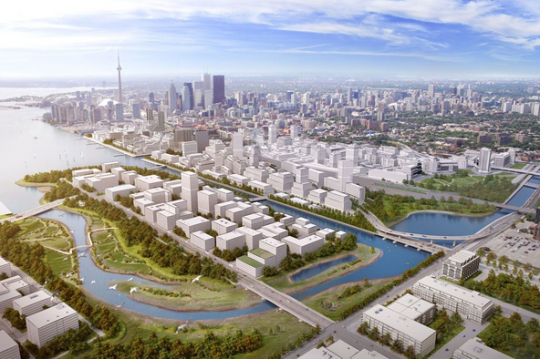
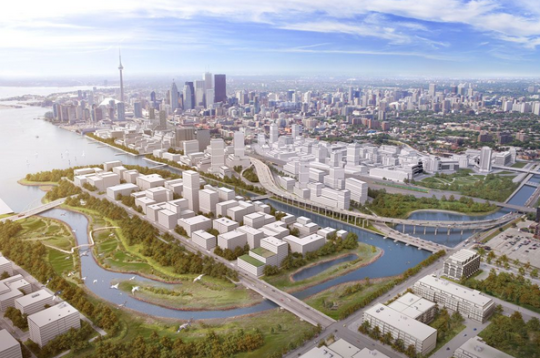
    Here’s what that looks like (versus the remove option shown at the top of this post):

    image

    Have we learned nothing from our past city building mistakes?

    Since that announcement, I went on Twitter every night this week to check out the discussions that were happening around #GardinerEast. And every night it got me so worked up that I then had trouble falling asleep. I have since stopped reading about the Gardiner East before bed.

    But rather than just get frustrated, my friend (a fellow city builder named Stephen Job) and I decided to do something about it and create a petition using Change.org.

    It is a petition that we will ultimately be sending to Toronto’s entire City Council prior to their June 9 meeting and we hope that you will consider signing it and sharing it with your network – regardless of whether or not you happen to live in Toronto. (Although it’ll certainly help if you’re a taxpayer and voter in the City of Toronto.)

    We just finished getting it up and you can check it out and sign it by clicking here.

    Images: Toronto Star

  • Toronto seeks injunction to stop Uber

    image

    One evening this past spring I was leaving a Rotman School event at Liberty Grand on the west side of Toronto. There aren’t a lot of taxis coming through this part of the city, so I figured I was going to have to wait while I hailed one from my phone. But as luck would have it, one happened to be pulling up just as I walked out of the hall.

    As he drove up and rolled down the window, I told him that I was going to the St. Lawrence Market area and that I needed to pay by credit card (I was trying to be a nice guy and avoid the inevitable fight when he was dropping me off). He responded by saying, “My machine is broken. Can’t you pay with cash?” I told him, “No, unfortunately I don’t have any cash on me. I need to pay with credit card.” He then rolled up his window and drove up closer to the entrance of the hall.

    Faced with this scenario, I did what most people would probably do nowadays: I pulled out my phone so that I could hail either an Uber or a Hailo cab (I’m sad that Hailo has since left the North American market). I decided on Hailo (it was cheaper until UberX came along) and ordered a car.

    But within a few minutes, the same taxi with the broken credit card machine circled back around, rolled down his window, and told me that his machine was now working and he would take me to the St. Lawrence Market. Knowing exactly what had happened, I said to him, “Wooooow, that’s funny that within the span of a few minutes your machine has magically started working again.” He wasn’t happy with that response.

    Now, we all know why he didn’t want to take my credit card. He didn’t want to pay the fees and he wanted the cold hard cash. And who can really blame him for wanting to maximize his profits. But for the end user, this experience sucks. When it’s 2 in the morning and all you want to do is go home to bed, you don’t care about the few dollars he’s trying to save. You just, want, to go, home.

    And that’s one of the reasons why Uber (and previously Hailo) is having such a huge impact on the market. Even before UberX arrived (the cheaper alternative), lots of people were more than willing to pay the Uber premium. And they continue to pay their controversial surge prices. But that’s because the experience is so much better than what’s offered today.

    We all know that Uber is under a lot of fire for what they do, but Toronto mayor Tory is 100% right in saying that ridesharing and peer-to-peer taxis are here to stay. Toronto may be seeking a court injunction to stop the service in this city, but I would agree that it’s likely going to be a big waste of money. The cat is already out of the bag.

    What’s happening here is no dissimilar to what happened with Napster. A court order may have forced the company to shut down, but it didn’t maintain the status quo for the music industry. That industry went, and continues to go through, a lot of change. So a better option, would be for everyone to sit down together and figure out what the future of the taxi industry is going to look like. Because I can guarantee you that it’ll continue to change.

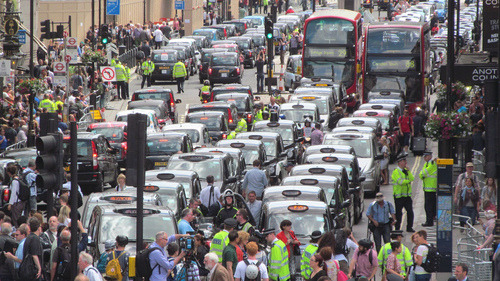
    Image: Anti-Uber protest in London (Flickr)