Daily insights for city builders, delivered every morning at 6 AM ET. I’m Brandon Donnelly — a Toronto-based real estate developer and founder of Globizen. I’ve been writing here since 2013.

Tag: marseille

  • Streets in the sky

    I went out this morning to grab coffee from around the corner and, on my way back home, I ran into two people in the elevator that, from what I could glean, had hit the same button in the elevator and then struck up a conversation. He asked if she had just recently moved into the building. She responded with no, and that she usually doesn’t see anyone else on their floor. He was surprised by this response and said that he knows everybody on the floor.

    Nearly a hundred years ago, architect Le Corbusier, as well as others, had the idea of creating “streets in the sky.” Perhaps the most famous example of this concept is his Unité d’Habitation in Marseille (pictured above). Now a UNESCO World Heritage building because of its role in the development of modernist architecture, the building houses five “streets”, two of which were intended to be fully-fledged shopping streets. These streets house(d) things like shops, restaurants, galleries, and even a hotel.

    Le Corbusier was famous for his desire to create machines for living in. And these streets in the sky were part of this philosophy. The idea was that by having all of the things you needed under one roof, you would then be able to live an efficient, productive, and enjoyable life. Architecture and design could do that for you.

    Of course, the other reason for this thinking was that we needed to get people away from cars. As the car became more commonplace in cities, conflicts arose. And architects began to grapple with how best to separate people and cars. One obvious solution was to simply lift people up and off the ground so that the street could be freed up for cars to do their thing. This was going to be the future.

    The pitfalls of this line of thinking have since then been widely documented. And today, I think it’s pretty clear that most cities are in fact taking the opposite approach. Instead of removing people, they are removing cars through pedestrianization projects. Some of these projects are temporary, but many are also permanent. This happening almost everywhere from Toronto to Sao Paulo.

    The other problem is that it’s extremely challenging to make retail uses work way up in the sky. And that’s why even second floor retail spaces often struggle compared to those on the ground floor. As I understand it, the non-residential tenancies in Marseille’s Unité d’Habitation have naturally evolved from being retail-centric to being more office-like. Supposedly you’ll now find architects and medical offices, which is not at all surprising.

    But that doesn’t mean that Le Corbusier’s instincts weren’t directionally right. We now have lots of examples of tall buildings housing an intense mix of uses and public functions. And in the case of multi-family buildings, the corridors do often serve as a kind of street. I happen to live off of one that houses our building’s amenities. And so in addition to just running into neighbors, I’ll often run into the odd birthday party or Sunday afternoon sumo-suit party. True story!

    It may not be the Champs-Élysées, but it is a kind of street for living.

    Photo by Bernd Dittrich on Unsplash

  • Toronto-Montréal should be a 2 hour high-speed train ride

    The Quebec City-Windsor corridor is the most densely populated region in Canada. The last time I checked Wikipedia, it was reported to house about 18 million people, or about half of Canada’s entire population.

    So it is not surprising that there have been numerous high-speed rail studies for this corridor over the decades, as well as studies for other important links in Alberta (Edmonton-Calgary) and other parts of the country.

    And yet, Canada remains the only G7 country without any high-speed rail. Though to be fair, the US doesn’t have all that much either; certainly with respect to the size of its population.

    However, there is some good news. In March of this year, the Government of Canada announced a Request for Expression of Interest related to high frequency rail service between Quebec City and Toronto. More information, over here.

    But from what I have read, it’ll be a faster upgraded service (~200 km/h), but not true high-speed rail (~250-300 km/h). I took the TGV from Marseille to Paris last summer, and this is how fast we were going:

    If we’re going to do this, let’s be the absolute best in the world and not settle for mediocrity.

  • 🏊‍♂️ Sunrise swims

    Les Goudes, Marseille

  • 🪨 Calanque de Port-Miou

    Without WiFi at the moment. This post barely made it online.

  • 🌊 Front door of our room

    Les Goudes, Marseille, France

  • ✈️ Off to France and trying something new

    Neat B and I are off to France for the next two weeks. We optimistically booked this trip at the beginning of the year and assumed that the world would be fairly normal and well-vaccinated by now. While there remains uncertainty, things are at least better than they were last winter when we were all caved at home.

    Regular readers of this blog will know that I aim to post 365 days a year, regardless of what may be going on in my life. And that will remain the case for the next two weeks. But I have decided to challenge myself and try something new.

    I’m going to exercise my photography passion a little and instead post a single photo each day. On some days it may have a caption or a short description, but on other days there may be no accompanying text at all. The plan is to shoot entirely on my Fujifilm X-T3. Or at least that’s the thinking right now.

    I’m sure that there will end up being some great content for those of you who are interested in the built environment (architecture, design, planning, real estate). But if travel and beautiful photos aren’t your thing, feel free to check back in two weeks for our regularly scheduled programming.

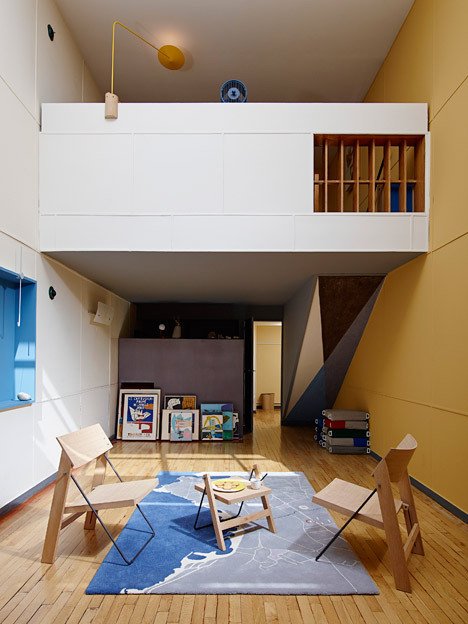
  • Visit Apartment N°50 in Marseille next month

    Completed in 1952, the Unité d’habitation in Marseille, France (more specifically known as the Cité radieuse) is one of the most famous buildings by Swiss-French architect, Le Corbusier. Every architecture student learns about it at one point or another.

    It’s famous because it was a model for a new way to live and build cities. Le Corbusier envisioned the apartment building as a kind of vertical city. The corridors weren’t thought of or referred to as corridors, they were instead called streets and lined with shops and businesses.

    Of course, Le Corbusier later became famous for inspiring an entire generation of buildings that many people now hate. Some believe he was completely misguided and others believe we simply bastardized his intents. But whatever the case may be, he certainly had a profound impact on cities.

    So if you happen to be in Marseille between July 4 to 19 (2015), you should check out an installation at the Unité d’habitation called Apartment N°50.

    It’s an installation put on by Jean-Marc Drut and Patrick Blauwart. They are the owners of Apartment N°50 and, since 2008, they have invited a designer or studio to come in and renovate it on an annual basis. They then open it up to the public during the summer. I think that’s a really neat idea and would love to visit sometime.

    Click here for the official Apartment N°50 website (it’s in French). The image at the top of this post is from Curbed.