
Many of you have probably visited or seen videos of the Maeklong Railway Market in Bangkok. (I’ve done the latter, not the former.) It is one of the largest seafood markets in Thailand and it is literally housed on the railway’s tracks. Every time a train passes through, the entire market needs to be pulled up and relocated. Even the awnings that cover the market need to be collapsed. The videos I’ve seen have all been taken from grade. But the below video (via Vala Afshar on Twitter), showing the market in plan view (from what was likely a drone), is arguably even more impactful. There isn’t a foot of wasted space.
Tag: market
-
The Toronto and Vancouver housing markets
CIBC World Markets recently published this report by Benjamin Tal talking about the Toronto and Vancouver housing markets. Here is an excerpt:
“But when the fog
clears it will become evident that the
long-term trajectory of the market will
show even tighter conditions. The supply
issues facing centres such as Toronto and
Vancouver will worsen and demand is
routinely understated. Short of a significant
change in housing policies and preferences,
there is nothing in the pipeline to alleviate
the pressure.”It’s a good read. Worth your time.
One stat that stood out and directly relates to some of the topics that we frequently talk about on this blog is the shift in Toronto from low-rise to high-rise housing.
In the report there’s a chart showing the “change in [housing unit] completions” in 2016 as compared to 2000. The switch from low-rise to high-rise is almost 1:1 in Toronto. In other words, we substituted high-rise housing for low-rise housing.
I think this speaks volumes about the fundamentals underpinning the Toronto condo/apartment market. We are continuing to build up because it is the future of housing in this city.
-
Toward more family condos
The Ryerson City Building Institute and Urbanation recently published a terrific report called: Bedrooms in the Sky. Is Toronto Building the Right Condo Supply?
Here is a quick synopsis: The 35-44 year old age bracket in this city will see significant growth over the next decade; single family homes are really expensive; and we’re not building enough family-friendly condo units.
When Urbanation looked at the data for all condo units currently under construction they found that the unit mixes still skewed toward 1-bedroom units, but that the number of 3-bedroom units is starting to trend upward. That feels right.
The report also talks about the affordability gap between condos and houses. The average condo in the Greater Toronto Area costs about $511,000, while the average detached house costs $1,134,000.
However, this isn’t exactly an accurate comparison because the average condo is smaller in size than the average house. I think a better metric is to look at price per square foot.
Also, houses give you the flexibility of a secondary suite. Right now that usually means a basement apartment, but pretty soon it’ll likely include a laneway suite. That creates an additional income stream and helps with overall affordability.
In any event, up until maybe recently, houses generally looked cheaper on a per square foot basis. And my view – which I have written about extensively on this blog – was that as soon as houses become “more expensive”, we’ll see an uptick in larger family-oriented condos.
A few weeks ago I went to an open house in a desirable area of Toronto. It was for a 1,300 sf semi-detached house with good bones, but in need of a full gut. Basement was low, only suitable for humans around 5′ tall. It sold for $1 million.
Let’s say that house needs $300,000 to bring it up to the level of a new condo. If that doesn’t include some sort of extension, now you’re in for $1.3 million or about $1,000 per square foot. You can still find a condo for less than that.
Which is one of the reasons why I think we’re now starting to see an uptick in larger/family units. (We are trying to do it at Junction House.)
But like all things in real estate, these things move slowly. The condos under construction today were designed years ago. Changes take time to work themselves through the system.
-
Morning bagel run
This morning I woke up and decided that I could go for a bagel with lox and cream cheese. I figured, it’s the weekend, I’m going to treat myself. So I walked across the street to St. Urbain Bagel Bakery (see above photo).
My Montreal friends reading this are probably thinking that this is no substitute for a Fairmount or St-Viateur bagel. But I enjoy St. Urbain. They are my go-to place for breakfast in the market.
What I really value, though, is the ability to walk across the street and grab a bagel for breakfast. It’s a pretty simple action. Nothing complicated about it.
But in our world of constant traffic jams, cars that should soon drive themselves, and near-instantaneous online delivery, it can be easy to forget that there’s still something really nice about just walking down the street in the morning and saying hello to a human.
I feel lucky that my neighborhood allows me do this. Not all do.
-
Transparent offer platform
A new “transparent offer platform” called Haus has just launched in California to serve the residential real estate market. The way it works is that all offers are submitted online. And once an offer has been confirmed, it – along with all of its terms – gets revealed to every other potential buyer. See image below.

I’ve seen a number of different iterations of this same idea, which tells me that this is a well-identified problem in the real estate market. Here’s a snippet from a recent TechCrunch article announcing Haus:
“We think the openness will create a more efficient market and that the number of offers and price will ultimately be dependent on demand,” said Haus GM Sarah Ham. “Bidding wars are a common, almost accepted, part of the real estate process today. But with our approach, buyers know where they stand. Buyers will know what they need to offer to make their offer competitive, but they also won’t negotiate against themselves.”
I completely agree that this is a problem that needs to be solved. It will create a more efficient marketplace. However, in this market, I suspect that the current information asymmetries largely benefit sellers, to the detriment of buyers. So I wonder if the supply-side of the marketplace will be willing to participate at scale. What’s really in it for them?
Side note: Haus is the latest project from Expa, which is a “startup studio” that works on its own ideas, as well as partners with other founders. I am very interested in this approach to creation because I think you have to try and make a lot of things if you want to do truly innovative things.
-
VIA 57WEST in New York starts renting apartments

Bjarke Ingels’ West 57th Street project in New York (developed by The Durst Organization) has just started renting apartments (March 1).
Since I’m in the rental business, I thought it would be worthwhile to take a look at the rents – though I tend to obsess over all buildings and not just rental ones.
Firstly, the project has a total of 709 apartments and 178 different unit types because of the architectural variations in the building. Of these units, 142 of them (20%) have been designated as affordable and were offered up via a lottery to people who fall within certain incomes ranges.
Here are the affordable rents via 6sqft.com:

I don’t know the exact numbers, but Curbed New York speculated – based on what was seen at other buildings on the west side – that the total number of applicants for these 142 units may have reached over 100,000!
For the market-rate units, the average monthly rents are as follows (via Curbed NY):
- Studio: $2,770
- One-bedroom: $3,880
- Two-bedroom: $6,500
- Three-bedroom: $11,000
- Four-bedroom: $16,500
I wasn’t able to find average unit sizes (to calculate per square foot rents), but I estimate the overall average unit size to be around 1,000 square feet.
940,000 sf (total gross floor area) – 45,000 sf of retail x 0.80 efficiency (lower than average because of the shape of the building) / 709 units = approximately 1,000 sf of rentable area per unit. That’s just my rough guess based on what I could find online.
Based on the Curbed comment section though, there are certainly some smaller units:

If anyone has any additional figures, please share them in the comments below. I think there are a few subscribers to this blog who are involved in the project.
Image from via57west.com
-
Why multi-family developers are shifting their customer focus
One aspect of the Toronto housing market that I’ve been paying close attention to is the adoption of multi-family dwellings by both long-term end-users and families.
I’ve written about this before (here and here, over a year ago) and have argued that here in Toronto we are at an inflection point. Multi-family dwellings – both rental and condo – are evolving to now target these new customer segments. Whereas previously, the new construction multi-family housing market was heavily geared towards investors and first-buyers. And often it was simply a stepping stone towards a single family home.
Now, every city and real estate market is different. And I have heard many people in U.S. cities say that Millennials are simply deferring what we saw with previous generations. At the end of the day they (or we, I’m a Millennial) are going to move to the suburbs and buy that car. The current trends we are seeing around city living and reduced driving are just that – short-term current trends.
But I think it’s worth reiterating: I do not believe that the status quo is what’s happening right now in Toronto. And I’m sure it’s also happening elsewhere. Time and time again I speak to developers in this city who are starting to shift at least some, and in some cases all, of their focus towards end-users, families, and larger units – particularly for new mid-rise product in the “neighborhoods.”
And if you think about it, this makes perfect sense.
The average price of a detached single family house in Toronto is well north of a million dollars. So when a developer brings to market a 1,200 sf family sized apartment at $600 psf ($720,000) or even at $700 psf ($840,000), that home now becomes a relatively “affordable” option in many desirable areas of the city. Particularly if you value location amenities and your time (i.e. shorter commutes) over raw quantity of space. I know I certainly do.
I know this isn’t going to appeal to everyone. But there is a big market here. Get ready.
What are you seeing in your city? Let us know in the comment section below.
-
This U.S. housing boom is different
Just a few days ago, The Federal Reserve Bank of San Francisco published an interesting research study where they argue that this U.S. housing boom is different than that of the early 2000s.
During the last boom, U.S. home prices peaked in 2006 and then dropped about 30% in the wake of The Great Recession. Since then prices have rebounded – almost to their pre-recession levels. This has some people asking whether this story is headed towards the same ending.
“We find that the increase in U.S. house prices since 2011 differs in significant ways from the mid-2000s housing boom. The prior episode can be described as a credit-fueled bubble in which housing valuation—as measured by the house price-to-rent ratio—and household leverage—as measured by the mortgage debt-to-income ratio—rose together in a self-reinforcing feedback loop. In contrast, the more recent episode exhibits a less-pronounced increase in housing valuation together with an outright decline in household leverage—a pattern that is not suggestive of a credit-fueled bubble.”
And here’s the chart:
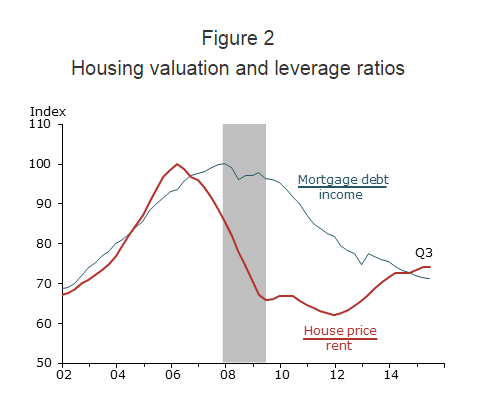
Source: Flow of funds, Bureau of Economic Analysis (BEA), CoreLogic, and BLS. Data are seasonally adjusted and indexed to 100 at pre-recession peak.
-
The contradiction in American housing policy
I really like this post by Daniel Hertz talking about the inherent tension in American housing policy.
Here’s his conclusion:
We are, in conclusion, profoundly conflicted as a nation when it comes to housing: we want it to be affordable, but we also want its prices to rise fast enough to be valuable as a financial investment. That’s a contradiction we need to acknowledge if our housing policy debate—and, ultimately, our housing policy—is going to be coherent and constructive.
Of course, this situation isn’t unique to the US. Though the US does have homeownership subsidies – such as the mortgage interest tax deduction – that other similar countries, like Canada, do not have.
Still, I feel a similar kind of contradiction here. We worry about excess supply and housing bubbles when the reality is that both of these things are desirable outcomes if, and only if, the primary objective is to maintain housing affordability.
But I don’t think that is the primary objective in practice. At least in this part of the world, I think we worry first and foremost about making sure that home prices continue to go up and that wealth is being built. Then, we worry about providing affordable housing for those that are unable to participate.
I’m not making a judgement call on whether or not that’s a good or bad thing. It just strikes me that this tension, and there certainly is a tension, is not an equal one.
-
New York’s 8-figure apartments
Whenever you’re starting to feel like real estate prices in your city are getting out of hand, just turn your attention to New York. It’ll make you feel better.
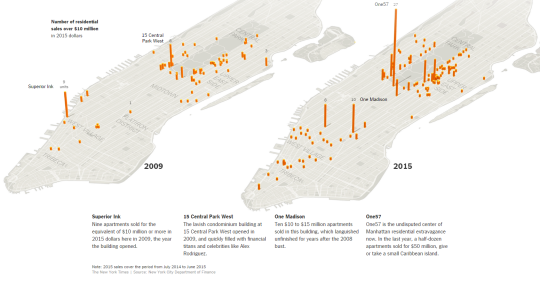
The New York Times published an interactive overview of the Manhattan real estate market today. It was spurred on by the fact that the average residential sale price in Manhattan just hit $1.7 million (a new record) and that there’s a growing number of 8-figure apartments being bought up.
Last year half a dozen apartments sold for more than $50 million in the One57 tower at 157 West 57th Street. (The New York Times calls this building the “undisputed center of Manhattan residential extravagance.”)
Here’s one of their diagrams showing the number of residential sales over $10 million in 2009 and then in 2015:
And here’s another one of their diagrams showing the bottom and top 10% of the current market:
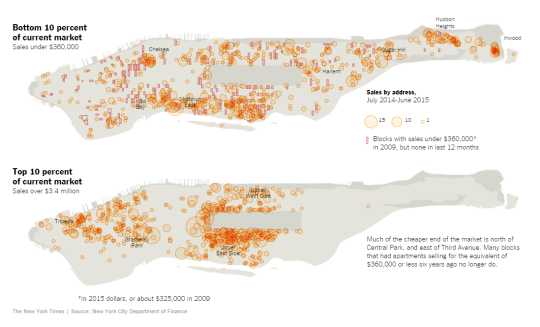
It’s interesting to see the clustering in certain areas and also the lack of clustering at the high end around the top of Central Park.