Daily insights for city builders, delivered every morning at 6 AM ET. I’m Brandon Donnelly — a Toronto-based real estate developer and founder of Globizen. I’ve been writing here since 2013.

Tag: market street

  • Turns out, pedestrianization actually increases retail sales volumes

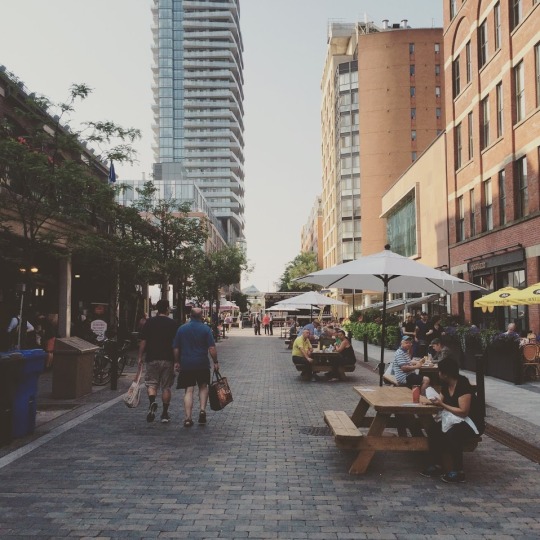
    As many of you know, I have been keeping a close eye on the pedestrian-only pilot that is currently underway on Market Street. And judging from all the engagement that my tweets usually get, a lot of you would love to see a lot more of this kind of urbanism both here in Toronto and elsewhere. (When Kensington Market?) The below photo was taken on Friday evening and Cirillo’s Academy, which is a culinary event space at the foot of the pedestrian-only stretch, was running some sort of event. All of the tables were filled with diners and it was basically a full fledged restaurant in the middle of the street. It was great to see.

    But the question that always comes up with these sort of initiatives, particularly here in North America, is: Will it hurt the businesses? To answer that, here’s a study that @economistcarson shared with me on Twitter that looks at the economic impact of street pedestrianization in Spanish cities. What the researchers did was essentially look at card transaction data from a major Spanish bank and then overlay it on top of land-use changes from an Open Street Map dataset. In doing so, they discovered some pretty important takeaways.

    Here’s what they found:

    • Pedestrianization actually increases retail sales volumes
    • Geographic location within a city tends to be insignificant
    • The two key factors for driving revenue are: (1) store density and (2) store category
    • For store category, the largest positive effect was observed for cafes, restaurants, bars, and other non-tradeable, local consumption activities

    What this last point is saying is that people, at least in Spanish cities, tend to prefer pedestrian-friendly environments when it comes to experience-based activities. And that makes complete sense. On the other hand, if you’re just running out for a little toilet paper and hemorrhoid cream, having a nice pedestrian-first experience is less critical. And this also makes sense.

    Some of you, I’m sure, will correctly point out that Spain has, on average, better weather compared to a place like Canada. And that their store densities and overall densities are likely higher, and that they have deep historic urban fabrics to rely on. All of these things are certainly factors. But I don’t think any of this should stop us from working to better optimize our cities for pedestrians. There are lots of successful examples all across Canada. It can work. Just look at Market Street.

  • So how is the Market Street pedestrian-only pilot project going?

    A portion of the street that I live on has been thinking about going pedestrian-only for a few years now. Last summer it was pedestrianized for a few weekends. And this summer, it’ll be pedestrianized until, I think, September as part of a more extensive pilot project. These sorts of moves can be controversial and so our usual approach is to ease-in with a pilot project.

    When our condominium board sent out a notice about the pilot project, they framed it as a closure to vehicles. But of course, the other way to frame this is that the street is now open to pedestrians. And since I happen to walk this street every day (and oftentimes multiple times a day), I’ve been tweeting out pedestrian usage updates.

    Click here to view on Twitter if the embedded tweets below aren’t showing up for you properly. Spoiler: it’s all working according to plan.

    Not every street (or area) is necessarily a good candidate for a pedestrian-first focus. But there are many great examples across the city, including Kensington Market and this stretch of Market Street. So let’s start investing in mechanical bollards, as they do in Europe, and make this pilot a permanent fixture.

  • Should Market Street be pedestrianized?

    Next to the St. Lawrence Market (here in Toronto) is an appropriately named street called Market Street. It is a lovely street — perhaps one of the nicest in the city. It’s old and historic and it was completely redone several years ago (evidence here) with nice unit pavers, bollards, a curbless design, and seasonal restaurant patios.

    In the winter months, the restaurant patios are packed up and additional parking is added to that side of the street. It was designed to be adaptable and in my experience it seems to be working quite well.

    Right now the local Business Improvement Area is running a pilot project to see what this street might be like if it were to be pedestrianized. It was closed to vehicles this past weekend and the same will happen this upcoming weekend. Here’s a photo of what that looked like on Saturday:

    It’s not perfect. A number of people commented on Twitter that the seating needs some shade. But hey, it’s a pilot project. It is about giving people a taste of what the future could be.

    I am a fan of pedestrianized streets in the right locations and when executed well. And I think this stretch of Market Street is a perfect candidate. It’s already pedestrian-only to the north of Front Street and it has the right kind of “edges” to ensure that it can be properly animated.

    If you feel the same way, I would encourage you to fill out this short survey that the St. Lawrence BIA has put out. I would also be curious to hear your thoughts on pedestrianized streets in general. Leave a comment below.

  • Toronto’s great streets

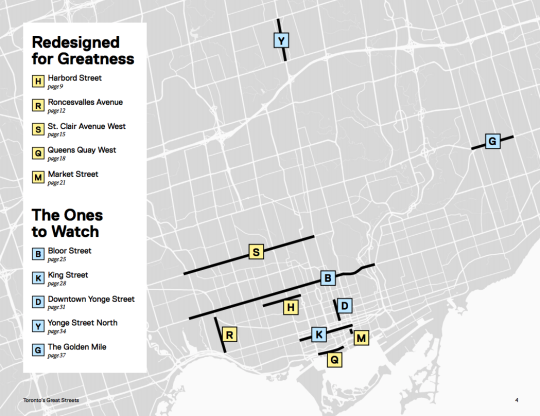
    Last week the Ryerson City Building Institute published a terrific report on Toronto’s Great Streets. It profiles five streets in the city that have been “redesigned for greatness.” They are:

    • Harbord Street (continuous bike lanes)
    • Roncesvalles Avenue (placemaking and people)
    • St. Clair Avenue West (dedicated streetcar lane)
    • Queens Quay West (public waterfront promenade)
    • Market Street (prioritized for people and patios)

    But what exactly makes a street a great one? The report describes it in this way: “They all play a key role in making the surrounding neighborhood a great place to live, work, and visit.”

    This relates closely to what the City of Toronto calls a “complete street”, which is an approach to accommodating multiple kinds of users, enhancing the local context, and determining which trade-offs to make.

    And there will always be trade-offs. I am fairly certain that all of these street redesigns were contentious at the time when they were proposed. Because at the end of the day they will never be all things to everyone.

    I remember the St. Clair West fight vividly because I moved to the neighborhood in 2009 and the dedicated streetcar lane didn’t fully open until 2010. From 2005 to 2017, streetcar ridership grew 23%. But drivers have remained grouchy.

    I now walk Market Street every single day and I agree that it’s one of the most beautiful and functional streets in the city. But the bollards are constantly getting beat up by drivers attempting to parallel park and the retail vacancy rate has not been 0% like is suggested in the report.

    Queens Quay West is also a magnificent street. It was a giant step forward in terms of the quality of the public realm in this region and I spend a lot of time there. But it’s of course not perfect. All of us have seen the reports of cars ending up in odd locations, including underground, along the waterfront.

    Riding your bike there can also feel like a challenging game of Frogger with all of the pedestrians that now obliviously meander back and forth across the cycling trail. I suggest riding with a good blow horn. The report rightly mentions the lack of delineation between these users.

    But cities are a living laboratory and none of these streets should now be considered static. We are fortunate to be in a position to critique levels of greatness. If anything, the map at the top of this post tells me that we need to create more greatness across the other areas of this city.

  • Saturday morning bike ride to the Bluffs

    This morning I got up at 7:30am and met a good friend of mine at the St. Lawrence Market for breakfast.

    Market Street is closed to cars today so it’s pedestrian-only. It should be this way all the time. They had a pig roasting on a spit when I walked by and a big stage set up. 

    Below is a photo of what it looks like. Keep in mind that this photo was taken just after 8:00am, which is why it’s not all that busy, yet.

    image

    When Market Street was redone a few years ago, the original vision for the street was for it to be pedestrian-only. But somebody told me that the city didn’t want that. Too bad. It strikes me as a perfect candidate for that.

    After breakfast, we then biked out to the Scarborough Bluffs in the east end of the city. If you click here, you can see the path we took via Strava. It’s only about 15km from downtown. The ride through the Beaches was by far the best stretch. The water was on my right hand side. The pavement was smooth and continuous. And I had George FitzGerald on my headphones for pacing.

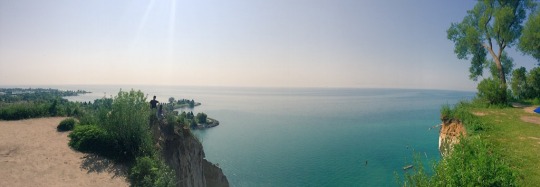
    When we got there, this was the view we were presented with:

    image

    It honestly doesn’t feel like Toronto. The water is turquoise and there’s a beautiful beach at the bottom of the cliffs. It felt like paradise.

    If you’ve never been to the Scarborough Bluffs, do yourself a favor and get out there on a beautiful summer day. It’s the dog days of summer and Toronto is a magical place right now.

  • New York City on Market Street

    On my walk to the subway this morning I was confronted by a transformed Market Street in Toronto’s St. Lawrence Market area. New York City had taken over.

    There were NYC yellow cabs, NYPD cars, FDNY trucks and lots of film people milling about in Canada Goose jackets. Toronto, once again, stands in for New York.

    image

    But while I think it’s great that we’re (presumably) creating a bunch of local jobs, there’s also a part of me that hates to see this. I hate it because I want the Toronto brand to be strong enough so that movies actually take place here, instead of just being filmed here.

    I mean, who wants to be the stand-in? It’s much better to be the actor.