Daily insights for city builders, delivered every morning at 6 AM ET. I’m Brandon Donnelly — a Toronto-based real estate developer and founder of Globizen. I’ve been writing here since 2013.
We have been talking about prefabricated and modular buildings for so long that it’s easy to think it might never happen. (Here’s a related post that I wrote back in 2015.) There are also lots of groups that have tried and failed. Perhaps the most high profile is the bankruptcy of off-site construction company Katerra, which had raised some $2 billion in funding, but for whatever reason(s) couldn’t figure things out.
That said, I’m starting to get the feeling that change might actually be underway in our industry. Over the last few months we’ve been talking about startups like Nabr. But there are many others, including Factory OS, which has been quietly building affordable housing in California (presumably far away from here). To date, they have completed 10 buildings and over 1,200 units, and they have another 24 or so buildings in the pipeline.
This feels promising to me. And I think it’s being aided by our current environment — costs are way up and people are desperately searching for efficiencies. But if this is really going to transform our industry, I think we’re going to need to be willing to make some sacrifices. Standardization and efficiency likely means making some concessions around design and overall specificity. Not every project can be custom, as is generally the case today.
That likely means that cities and communities will also need to become more forgiving when it comes to urban design guidelines. Could you please step your building back right here and follow this oblique angle that lines up with this important historic datum line? Nope, sorry, can’t. Our production line can’t accommodate that sort of change. Would you like the most affordable housing possible with today’s means or would you like a custom design?
Nabr, which I wrote about last year over here, recently announced its first residential project in San Jose’s SoFA district. Named SoFA One, the project is expected to have 125 apartments that will be offered up on a hybrid lease, own, and lease-to-own model. In this latter scenario, the company is saying that people will be able to buy with as little as 1% down. Construction isn’t scheduled to start until later this year, but if you’d like to get early access, you can add yourself to their waitlist, here.
As a reminder, Nabr is touting itself as a direct-to-consumer real estate company that aims to bring the same manufacturing and supply chain efficiencies that we have seen in virtually all other industries to the production of housing. This, of course, is not a new ambition. The flatlining of construction productivity is well documented, and lots of architects, builders, and entrepreneurs have tried to innovate in this space over the years. But it’s clearly a notoriously difficult problem to solve. So the obvious question here is: What is going to make Nabr any different?
Nabr is trying to productize housing. To do this, they’re building a vertically integrated process, going deep into supply chains, and trying to standardize their product offering as much possible. In the case of SoFA One, the base building is expected to consist of a CLT loft-style frame that can then be fitted out with various interior offerings. The idea here is that 90% of the build will be a repeatable system but that the remaining 10% is something that their customers will be able to customize — similar to when you’re buying a new car. The car is the same, but would you like black leather or brown leather?
Continuing with the car analogy, the company is also taking a move out of Tesla’s playbook for how they plan to roll out their products. The plan is to start at the top of the market (like what Tesla did with its expensive roadster) and then move downmarket as they drive efficiencies and cost savings in their delivery process. What they are trying to do is find the compounding innovation that has been present in most industries but that has been noticeably lacking from construction.
This all sounds great, but we know that buildings have a myriad of unique challenges compared to other products like cars and smartphones. My iPhone is the same as your iPhone, except for maybe the color and the case I put on it. But each development site is unique. Some have a high water table below it and some don’t. Some have adjacencies that will impact how you need to build and some don’t.
Each jurisdiction also has unique codes and regulations — everything from urban design guidelines to more or less stringent seismic requirements. Some cities have snow and some cities don’t. The list goes on. So what Nabr is going to have to do is create regionalized products with as much repetition as possible. And if they can generally lock the ~90% base building systems and just adjust the balance as needed, maybe that’s enough to do it.
At the end of the day, our industry is not completely void of innovation. It’s just a bit slow to change. We never used to build skyscrapers, but now we do. So I’ve decided to cast my developer cynicism aside. Today, we don’t have truly productized housing, but maybe we will.
As an aside, Nabr also recently shared their leaderboard of cities where people want to see a future Nabr building. Those cities are New York, London, Los Angeles, Toronto, and San Francisco.
We are living through an inflationary hard cost environment. In speaking with one of our cost consultants the other week, he was predicting that overall we could see another 9-10% increase next year here in the Toronto area. Now, who knows what will ultimately happen. But this is top of mind for everyone in the industry and it will continue to impact how and what we build.
One of the challenges with construction — and this is will documented — is that unlike the manufacturing industry, which has seen sustained productivity improvements over the years, the construction industry has seen relatively little productivity growth over the last half century. In fact, you could argue that it’s been mostly negative in recent history.
The obvious thought is why not just apply what we’ve been doing in manufacturing to construction. There is, of course, a long standing tradition of trying to do this, with varying degrees of success. But at the end of the day, building a house remains different than building something like a car.
Probably the key difference is that every construction site has unique constraints and conditions and so the process is constantly changing. Whereas the innovations that Henry Ford pioneered were centered around interchangeable parts and a well-defined process that could be repeated millions of times to generate the exact same output.
From what I can tell, there seems to be two ways in which we can think about improving productivity. One, we can try to be more Ford-like and drive standardization. This means more off-site factory construction and more standardization. This is the typical “pre-fab” approach and companies like R-Hauz, as well as many others, are already successfully doing this. The trade-off is less design flexibility.
The second option has to do with better software and hardware. What if we had significantly better “digital twins” for our buildings such that we could see and experience it in 3D before it is physically built? I’m thinking strap on VR goggles and do a walkthrough with the team. This could allow us to pinpoint all of the issues before they actually happen on the job site.
In parallel to this, what if we had far better on-site automation and robotics to then execute on the above digital twin? Think 3D printing concrete instead of using traditional forms. This is all happening and being worked on, but it doesn’t seem to be at a point where it is changing our industry. But it is exciting to think that it may one day.
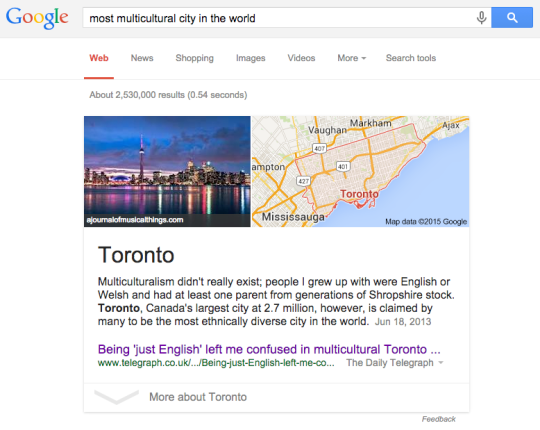
In his words, Toronto has become the success story that it is precisely because we are good at taking in lots of immigrants and making them economically productive.
Sure, there are many things that we could be doing better, but you don’t get to be the most multicultural city on the planet without doing a lot of things right. More than half of this city is now foreign born. The term “visible minority” is quickly expiring.
And more than anything else, this accomplishment is arguably what has allowed us to become the global city that we are. Click here for a fascinating chart from the Toronto Star that allows you to see the number and source of immigrants that have come to this city over the last half century.
But of course, Toronto is not alone in this accomplishment.
Urban economist Edward Glaeser wrote a great essay back in 2005 called Urban Colossus: Why is New York America’s Largest City? It’s an incredibly interesting read for those of you interested in cities and so I definitely recommend it.
But the crux of his argument is that New York is the largest and most dominant city in America because of geography – specifically its deep harbor – and because of its success in manufacturing.
What this meant is that New York became the center of shipping in the country and the point of entry for the majority of immigrants coming into the United States. But since transportation costs were still relatively high at the time, most immigrants arrived in New York and stayed in New York.
Luckily, New York had a robust manufacturing economy – notably because of sugar refining, publishing and printing, and the garment industry. This allowed the waves of immigrants flooding into New York to become economically productive.
From 1850 to 1920, the population of the New York grew about 800% from roughly 700,000 people to over 5.6 million people.
So the moral of the story is simply that immigration has and will continue to play a pivotal role in the shaping of our cities. Canada has a sub-replacement fertility rate somewhere around 1.61 births per woman (2012). This is lower than that of United States, which is around 1.88 births per woman.
That means that without immigration, we do not grow. We shrink. And that’s usually not a great thing for economies.
If you’ve been reading this blog since last year, you’ll know that I’m hugely interested in Detroit. I went for a visit last fall and I hope to go back sometime this summer. I think the city has tremendous potential and I would love to see it come back. I’m rooting for it.
Between people like Dan Gilbert and consumer brands such as Shinola, there’s a palatable sense of momentum developing in the city. Here’s a short video of the Shinola story from This Built America–which is a project focused on the people and companies that are rebuilding America and its manufacturing base.