Daily insights for city builders, delivered every morning at 6 AM ET. I’m Brandon Donnelly — a Toronto-based real estate developer and founder of Globizen. I’ve been writing here since 2013.
Dixie Outlet Mall in Mississauga has just launched a drive-in movie theater that will run for three Saturdays starting on September 12, 2020. Tickets are available for $5 and you have to purchase in advance. It’s first come, first park. And there only 100 parking spots available.
All of the proceeds from ticket sales will be donated to the New Haven Learning Centre, which is a group that works to positively change the lives of people with autism, and other related disorders. For more information about the Dixie Drive-In, click here.
And for those of you who are curious, the answer is yes, a minor variance application was required in order to allow this “pop-up.”
Here are a couple of cut-up snippets from a recent post by Seth Godin titled: “Waste and the new luxury.”
Luxury goods are built on a foundation of waste.
The front lawn is a luxury good, a sign that you don’t need to graze your cows on every square inch, and that you’re willing to waste the lawn.
There’s a new luxury that’s occurring, though, one that’s based on efficiency.
A luxury that’s based on investing in renewables, in resources that might be seen as endless, in smart design, in the satisfaction of knowing that others are benefitting, not paying, for the experience or the object you’re buying.
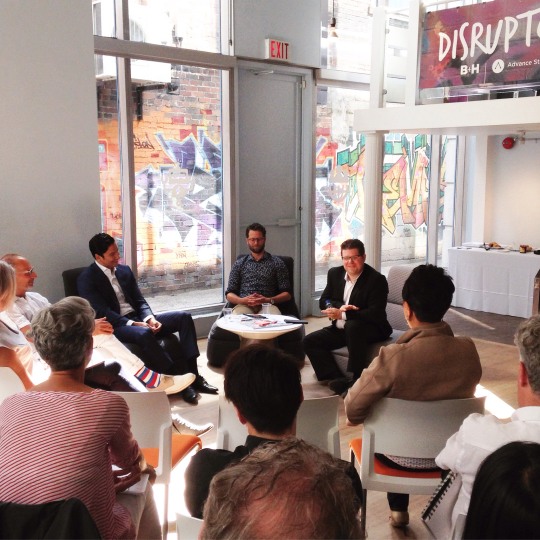
This morning I gave a presentation and participated in a design charrette that was organized by B+H Advance Strategy about the “mall of the future.” (See photo above.) It’s a 2-day event and I was only able to stick around for a few hours in the morning, but I think it’s great that B+H Architects takes the time to research and get a deeper level of understanding in the areas in which they work. Great design demands that.
The way the charrette was structured was around a handful of future scenarios. The idea being that it’s impossible to accurately predict the future, but it is possible to play out different possible futures to see what you get. I’m looking forward to seeing what the teams ultimately come up with at the end. I would also be really curious to hear your thoughts in the comment section below.
But before we decide on what malls are going to become in the future, it’s perhaps useful to think about how they got their start. The man largely credited with inventing the fully enclosed mall typology is a man by the name of Victor Gruen. He was a Vienna-born architect who moved to the US in 1938.
“Fifty years ago, Victor Gruen designed a fully enclosed, introverted, multitiered, double-anchor-tenant shopping complex with a garden court under a skylight—and today virtually every regional shopping center in America is a fully enclosed, introverted, multitiered, double-anchor-tenant complex with a garden court under a skylight. Victor Gruen didn’t design a building; he designed an archetype.”
The most interesting thing about this story though is that Gruen’s initial hope was that the mall would urbanize America’s suburbs. The garden court was supposed to be a kind of town square. And his broader vision included a mix of higher density uses surrounding the perimeter. But in reality the opposite happened: The mall helped to further suburbanize America.
However, as our malls begin to show their age (or die) and as we relearn to appreciate walkable urban environments, mall landlords are increasingly thinking mixed-use and higher density. And ironically, many of the plans probably don’t look all that dissimilar to Gruen’s original ideas. So maybe one possible future is simply the one that Gruen wanted to create all along.
A lot of shopping malls are dying. You’ve probably heard this before. But how bad is it and what exactly is happening?
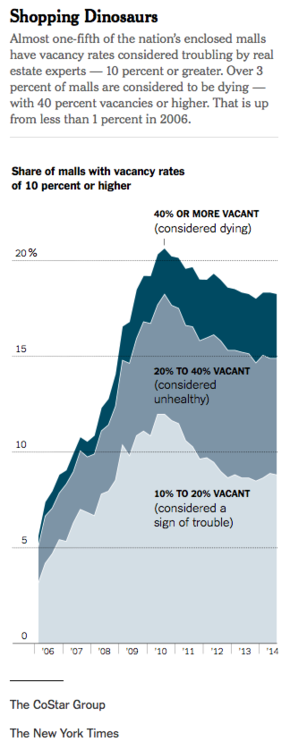
Well, a new report by CoStar (heard through the New York Times) found that nearly 20% of the 1,200 malls in the US are presently in trouble. “Trouble” is defined as a mall with a vacancy rate of 10% or more.
But what’s perhaps most disconcerting about this number is that, as recently as 2006, only about 5% of the malls in America would have been pegged as being “in trouble.” Here’s a chart from the New York Times (I’d love to see this same graph with a longer time horizon):
But not all malls are dying. The general sentiment seems to be that the high-end A malls are and will continue to thrive, and that it’s only the B and C malls that are dying:
Tom Simmons, who oversees the mid-Atlantic shopping center division of Kimco, another real estate giant, is more blunt. “There are B and C malls in tertiary markets that are dinosaurs and will likely die,” he said, but “A malls are doing well.” (NY Times)
So why is this happening? Some think it’s because the US is over-retailed. And some think it’s because of rising income inequality – which would explain why the high-end malls continue to thrive. But the experts seem to agree that it’s not the result of more people shopping online:
One factor many shoppers blame for the decline of malls — online shopping — is having only a small effect, experts say. Less than 10 percent of retail sales take place online, and those sales tend to hit big-box stores harder, rather than the fashion chains and other specialty retailers in enclosed malls. (NY Times)
I wrote a post 2 months ago where where I argued that big box stores will be the most impacted by online shopping (which is why so many of them now sell groceries). But I don’t believe that they are the only retailers that will be affected. Quite the opposite: Every retailer is or eventually will be impacted by the internet.
This threat is real.
Millennials have no hesitations about buying things online and, in many cases, they would prefer to do so. It has already been well documented that we (I’m a Millennial) don’t like driving as much as previous generations. So what makes you think we’d enjoy the process of driving to a mall?
But the other factor at play, I think, is that malls are no longer the “public space” of young people. Their position as a kind of cultural institution is waning. At the same time, more and more people are craving uniqueness. They like independent shops, not malls that all look and feel the same. And as these young people become old people, we might find that even the A malls start becoming impacted.
I don’t believe, for a second, that retail nodes within cities will ever disappear. But I think our attention would be better spent figuring out what the mall of the 21st century will be, as opposed to hiring PR firms to try and spin doctor our way out of this dead mall phenomenon.
Last month Oxford Properties submitted a site plan application for the redevelopment of the rundown Cumberland Terrace in Toronto’s Yorkville neighborhood. If you’d like to browse the full application (including all the drawings), you can do that here.
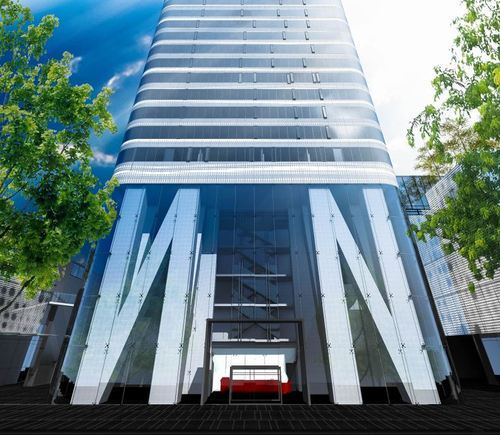
The proposal is a departure from previous plans and now includes 3 buildings: a 4.5 storey building, a 2.5 storey building, and a midblock 54 storey residential tower (the lobby is shown above). There will be both retail and residential uses.
For those of you familiar with the mall, it should go without saying that Cumberland Terrace is in desperate need of redevelopment. So I’m not going to talk about that today. Instead, I’d like to mention 2 other points that stood out to me about the application.
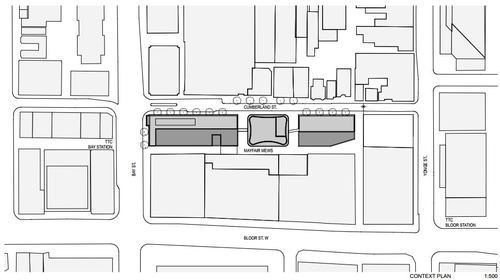
The first is the 2 midblock connections on either side of the tower, running from Cumberland Street to Mayfair Mews in the rear (see below). Yorkville has a history of intimate laneways, and so it’s nice to see some of this being carried through in a new development. It also opens up the opportunity for an improved Mayfair Mews.
Secondly, it’s somewhat surprising to see that the 54 storey residential tower is being proposed as rental. Toronto doesn’t build a lot of purpose-built rental apartment buildings. There are some (from the likes of Morguard and Concert Properties), but we haven’t done it at scale for decades. And that’s largely because the demand for condos has been so great.
But recently I’ve been noticing a renewed interest from the real estate community in multi-family rental assets. Cadillac Fairview also proposed a 65 storey rental building at the north west corner of Yonge Street & Queen Street last year – though they later withdrew their application.
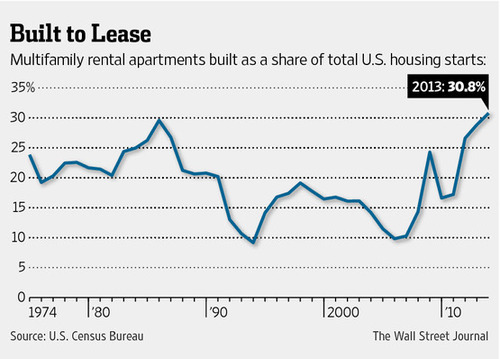
In the US, rental apartments as a share of all new housing is also at record highs – over 30%. And that’s partly because credit remains tight (certainly compared to pre-2008) and economic growth has been tepid. But also because of demographic changes. People are having fewer children, later in life, and so many are putting off buying.
So I think we’re going to see even more rental apartments being built in Toronto in the coming years.
It’s December. You’re in Toronto. The high for today is 5 degrees celsius. But the overnight low is expected to reach -11. Would you rather shop inside a warm mall or outside along a hip urban Main Street?
This is a question that has come up a number of times in retail real estate meetings here in Toronto and the general consensus is often that people in our climate don’t want open air malls and Main Streets. They prefer enclosed malls.
However, this is not to say that we don’t have open air malls and that we don’t have a thriving downtown, because we do.
What I am saying though is that when the pension funds sit around contemplating what retail investments to make, they’re still largely thinking enclosed shopping centers. That’s why it seems like every major mall in Toronto is going through an expansion.
Generally speaking, I don’t love malls. There’s no urban authenticity. I find it much more enjoyable shopping at one-off and independent stores. But is this just a snobby architect, planning thing? I’d love to continue the conversation on twitter.