
Daily insights for city builders, delivered every morning at 6 AM ET. I’m Brandon Donnelly — a Toronto-based real estate developer and founder of Globizen. I’ve been writing here since 2013.

Tag: mainland china

  • Over 60% of global luxury spending now happens in Asia

    The global luxury goods market is somewhere around US$300 billion if you exclude fancy cars. And in just 4 years, global luxury spending has flipped from over 60% of it being in Europe and the Americas, to now over 60% of it being in Asia — with over 40% of it being in mainland China alone. See above chart from the Financial Times.

    But I think what really happened is that when global travel shutdown in 2020, Chinese buyers just started spending all of their luxury goods money at home instead of flying to Paris for the week. Because if you look at Chinese luxury goods spending in 2018, somewhere around 1/4 of it was done in mainland China, whereas today it’s close to 100%.

    So the Chinese have been moving this market for quite sometime. But now that the consumption has moved entirely home, what does that mean for cities around the world? Hong Kong used to be one of the most important places for luxury consumption in Asia (no sales tax), but that has changed and it probably won’t return. This is for reasons that go far beyond luxury goods.

    But I think we’ll see spending in Europe bounce back along with Asian travel. Because buying a luxury good is about much more than just the good itself. It’s about the experience. It’s about how it makes you feel when you buy it. And it’s about signalling to others who you are as an individual. This may sound vacuous, but we all do it, with or without expensive luxury goods.

    There are also new opportunities emerging by way of NFTs. I am sure that some brands are already doing this, but if I were in charge, I would issue a unique NFT with each luxury goods purchase that records, among other things, where it was purchased. Is a bag purchased on the Champs-Élysées worth more if there is a record of it that is etched in stone permanently? Maybe.

  • Billionaire wealth in China grew by 1146% over the last decade

    UBS and PwC’s recent report on billionaire wealth highlights some interesting trends about the global economy and global wealth.

    • Billionaire wealth in mainland China is now second to only the United States, having grown by about 1146% from 2009 to 2020, compared to 170% in the US. As of the middle of this year, it was sitting at about USD 1.7 trillion in China, compared to USD 3.6 trillion in the US.
    • Hong Kong remains a force with only 1,105 square kilometers of land (not all of which is developable). Billionaire wealth grew by about 208% to USD 356 billion over the same time period as above. That puts it ahead of the United Kingdom, Canada, and Brazil in total dollars.
    • About half of all billionaires seem to have a significant amount of their wealth invested in real estate. Somewhere between 21-40% of their net worth.
    • At the same time, the report identifies the real estate industry as having the fewest number of “innovators & disruptors.” Only 17% of billionaires (whose wealth is primarily derived from real estate) are classified in this way. The report calls out the sector as being “especially slow to embrace technology to boost efficiency.”
    • Perhaps the most interesting takeaway is that, even within the rarified billionaire community, tech is driving polarization. For most of the last decade, the sector didn’t matter all that much. The rich were getting richer. Now it’s more so the tech rich. And COVID-19 seems to be accelerating this trend.

    This is not to say that I think people are particularly worried about billionaires who maybe aren’t getting as rich as they used to. That’s like complaining about being too good looking. But it is clear that tech is driving a bunch of macro shifts in the global economy and this is just another example of that playing out.

    Image: UBS and PwC

  • Price of 432 square feet in Hong Kong and the future of the region

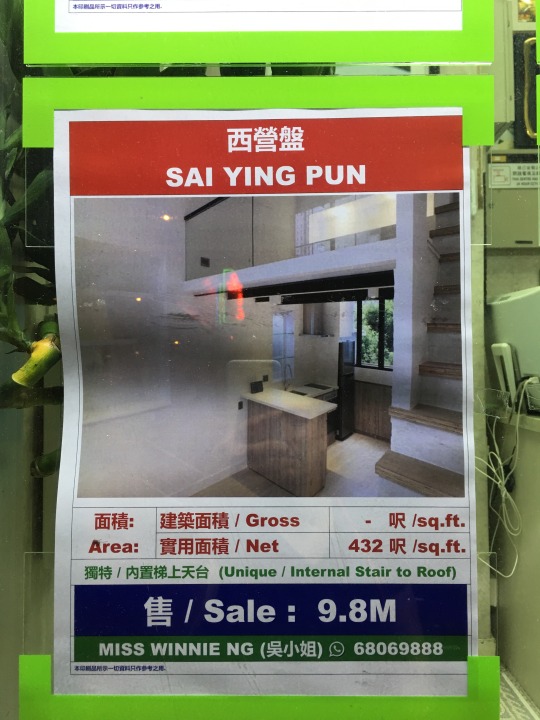
    I came across this Hong Kong apartment listing earlier in the week. Sai Ying Pun is the neighborhood.

    image

    HK$9.8 million = C$1,554,833 based on today’s exchange rate (1 CAD = 6.30293 HKD).

    At 432 square feet (net), that’s C$3,599 psf. But I have also been told that new buildings here could easily fetch C$5,000 psf and probably much more.

    There’s certainly a tremendous amount of wealth in Hong Kong. However, the topic of discussion right now is the new money being generated in mainland China.

    I am curious what all of this could mean for Hong Kong, it’s place within the PRC, and for real estate long-term.

    Hong Kong’s Basic Law stipulates that the region shall maintain a capitalist system and that its current way of life shall be preserved outside of the PRC. 

    But that constitutional document is set to expire in 2047 – fifty years after the handover from the British. And one would assume that China would favor more, rather than less, integration. 

    Already the Cantonese language – the official language of HK along with English – seems to be getting diluted in favor of the “speech of the officials.”

    So what will Hong Kong look like by the middle of the 21st century? Will it simply become a “second city” to Beijing and Shanghai?

    Place your bets in the comments below. Or call Miss Winnie.

  • #donthave1million

    Tiny Park by David Brookfield on 500px.com

    https://500px.com/embed.js

    After I wrote this week’s post about Chinese homebuyers in Vancouver, I was surprised to learn about the racism debate that flared up in the city / on Twitter. I guess this really is a touchy subject. (See: #donthave1million)

    My reaction to the research was: Great to see someone (Andy Yan) putting in the time to try and better understand a market phenomenon. It’s painful how opaque real estate markets can be. Let’s get even more data so that we can make even better policy decisions. I didn’t read it as: let’s deliberately single out a race.

    Because the reality is that we all knew this was happening.

    Bloomberg recently published an interesting and related article that talks about China’s money exodus and how the Chinese logistically get their money out of the country. There are restrictions in place. 

    But first, here are two snippets from Bloomberg that describe the order of magnitude we’re talking about:

    This flood of cash is being felt around the world, driving up real estate prices in Sydney, New York, Hong Kong and Vancouver. The Chinese spent almost $30 billion on U.S. homes in the year ending last March, making them the biggest foreign buyers of real estate. Their average purchase price: about $832,000.

    In total, UBS Group estimated that $324 billion moved out last year. While this year’s numbers aren’t yet in, during the three weeks in August after China devalued its currency, Goldman Sachs calculated that another $200 billion may have left.

    Now here’s how it is being done:

    It works like this: Chinese come to Hong Kong and open a bank account. Then they go to a money-change shop, which provides a mainland bank account number for the customer to make a domestic transfer from his or her account inside China. As soon as that transaction is confirmed, typically in just two hours, the Hong Kong money changer then transfers the equivalent in Hong Kong or U.S. dollars or any other foreign currency into the client’s Hong Kong account. Technically, no money crosses the border – both transactions are completed by domestic transfers.

    And here’s a snippet that stood out for me because it shows how easy this has become:

    While the first exchange has to be set up face-to-face, customers can place future orders via instant-messaging services such as WhatsApp or WeChat, and money changers set no limit on how much money they can move.

    Given the scale and complexity of this issue – housing affordability – I have to believe that cities and policy makers would be far better off with more, rather than less, information. I hope we can work towards that.

  • Is Hongcouver better off than Vancouver?

    The Twilight Zone | Vancouver by Apar Sidhu on 500px.com

    https://500px.com/embed.js

    It’s raining this morning in Toronto. The sun really hasn’t come up and out yet. And I’m spending the morning drinking coffee and reading a City Journal article from this past summer called “Hongcouver.”

    The article talks about how the Chinese – first from Hong Kong and then from mainland China (PRC) – have dramatically reshaped the economic and cultural landscape of Vancouver.

    I, unfortunately (it’s a great city), don’t spend a lot of time in Vancouver and so I don’t have an accurate sense of the local sentiment towards all of this change. But there’s no question the city has changed. 

    Here’s a snippet from the above City Journal article:

    As for the notion that Chinese money tended to be ill-gotten, Yu pointed out that the property boom was propelled by the structural disparity between prosperous Hong Kong, a dynamic economy, and the comparative backwater of Vancouver, still “living on the fumes of empire.” For the price of a Hong Kong flat, a Chinese immigrant—even, say, an accountant—could buy a splendid home on Vancouver’s West Side. “The Hong Kong Chinese who came could buy their way into any neighborhood. [They] knew that money was a tool,” Yu told me. “They weren’t going to accept a second-class citizenship in Vancouver. They could say, ‘I don’t care about your British Imperial manners, I am going to buy your house.’ ” The irony was that the Hong Kong arrivals—“more sophisticated than the people they were displacing,” with “better schooling, better English accents,” Yu said—were themselves the products of a system of law and finance instituted by the British with the establishment of their Hong Kong colony in the 1840s, after Britain thrashed China in the First Opium War.

    A lot of this was fuelled by the now defunct Immigrant Investor Program. The intent of the program was to allow “experienced business people” into the country in order to contribute to economic growth. If you had business experience, a net worth of at least C$1.6 million (that was gained legally, of course), and were able to invest C$800,000, then you could get permanent residency.

    Between the mid-1980s and the end of the 1990s, approximately 30,000 Chinese came to Vancouver via this investor-class visa. And between 1987 and 1997, it is estimated that this group of Chinese possessed about $35 to 40 billion in disposable income. No wonder they bought real estate.

    But the interesting question is whether or not Vancouver is better off now than it was in the 1970s before all of this migration really took hold. 

    There many who would argue that it is not. Vancouver now has the most expensive real estate in Canada and prices have completely detached themselves from local income levels – as they have in many international cities.

    But there’s also a strong argument to be made that this influx of money has made the Vancouver economy more dynamic. Unemployment in the city was cut almost in half between the early 1980s and 1991 during the first wave of migration. It went from 13.6% to 7.7%.

    In a way, it’s not all that different than what’s currently happening in San Francisco with tech and housing. I’m not saying there aren’t problems to be solved. But I think many of us can agree that the answer is not to eradicate the tech sector.

    That’s throwing the baby out with the bathwater.