Daily insights for city builders, delivered every morning at 6 AM ET. I’m Brandon Donnelly — a Toronto-based real estate developer and founder of Globizen. I’ve been writing here since 2013.

Tag: lyft

  • Lyft announces subscription plan

    Last week, Lyft announced a new subscription plan

    It costs $299 every 30 days and you get 30 rides included (up to $15 each). So it represents a possible 1/3 discount on rides. If you go over the 30 rides per month or over $15 on any one ride, you simply pay the difference. Though as a subscriber, you get 5% off additional rides.

    Subscriptions are good for business. They can be like an annuity. And I suspect that with the above model, there will be unutilized rides every month that the company is just able to bank. You can’t carryover rides with this plan.

    But moreover, Lyft’s “All-Access Plan” is designed to help you ditch your car. Trade your car payment for a ride subscription plan. So if the numbers didn’t quite work for you before, maybe they do now. Depending on the situation, I can certainly see this plan being cost effective.

    But as ride hailing/sharing continues to nibble away at public transportation and personal vehicle ownership, what will this mean for cities?

  • Lyft reveals plans for bikes and scooters

    On Monday, John Zimmer and Logan Green, the co-founders of Lyft, published this Medium post announcing their “approach to partnering with cities to introduce bike and scooter sharing” to their platform. 

    “Approach to partnering with cities” is undoubtedly a carefully chosen set of words given all the backlash going on right now around dockless scooters.

    Nevertheless, this is an exciting announcement. I could have used a scooter this afternoon to get to a meeting. And this is all part of their larger goal of transforming Lyft into a multi-modal platform – one that will also support conventional public transit.

    Here is an excerpt from the Medium post:

    Transit, bikes, small electric vehicles, and infrastructure such as safe pedestrian paths and bike lanes, all play a large role in decoupling people’s right to mobility from car ownership. We know we can’t accomplish this alone, and we’re committed to working with cities and residents to bring these elements together in the most cohesive way to maximize a reduction in vehicle miles traveled.

    The company has also set the goal that 50% of all trips on the Lyft platform will be shared rides by 2020. It is yet another example of the lines between public transit and ride sharing apps becoming blurrier. 

    Full post can be found, here.

  • Road pricing for whom?

    New York City is considering a congestion charge for drivers entering Manhattan below 60th street. It is part of Governor Cuomo’s Fix NYC plan. But we all know how difficult these things are to implement.

    Last month, Felix Salmon wrote a piece in Wired where he argued that our cities are dying of traffic congestion and that the cause is ride-hailing services like Uber and Lyft. The solution: A tax on ride-hailing services.

    The article elicited a few reactions, including this one by Charles Komanoff over at Streetblogs and this one by Joe Cortright over at City Observatory. Joe’s message: “The problem isn’t the ride-hailed vehicles, it’s the under-priced street.” 

    Precisely.

    Felix later followed-up with a post on his blog where he clarified that the reason he loves this idea – of taxing ride-hailing companies, not riders – is that it’s far more politically palatable than a blanket tax on all cars. I don’t disagree.

    Which is why I think my idea is something which is eminently politically possible, in contrast to congestion pricing, which has been implemented exactly nowhere in the USA.

    Americans love their cars, and they love the freedom that cars represent, and they hate the idea that they should be taxed for driving their cars. Tolls on roads and bridges are bad enough, but a fee just to drive in to a city?

    That said, I’m with Charles and Joe. 

    Last year, it was reported that roughly 25% of all Uber trips in New York City were UberPool trips. I’m not sure what the number is today, but these are people who are car pooling to get around. That’s generally considered to be a positive thing.

    Are these really the trips we want to be discouraging (and singling out) with a charge simply because we don’t have the moxie to do what is right and makes rational sense?

    Photo by Austin Scherbarth on Unsplash

  • Centralized taxi branding vs. decentralized ride fulfillment

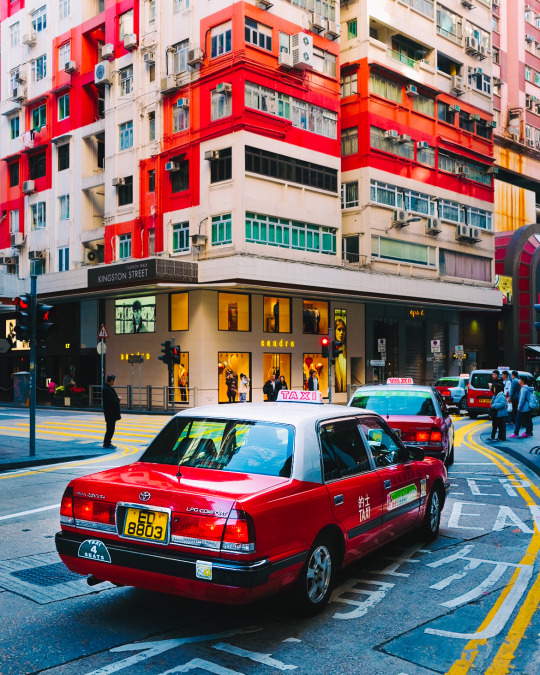
    Back in 2013, when this blog was in its infancy, I argued that Toronto needs a consistent taxi brand. Since nobody was reading the blog at the time, I am sure that most of you have never read this post. I even forgot about it, until last night when I posted this photo of Hong Kong to Instagram:

    It reminded me of the role that taxis play in city branding. This photo is clearly of Hong Kong. But take away the taxis in the foreground and I would really have to think in order to identity it. I would then be searching for street signs and looking to see what side of the road the cars are driving on.

    Now, a few things have changed since 2013. Back then I didn’t have the same appreciation for decentralized ride hailing (Uber and Lyft), though I did have the same distaste for the taxi cartel. And I recognize that there is a tension between centralized taxi branding and a decentralized approach to ride fulfillment. 

    I’m not exactly sure how to solve this problem, but maybe it gets easier with autonomous vehicles and probable changes to the way consumers own, or don’t own cars. I believe it’s important for places and cities to have specificity. If you have any thoughts, please leave a comment below. 

    (I am trying to respond to all comments on this blog, because I’m finding it impossible to respond to all blog related emails. Sorry.)

  • We are all being manipulated by behavioral economics

    Ever notice how whenever you’re taking an Uber the driver usually gets another fare just before he (Uber drivers are overwhelmingly male) is about to drop you off? That’s on purpose.

    Earlier this month the New York Times published an interactive feature describing how Uber uses behavioral economics (or psychological tricks) to encourage its drivers to work longer, take more fares, and so on.

    Here’s a quick sidebar note about behavioral economics from Francesca Gino of Harvard Business School:

    According to the traditional view in economics, we are rational agents, well informed with stable preferences, self-controlled, self-interested, and optimizing. The behavioral perspective takes issue with this view and suggests that we are characterized by fallible judgment and malleable preferences and behaviors, can make mistakes calculating risks, can be impulsive or myopic, and are driven by social desires (e.g., looking good in the eyes of others). In other words, we are simply human.

    And now back to Uber. One tactic they use is goal setting. People are drawn to goals. This translates into driver messages like this one: “You’re $10 away from making $330 in net earnings. Are you sure you want to go offline?”

    But the experiment I found most interesting from the NY Times piece is the one that Lyft completed where it discovered that showing drivers lost/dropped fares was a far more powerful motivator than showing completed rides. In other words: Look at all this money you’re losing out on by not driving!

    This finding is in line with something I’ve written about a few times before on this blog: prospect theory. One of the tenets of this theory is that “losses hurt more than gains feel good.” We, humans, tend to focus more on the former.

    Of course, Uber is not alone in employing behavioral economics. Every app on your phone is being continuously optimized so that it gets as much of your attention as possible. But where is the line between encouragement and manipulation?

    If you’re interested in this topic, check out this HBR article called, Uber Shows How Not to Apply Behavioral Economics.

  • So how’s Uber doing?

    A travel expense management company called Certify recently analyzed over 10 million ground transportation receipts across North America for the 3-month period ending last September (2016). 

    And what they found was that, for the first time ever, Uber and Lyft exceeded traditional taxis and rental cars when it came to business expenses. Uber was at 48% and Lyft was at 4%. So together, these two platforms have more than half of this particular market.

    If you compare this to Certify’s data from the same quarter last year, “ride-hailing services” previously accounted for 34% of receipts, whereas taxis and rental cars were at 22% and 44%, respectively. So Uber is up in a big way.

    This may not be surprising for a lot of you, but I thought it would be valuable to check-in on what the numbers say. 

    I’m hit with two thoughts. Firstly, it’s not a question of mobile apps superseding traditional taxis; it’s a question of one company taking over. And secondly, people seem to be favoring Uber over driving themselves around. I know I’ve been heading in that direction.

    Those are two powerful trends.

  • How much market share are New York’s yellow cabs losing to Uber?

    Todd W. Schneider recently mined data from the New York City Taxi & Limousine Commission to create a chart summarizing yellow taxi, Uber, and Lyft usage

    The data only runs up until January 2016, but here’s what he found:

    “…yellow taxis provided 60,000 fewer trips per day in January 2016 compared to one year earlier, while Uber provided 70,000 more trips per day over the same time horizon.”

    The Uber data only begins in 2015, but you can still see how quickly it is growing and how yellow taxis are losing market share. Five years ago, yellow taxis were reaching over 500,000 trips per day (a pretty amazing number) and in January of this year they were at about 350,000 trips per day. 

    It also appears that Lyft is struggling to gain traction.

    image

    What’s also great about Todd’s blog post is that he has set it up so that his chart will automatically update as new data becomes available. So if you’re interested in this topic, you should bookmark his post.

  • Should you buy a car or just take Uber?

    Urban dawn by Raymond  on 500px.com

    https://500px.com/embed.js

    My friend Evgeny published a great blog post today called, On Car Ownership And The Future Of Transportation

    And in it he made the argument that instead of buying a car and an expensive downtown Toronto parking spot (average price: $40,000 – 60,000), most of us urbanites would be better of just taking a taxi or Uber.

    This got me thinking: At what point does it really make sense to completely forgo owning a car? (Full disclosure: I own both a car and a downtown parking spot.) So I decided to dig into the numbers a bit more and compare 4 mobility options:

    • Owning a car ($25,000 upfront) + downtown parking spot ($40,000 upfront) and driving yourself everywhere
    • Taking a regular taxi exclusively ($3.25 base + $1.75 per km)
    • Taking an UberX exclusively ($2.50 base + $1 per km)
    • Or, taking a futuristic driverless car everywhere (here I assumed $1.50 base + $0.25 per km)

    With the above numbers, I then assumed 15,000 km traveled per year and an average trip length of 15 km (so 1,000 trips per year). The trip length and number of trips per year matter because of the “base fare” that is charged when you take a taxi or Uber.

    I also assumed that the cost of owning a car is $0.60 per km (estimated from this Globe and Mail article) and that there is an opportunity cost to NOT renting out your downtown parking spot ($200/month). That is, every month that you spend driving yourself around and parking your car, you are forfeiting parking revenue.

    Finally, I looked at a 10 year time horizon and then “discounted” all the costs back to today’s dollars so that I could compare each mobility option.

    So what did I find?

    image

    What this says is that if you’re driving 15,000 km per year (average trip length 15km), then you’re better off taking UberX everywhere, as opposed to going out, buying a car and parking spot, and driving yourself around.

    But does this hold true at different travel distances?

    Based on my model, once you hit around 18,000 km per year, then you’re better of with option 1 (owning a car). That’s because the per km savings associated with driving yourself around are enough to offset the upfront costs of the car and parking spot.

    On the flip side, when you drop below 7,500 km traveled per year, even a regular taxi starts to make sense. That’s because you’re simply not traveling enough to reap the benefits of owning a car/parking spot. Again, high upfront costs; lower per km operating costs.

    Of course, there are a number of things I didn’t consider in my model. For one, most people finance their car and parking spot (it is bundled into their home mortgage). So I’m sure there are ways that you could change the above outcomes using leverage.

    At the same time, I didn’t account for the fact that when you’re being driven around (as opposed to driving around) you have the flexibility of doing work, responding to emails, and so on. If you want to attach a value to your time, then the scale would tip back in favor of taxis and Uber.

    But all of this was really just to make one point: look how cheap it could be to ride around in a driverless car. When that becomes the reality in our cities, which it will, it’s going to completely transform our current beliefs around cars, parking, and many other things.

    I guess that’s why General Motors just invested $500 million in the peer-to-peer ridesharing company, Lyft. They know the shit is coming.


  • Ridesharing could help solve the last mile problem

    X by Keith Mokris on 500px.com

    https://500px.com/embed.js

    A few months ago I wrote a post about Uber’s new “Smart Routes” feature and ended by saying that it’s not just taxis who need to be thinking about platforms like Uber, it’s also public transit authorities.

    I said that because I think that multi-modal is already the new reality in terms of how we get around cities and because the line between different modalities is becoming greyer all the time.

    That’s why I was interested when I stumbled upon this NextCity article talking about how Lyft is starting – it’s still early days – to collaborate with transit authorities in order to make it easier for people to switch between public transit and its peer-to-peer ridesharing marketplace.

    Why might this matter? Here’s an excerpt from the article:

    “According to the company’s data, 25 percent of Lyft riders say they use the service to connect to public transit. In Boston, 33 percent of those rides start or end near a T station. And transit hubs like Chicago’s Union Station, D.C.‘s Union Station and Boston’s South Station are among the most popular destinations for its users, Lyft finds. So riders already see on-demand rides as a solution to the first mile/last mile problem. Lyft thinks it can do more.”

    These last 2 sentences are interesting. Public transit can often suffer from what is known as the first mile/last mile problem. This is a problem where riders find it difficult to get to the nearest transit route from their departing point or to their ultimate destination once they exit transit.

    Bikesharing can be used to solve this. But, clearly, so can ridesharing.

    The other important aspect of this emerging collaboration is that ridesharing apps can offer a lot of incredibly valuable data to transit authorities. If 25% of users are indeed using it to connect to public transit, then all of a sudden cities are getting a more complete picture of point A to B travel. (Among many other things.)

    But the question in my mind is now, who is going to and who should act as the overall steward in this multi-modal urban mobility network? 

    There are lots of different players involved. Some are public and some are private. But they all play a role in how we are going to continue moving around our cities.

  • Comparing taxis to ride sharing services

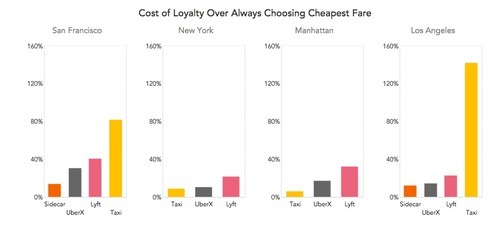
    This morning I woke up to a post from venture capitalist Fred Wilson talking about the cost of loyalty when it comes to local transportation markets. More simply, it was a cost comparison between regular city taxis and ride sharing services such as a UberX, Lyft, and Sidecar in San Francisco, Los Angeles, and New York.

    The data was sourced from whatsthefare.com and looks like this:

    The way to understand this chart is to think about it as the answer to this question (from whatsthefare.com): If I were to take 1,000 rides over my lifetime with one individual service, how much more would I pay than if I compared prices and always picked the cheapest option?

    What you should immediately see is that regular taxis are far more expensive in San Francisco and Los Angeles compared to all of the ride sharing services. In the words of Fred Wilson: “That is crazy. They are going to go out of business in those markets with that pricing.”

    In my words: They are fucked.

    I wonder where Toronto would place against these cities. My gut tells me that we would be closer to San Francisco than New York. And if that is the case, I think you can figure out what that means.

    I thought this would be an interesting post given yesterday’s point about our cities being multi-modal. We urbanites have many more options at our disposal than we did only a few years ago. And if they’re cheaper and more convenient, we’re going to use them. I think that’s a good thing.