
Daily insights for city builders, delivered every morning at 6 AM ET. I’m Brandon Donnelly — a Toronto-based real estate developer and founder of Globizen. I’ve been writing here since 2013.

Tag: local

  • The fast-foodification of cities

    Greg Isenberg recently wrote about what he refers to as the fast-foodification of everything — including cities. His arguments are that (1) we have reached peak sameness (Toronto is largely indistinguishable from, say, Sydney) and (2) the best brands and companies going forward will be local, unique, and community-driven.

    I don’t know how to assess whether we have reached peak sameness, but I do know that, whatever we are experiencing right now, is at a minimum 100 years in the making. The International Style (of architecture), which emerged after WWI, is exactly what the name suggests. The intent was to fashion an approach to architecture that worked anywhere in the world. Location, climate, and context were all irrelevant.

    This approach has been widely criticized for the reasons you might expect and for the reasons that Isenberg outlines in his post. But sameness is not exclusively the result of European architects who wanted to eschew ornament and local flourishes. As the world continues to globalize and become “smaller”, there is an inevitability to this growing and continued sameness. Business wants economies of scale.

    But there is no question that, more than ever, people are craving unique and local experiences and places. And if you can create that in our globalized world, you are going to win.
  • The local vs. global city

    Blogger and Senior Fellow at the Manhattan Institute for Policy Research, Aaron M. Renn, recently published an interesting long-form article called, Rethinking America’s Cities’ Success Strategy.

    One of the central themes is the idea that globalization has caused a kind of bifurcation in cities – a disconnect between the local and the global. In an effort to compete with other global cities around the world, we have begun to turn our back on local concerns. At the same time, not every city has the market power of, say, New York or London.

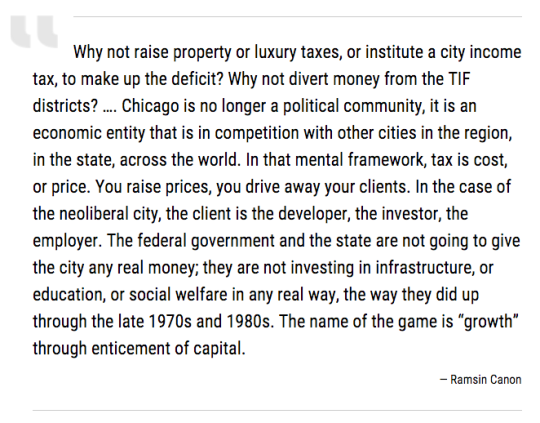
    So what does this mean for cities? Here’s a quote from the article that I think does a good job explaining the mental model:

    At the end of the article, Aaron makes a number of recommendations for how to better think about local entrepreneurship and economic growth. The first one is as follows:

    “Local civic priorities should favor building a successful and inclusive local economy, including entrepreneurship, over global concerns and real estate development.”

    Despite this being seemingly contradictory to do what I do for a living, I think it’s important to note that on a fundamental level, architects and developers simply create space. 

    It might be a beautiful space. A space that improves well-being, creates value, and enables certain activities. But at the end of the day, there needs to be demand for that space. And a robust local economy is paramount to that equation. So I agree that we shouldn’t forget about local and expect that “if we build it, they will come.”

    If you have the time, the full article is worth a read. It’s also part of a broader series on entrepreneurship and cities, so there are a bunch of other related articles on the same page.

  • Find the best local construction professionals at the lowest prices

    One of my closest friends, who also happens to be in the same industry, is currently testing out a new construction marketplace idea. It’s called Tenderlet and it’s an online platform that helps your average house or condo owner “find the best local construction professionals at the lowest prices.”

    Right now it’s just a basic website, but he is obviously thinking that it could grow into a far more robust online marketplace.

    The way it works is real simple:

    1. You tell Tenderlet about your construction job – everything from a water damaged ceiling repair to new hardwood flooring. 
    2. Tenderlet goes out and gets multiple quotes on your behalf (just like how the professionals do it). 
    3. Then Tenderlet comes back to you with at least 3 quotes and a recommendation. It’ll even handle scheduling and payments.

    Eventually he’s imagining that there will be a mobile app, reviews for the construction professionals, and a location dimension, which can make all the difference, particularly for smaller jobs. But you have to start somewhere.

    I think he’s on to something here. I know I want to use it. So I would encourage you to check out tenderlet.com and give it a try. If you have any feedback about the idea, I am sure he would love to hear from you in the comment section below.

  • Japan’s disposable housing

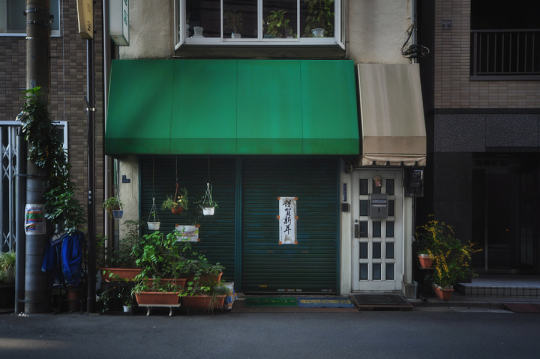
    緑 by Austin  Hou on 500px.com

    https://500px.com/embed.js

    As further evidence that real estate is a local business, let’s take a look at the housing market in Japan today. It’s a very unique market.

    According to this Freakonomics podcast, 50% of all single family houses in Japan are demolished by the time they reach 38 years old. That’s their half-life. By contrast, in the US, this number is 100 years.

    The reason for this is rapid depreciation. Real property typically consists of two things: land and the building. Land doesn’t depreciate. But the structure sitting on the land does.

    In Japan, the building or structure is thought to be fully depreciated (and therefore worth nothing) after about 30 years for a single-family home and after about 40 years for an apartment/condominium.

    The result is that there’s virtually no resale housing market. When somebody buys a house, it is usually torn down and completely rebuilt. It’s a uniquely Japanese phenomenon.

    So why does this happen?

    The Freakonomics podcast presents a couple of hypothesis. Some believe that it’s caused by a Japanese fixation with newness. New is seen as pure and clean. 

    Others believe that it has to do with a building code that is constantly changing due to the high frequency of earthquakes in Japan. 20% of the world’s earthquakes with a magnitude of 6.0 or greater happen in Japan. And so there appears to be a belief that newer homes – with the latest seismic technologies – are the safest.

    Whatever the case may be, the fact that there’s virtually no resale housing market in Japan, not surprisingly, produces some interesting outcomes. For one, maintenance and DIY home projects are uncommon. Why invest in your home when it’s not viewed as an asset, but as a disposable good?

    At the same time, people worry very little about marketability when they are building new. And this is a big reason why Japan is so famous for its radically designed homes. When you’re building only for yourself, you just do what you want.

    But most importantly, some (such as Richard Koo, who is interviewed in the podcast) believe that this approach to housing is a huge “obstacle to affluence.” Without a functioning resale market, the Japanese don’t get the opportunity to build wealth/equity in the same way that other countries do.

    Do you buy that?

  • How well do you know your neighbors?

    One startup that’s been on my radar (which isn’t yet available in Canada) is Nextdoor. They describe themselves as a “private social network for your neighborhood” and are active in more than 22,500 American neighborhoods. To date they’ve raised $100M in venture funding.

    From what I can tell, their primary focus (and big value proposition) has been around safety and security. Residents can use it to report incidents, such as a car break in. There are obviously other use cases, but I keep hearing this one come up. And I think it works because the community is so closely controlled. Every address is verified.

    But a few things come to mind as I read about their success and growth (400% neighborhood growth over the past year). How many social networks can people handle? Why can’t this be done using an existing platform (and perhaps a closed group)? And is there an opportunity to create the same kind of closed social network for condo and apartment buildings?

    There are lots of social networks out there. Whether you’re a wine snob or a pet owner, somebody has thought it. But if Path’s recent struggles are any indication, niche social networks can be tough. Which is why Nextdoor seems like a bit of an outlier to me.

    But I think the success of Nextdoor stems from the fact that, even in our hyper connected world, a lot of us, paradoxically, still don’t know the people who live right beside us. And I think this is also the case in multi-family dwellings. It’s a problem I’ve thought about and discussed with an number of my condo-dwelling friends.

    So I look forward to seeing how Nextdoor evolves and also seeing if they end up expanding to condos and apartments.